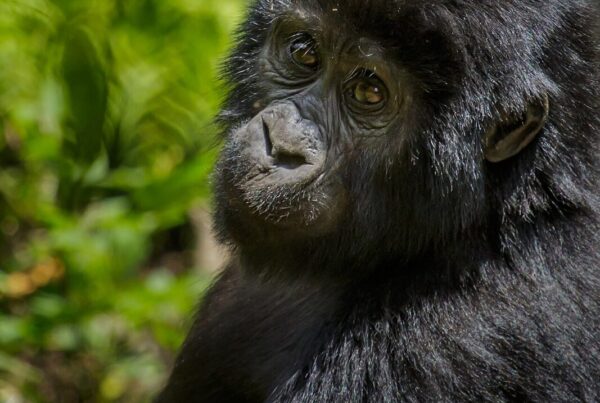
Uganda’s wildlife photography environments span a wider range than almost any other single-country safari destination — from the intimate low-light challenge of mountain gorillas in Bwindi’s primary forest to the wide-angle golden-hour savannah of Queen Elizabeth’s Kasenyi Plains, the intimate chimp encounters at Kibale’s forest edge, and the Nile horizon at Murchison — and each environment requires a substantially different approach to equipment, settings, and compositional thinking. These tips address the specific challenges of Uganda’s most significant photography locations: the forest light management that separates sharp gorilla portraits from blurry disappointments, the boat cruise timing that produces Kazinga Channel reflections, and the vehicle positioning discipline that makes Ishasha’s tree-climbing lions printable rather than record shots. The gorilla photography environment is covered in depth in the dedicated Bwindi gorilla photography guide; this guide covers the full Uganda safari photography picture.
Key Highlights
- Gorilla forest: ISO 1600–6400, 70–200mm f/2.8, no flash — pre-set before forest entry
- Savannah game drives: ISO 400–800, 100–400mm+ zoom, bean bag or window mount for stability
- Chimp tracking: similar to gorilla settings — fast AF, burst mode, minimum 1/500s for moving chimps
- Kazinga Channel boat cruise: golden hour (6–8 a.m., 4–6 p.m.) with hippos + elephants at 5–10m
- Best overall lens for Uganda: 100–400mm zoom covers savannah, chimps, and most forest scenarios
- Gorilla Habituation Experience (USD $1,800): 4 hours vs 1 hr — the ultimate Uganda photography permit
Uganda’s wildlife photography conditions range from the extraordinary intimacy of mountain gorilla trekking — where habituated animals move within 5 to 8 metres of the observer in the diffused light of a primary forest interior — to the sweeping open savannah of Queen Elizabeth’s Kasenyi Plains at golden hour, where lions and Uganda kob are photographed in the wide-angle drama of African savannah light at its most cinematically compelling. The diversity of Uganda’s wildlife photography environments requires a flexible approach to equipment selection, camera settings, and compositional technique that differs substantially between the enclosed forest and the open plains, between the intimate primate encounter and the distant raptor on the Kazinga Channel. These photography tips address the specific challenges and opportunities of Uganda’s most significant wildlife photography environments for safari visitors planning their first or most ambitious Uganda photography programme.
1. Gorilla Forest Photography — Working in Low Light With Intimate Subjects
- Bwindi forest light is dim and dappled — shoot at ISO 1600-6400 with wide aperture to maintain shutter speed
- Minimum shutter speed for gorilla portraits: 1/250s for stationary subjects, 1/500s for moving animals
- Use AF tracking mode and keep the focus point on the gorilla’s eyes at all times during the encounter
- Pre-set camera exposure compensation for the dark forest before the briefing point — no time to adjust during the encounter
- A 70-200mm f/2.8 lens covers the gorilla’s likely proximity range at Bwindi encounter distances
Mountain gorilla photography in Bwindi’s forest interior presents the most technically challenging wildlife photography environment of any Uganda safari experience — dim, dappled light filtering through multiple canopy layers, subjects moving unpredictably through dense vegetation, and the emotional intensity of the encounter creating a psychological pressure to capture everything simultaneously rather than calmly working through a systematic camera management sequence. The primary technical challenge is light — Bwindi’s primary forest interior can measure 2 to 3 EV stops darker than the open savannah conditions for which most camera automatic exposure systems are calibrated, requiring manual override of the camera’s exposure decisions to avoid underexposed images in the dense forest environment. Set ISO between 1600 and 6400 depending on light conditions under the specific canopy, open the aperture to the widest setting the lens provides, and use the minimum shutter speed required for the subject movement being photographed.
The 70-200mm f/2.8 zoom lens is the most versatile single lens for gorilla photography in Bwindi’s encounter distances — providing the reach for frame-filling gorilla portraits at the minimum 7-metre distance rule while also covering wider compositions showing the animal in its forest environment at distances when the family is further from the observer during the encounter. The f/2.8 maximum aperture is the critical specification here — the shallow depth of field it produces at longer focal lengths separates a gorilla’s face from the distracting forest background in the way that creates the most compelling portrait images, and the light transmission it provides is essential for maintaining adequate shutter speeds in the forest’s consistently dim conditions without pushing ISO to quality-degrading levels. Using autofocus tracking mode with the focus point centred on the gorilla’s eyes maintains sharpness through the animal’s head movement — the most expressive and most photographically significant part of the subject in any wildlife portrait context.
Pre-set before the encounter: Use the walk to the gorilla family — which can take 30 minutes to 8 hours — to test and finalise your camera settings in the forest light conditions you are experiencing on that specific day. Adjust ISO, aperture, and minimum shutter speed until the exposure is correct for the forest light before reaching the gorillas. Arriving at the family and discovering your exposure settings are wrong costs irreplaceable minutes of the one-hour maximum encounter adjusting settings that should have been resolved during the approach.
2. Savannah and Game Drive Photography — Working With Distance and Light in Open Terrain
- Queen Elizabeth and Murchison Falls game drives require 300-500mm telephoto reach for vehicle-distance animals
- Golden hour shooting windows (first and last 2 hours of daylight) deliver the best savannah light quality
- Use a bean bag or window mount to stabilise long telephoto lenses from the vehicle window
- Vehicle engine-off during sightings reduces vibration that degrades sharpness at long focal lengths
- Shoot wide as well as telephoto — the Uganda savannah landscape reward compositional variety
Savannah game drive photography at Queen Elizabeth and Murchison Falls requires a fundamentally different technical approach from the gorilla forest photography — longer focal lengths for the greater distances of open-landscape wildlife encounters, faster shutter speeds for moving animals in bright light, and the compositional discipline of placing wildlife subjects within the broader savannah landscape rather than filling the frame with a single animal as the intimate forest encounter permits. A 300mm to 500mm telephoto range covers the majority of game drive photography scenarios across Uganda’s savannah parks, with 500mm providing the most useful reach for distant predator and raptor subjects while 300mm handles the closer vehicle approach distances to grazing mammals and the boat-based water bird photography at Kazinga Channel. Stabilisation is critical at these focal lengths — use a beanbag, window mount, or monopod resting on the vehicle door frame rather than hand-holding long lenses from a moving vehicle where even gentle engine vibration at low idle speed degrades sharpness at 1/500s shutter speeds.
The quality of Uganda savannah light changes dramatically across the day in ways that the experienced wildlife photographer manages deliberately rather than shooting at equal intensity throughout. The first two hours after sunrise and the last two hours before sunset produce the warm, angled, low-contrast light that reveals texture in animal fur and feathers, creates dimensional depth in the landscape, and provides the colour palette — orange, gold, and rose — that transforms technically adequate wildlife images into emotionally resonant photographs. Midday light from 10am to 3pm in Uganda’s equatorial sun flattens animal colouration to a bleached washed-out palette and creates harsh shadows under chin and belly that are unflattering to any animal subject. Plan game drive photography for the golden hour windows and use the midday period for rest, vehicle-based bird watching at productive locations, or the Kazinga Channel boat safari where water reflection and partial shade from the boat canopy moderate the worst midday light effects on water bird photography.
Shoot the landscape as well as the animals: Uganda’s savannah parks reward wide-angle landscape photography that places wildlife in their environment rather than exclusively the close telephoto portrait format. The Kasenyi Plains at sunrise with the Rwenzori mountains visible to the north, the Kazinga Channel with elephant reflections in the late afternoon water, and the Narus Valley at Kidepo with lion silhouettes at golden hour all produce images of lasting power that the close animal portrait alone cannot provide. Carry a versatile standard zoom (24-70mm) alongside the telephoto for the landscape compositions that emerge between the close animal sightings during the game drive circuit.
3. Chimpanzee Photography at Kibale — Fast-Moving Subjects in Dense Forest
- Chimpanzees move faster and more unpredictably than gorillas — use continuous autofocus burst mode
- Aerial photography of chimps in the canopy requires 200-400mm with fast shutter (1/1000s minimum)
- Ground-level chimp interaction and feeding scenes are most accessible at the Kanyanchu community
- The noise and energy of chimpanzee encounters creates photographic opportunities gorilla trekking never provides
- Forest edge at Kibale provides more light than Bwindi interior — slightly more forgiving exposure conditions
Chimpanzee photography at Kibale Forest requires the most aggressive autofocus and burst rate settings of any Uganda wildlife photography context — these are fast-moving, acrobatic, and deeply unpredictable subjects whose transitions from stillness to rapid movement are instantaneous and create opportunities that disappear within seconds. The continuous autofocus tracking mode with the highest burst rate your camera supports is the recommended baseline configuration for any Kanyanchu chimpanzee encounter, with subject tracking algorithms that follow the animal’s moving shape through the frame rather than requiring the photographer to manually relocate the focus point during the animal’s movement. Subjects in the forest canopy require minimum 1/1000s shutter speed to freeze limb movement during aerial locomotion — the dramatic brachiation and branch-jumping behaviour that creates the most energetic and compelling chimpanzee photography.
The most intimate chimpanzee photography occurs at ground level when a habituated individual descends from the canopy for ground feeding or social grooming — these ground-level encounters with the Kanyanchu community allow eye-level photography at approach distances comparable to the gorilla encounter, producing chimpanzee portraits with a directness and emotional charge that the overhead canopy photography cannot match. The forest edge environment at Kibale is marginally lighter than Bwindi’s deep forest interior, allowing slightly lower ISO settings and faster shutter speeds for equivalent image quality — a technical advantage that makes the Kibale chimpanzee photography somewhat more forgiving of equipment limitations than the demanding gorilla forest light conditions at Bwindi. The noise and energy of the chimpanzee encounter — the pant-hoots, the charging displays, the overhead aerial acrobatics — creates photographic drama and diversity that the calmer gorilla encounter rarely produces in the same volume of energetically distinct image opportunities per encounter hour.
Position for ground-level encounters: When the Kanyanchu chimps descend to the ground, move immediately to a low crouching position to photograph at the animal’s eye level rather than looking down from standing height. Ground-level chimpanzee portraits with natural forest floor context and direct eye contact produce the most compelling Kibale photography — ask your ranger to signal when ground-level positioning is safe and appropriate without approaching closer than the minimum safe distance the ranger maintains throughout the encounter.
4. Kazinga Channel Boat Photography — Water Birds and Mammals at Close Range
- The Kazinga Channel boat safari provides the most accessible wildlife photography in Uganda
- Water birds at eye level from the low boat deck — ideal for African skimmer, pied kingfisher, Goliath heron
- Hippos photographed at water-level proximity impossible from any land-based vehicle position
- The flat boat platform eliminates vehicle vibration as a sharpness factor — image stabilisation still advised
- Afternoon departure (2pm) provides the best golden light quality for the 2-hour boat photography session
The Kazinga Channel boat safari provides the most physically accessible and technically forgiving wildlife photography opportunity on the entire Uganda safari circuit — a flat-bottomed stable platform with no vehicle vibration, water bird subjects at genuine eye-level from the low boat deck, and hippos photographed at water-level proximity that no land-based position can replicate. The African skimmer — one of Africa’s most photographically distinctive birds, with its lower mandible longer than the upper and the characteristic skimming flight photography technique — nests on the Kazinga channel sandbars and can be photographed in flight from the boat at distances close enough for frame-filling images with a 300mm lens. Pied kingfisher hover-and-dive sequences above the channel water are endlessly repeating subjects during the 2-hour boat trip, and the Goliath Heron standing statuesque at the channel edge in the late afternoon golden hour light provides the most architecturally composed individual subject on the channel bird list.
Hippo photography from the Kazinga boat has a fundamentally different and more intimate quality than any land-based hippo sighting — the low boat deck places the camera at water level, looking across the channel surface toward animals that are mostly submerged with only the ears, eyes, and nostrils above water in daytime resting posture. This water-level perspective exaggerates the hippos’ sense of scale and creates compositional compositions that the elevated land-based angle from a vehicle roof hatch never provides. The afternoon 2pm departure captures the golden hour light quality in the final 60 to 90 minutes of the 2-hour trip as the sun approaches the Rwenzori mountain horizon to the west — the single best light window of the day for Kazinga Channel photography for any visitor choosing between the morning and afternoon boat departure times.
Take the afternoon boat for golden hour light: Book the 2pm Kazinga Channel boat departure specifically for the photography light quality in the final section of the trip as the afternoon sun drops toward the horizon. The morning departure provides better animal activity in some conditions, but the photographic quality difference between flat morning light and golden afternoon light on water bird and mammal subjects is decisive for image quality — the afternoon departure consistently produces more memorable photography for visitors who prioritise image quality over maximum animal activity intensity.
5. Night Game Drive Photography — Nocturnal Wildlife in Artificial Light
- Night game drives use powerful external spotlights — camera settings: high ISO (6400+), wide aperture, fast shutter
- The spotlight creates harsh directional light — position yourself to minimise the light’s shadow behind the subject
- Leopard eye-shine in the spotlight is one of Uganda’s most dramatic nocturnal photography moments
- Use image stabilisation at all times — the vehicle and moving spotlight create constant micro-vibration
- Mirrorless cameras with modern high-ISO performance have significant advantages in night game drive photography
Night game drive photography at Queen Elizabeth, Kidepo, and Lake Mburo requires the highest ISO settings and most aggressive noise management of any Uganda wildlife photography context — the external spotlight attached to the game drive vehicle provides a powerful but single-direction light source that creates specific challenges for natural-looking wildlife photographs. High ISO settings between 6400 and 25600 are necessary to maintain the shutter speeds required to freeze nocturnal wildlife movement in the spotlight beam at typical game drive distances. Modern mirrorless cameras with back-illuminated sensor designs — Sony A7 series, Canon R series, and Nikon Z series — provide substantially better high-ISO performance than equivalent DSLR sensor generations and are genuinely advantageous in the night game drive photography context where noise at high ISO is the primary image quality limiting factor.
Positioning relative to the spotlight is the key compositional challenge in night game drive photography — the ranger operating the spotlight controls the light direction, and the photographer’s position in the vehicle determines whether the light falls from a slightly flattering angle or creates the harsh nose-shadow effect that frontal spotlight illumination produces when the camera is positioned directly in line with the light source. Request a position at the side of the spotlight rather than directly behind it, and use the slight angle differential between spotlight and camera position to create a more dimensional light quality than straight-on frontal illumination. The leopard eye-shine moment — where the spotlight first reflects from the cat’s tapetum lucidum before the animal’s body becomes visible — is the most dramatic photographic instant of most Uganda night drives, occurring without warning and lasting only seconds before the animal moves out of the beam or positions itself differently in the vegetation.
Prepare high-ISO settings before dark: Configure your camera’s maximum auto-ISO limit, minimum shutter speed in auto-ISO mode, and image stabilisation settings during the daylight portion of the evening before the night game drive begins. Testing the high-ISO noise characteristics of your specific camera body by photographing in low-light conditions during the post-dinner period before departure is useful preparation — the first spotlight animal encounter during the night drive is not the moment to discover your exposure settings are producing unacceptable results that require adjustment under time pressure.
Uganda’s photography diversity — from the intimate forest light of Bwindi’s gorilla encounter to the dramatic golden hour of the Kazinga Channel boat safari, from the fast-moving challenge of Kibale chimpanzees to the nocturnal drama of Queen Elizabeth’s night drives — rewards the photographer who prepares specifically for each environment rather than relying on a single camera configuration to handle every condition. The investment in understanding each photography context before arrival produces images that document not just the wildlife but the specific quality of light, the particular environmental character, and the emotional atmosphere of each encounter — the elements that transform technically adequate wildlife records into photographs worth showing for the rest of your life.
Frequently asked questions about Uganda safari wildlife photography
What is the best camera lens for a Uganda safari?
The single most versatile lens for a Uganda safari is a 100–400mm f/4.5–5.6 zoom — it covers savannah game drives (lion at 200 metres, bird on a waterhole branch), chimp tracking (fast-moving subjects at variable distances), and most gorilla encounter distances from the minimum 7-metre rule. Its limitation is aperture in low forest light — for serious gorilla or chimp forest photography, a 70–200mm f/2.8 is a better choice, trading some reach for the extra 1–2 stops of light. If carrying two lenses, the combination of a 70–200mm f/2.8 (forest and intimate encounters) and a 100–400mm f/4.5–5.6 (savannah and birds) covers Uganda’s full photography range. For a single-lens approach, the 100–400mm at ISO 3200–6400 in the forest is the practical compromise.
What are the best photography opportunities in Queen Elizabeth National Park?
Queen Elizabeth’s three signature photography experiences are: the Kazinga Channel boat cruise (hippos, elephants, and buffalo at close range from a stable boat platform — golden hour cruises at 7 a.m. or 4 p.m. are optimal), the Kasenyi Plains game drive (lion prides and Uganda kob in open grassland with Rwenzori Mountains as backdrop), and the Ishasha sector’s tree-climbing lions (fig tree sightings in late morning when lions are resting — a wide 24–70mm for the environmental tree-and-lion composition, a telephoto for face portraits). The Mweya Peninsula viewpoint over the Kazinga Channel at dawn also produces excellent landscape photography in the mist — worth the early alarm before the game drive departs.
How do you photograph chimpanzees in Kibale Forest?
Chimpanzee photography in Kibale shares most technical challenges with gorilla photography — low forest light, moving subjects, one-hour time limit — but adds the chimps’ preference for vertical movement through the canopy, which means tracking AF and burst mode are essential for capturing sharp images of animals swinging or climbing. Set your camera the same way as for gorilla photography: ISO 1600–6400, widest available aperture, minimum 1/500s shutter speed for moving subjects. A 70–200mm covers most Kibale encounter distances. Unlike gorillas, chimps frequently climb into open canopy patches where light is better — wait for these moments for the best exposure windows. Habituated chimp groups at Kibale’s Kanyanchu trailhead are well-accustomed to cameras.
What is the best time of day to photograph wildlife on a Uganda safari?
The golden hours — 6–8 a.m. and 4–6 p.m. — apply to Uganda’s savannah photography as they do everywhere in Africa. Uganda’s equatorial position means sunrise and sunset happen quickly (6 a.m. and 6 p.m. year-round), so the quality light window is shorter than at higher latitudes — plan to be in position before 6:30 a.m. for morning light. Gorilla trekking begins at 7 a.m. with a briefing, and families are typically reached between 9 a.m. and noon — full overhead light in the forest, which matters less than in open savannah photography since canopy shade is the dominant factor. Kazinga Channel boat cruises and Murchison Nile cruises are scheduled at dawn and late afternoon specifically to capture the golden-hour light on the water.
Are photography vehicles or open-sided vehicles available in Uganda’s parks?
Most Uganda safari vehicles are modified Toyota Land Cruisers or Land Cruiser Prados with a roof hatch that opens for standing game drive photography — the standard format across East Africa. Fully open-sided vehicles (as found in some Botswana camps) are not standard in Uganda’s government parks, partly because of Uganda’s equatorial rainfall. Some luxury operators near Queen Elizabeth and Kidepo offer customised photography vehicles with additional hatches or custom bean bag mounts. For gorilla and chimp trekking, no vehicle photography is involved — you are on foot with a hand-held setup. A sturdy bean bag rested on the vehicle door frame is the standard stabilisation method for vehicle-based wildlife photography across all Uganda parks.
Prepare your photography kit
- Gorilla Trekking Photography Guide — detailed Bwindi-specific tips
- Uganda Gorilla Families — know your subjects before entering the forest
- Gorilla Permit Guide — book the GHEX for 4 hours of photography time
- Bwindi Sector Comparison — sector terrain affects photography conditions
- Safari Itineraries — photography-focused trip shapes for Uganda
- Best Photography Spots in Uganda: Safari Photographers Guide
- Best activities at Lake Bunyonyi for Uganda safari visitors
- Best birding destinations in Uganda for safari visitors
- Best 7-Day Uganda Safari Itinerary: Gorillas, Chimps, and Wildlife
- Best 14-Day Uganda Safari Itinerary: Complete Wildlife and Gorilla Experience
- Best Safari Animals to See in Uganda: Complete Wildlife Guide
- What a 3-Day Uganda Wildlife and Cycling Safari Did to My Family Was Beyond Anything We Expected
- Why a 2-Day Uganda Wildlife and Cycling Safari Is the Perfect Business Break
- Why Would My Soul Long for a 9-Day Uganda Gorilla Trekking and Wildlife Safari?
- Murchison Falls Uganda Wildlife Safari — 4-Days: Where the Nile Breaks and the Wild Roars