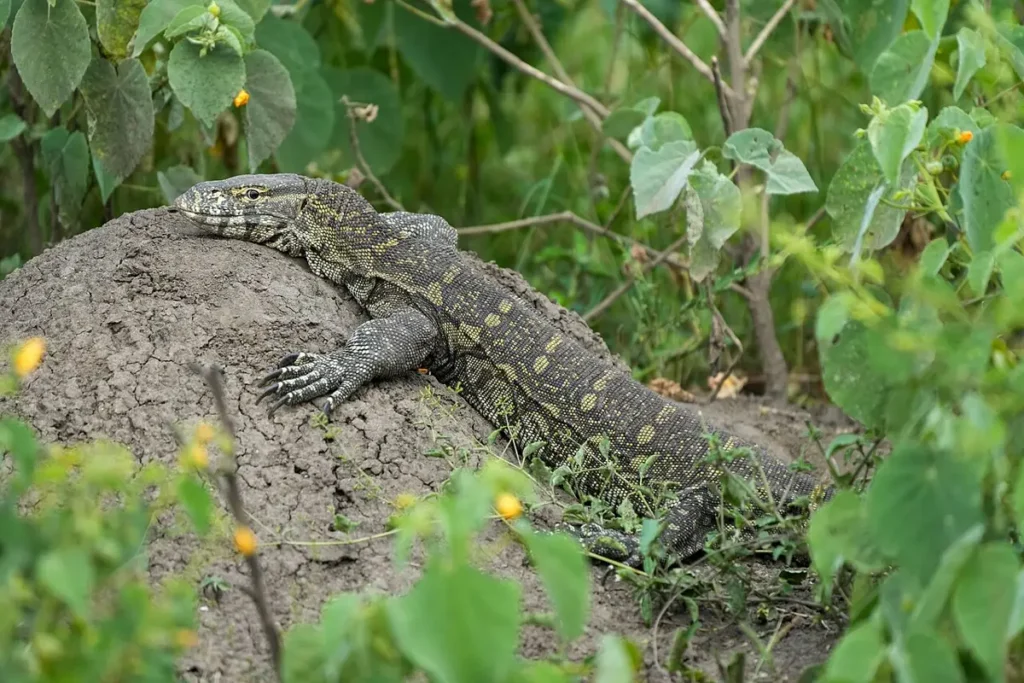
The Nile monitor lizard is the largest reptile in Uganda and the second-largest lizard in Africa, exceeded only by the Komodo dragon. It is a creature of extraordinary physical capability — a strong swimmer, a capable climber, a sprinter on land, and an opportunistic predator that will eat almost anything it can overpower. Found throughout Uganda wherever there is water, the Nile monitor is one of the most commonly encountered large reptiles on any Uganda safari, and one of the most underappreciated.
Physical Characteristics
Adult Nile monitors (Varanus niloticus) typically reach 1.5 to 2.1 metres in length, with large individuals occasionally exceeding 2.5 metres. Males are significantly larger than females. The body is robust and muscular, with a long neck, powerful legs equipped with strong claws, and a laterally flattened tail that serves as a propeller in water and a weapon on land. The tail alone accounts for approximately 60 percent of total body length.
The skin is covered in small, bead-like scales rather than overlapping plates. Colouration varies by age — juveniles are more boldly marked with yellow spots and bands on a dark background, while adults tend to be darker and more uniformly coloured. The tongue is long, forked, and highly mobile, used to detect scent particles in the same way a snake uses its tongue — Varanid lizards have a Jacobson’s organ in the roof of the mouth that processes chemical information delivered by the tongue.
Habitat and Distribution in Uganda
Nile monitors are found throughout Uganda wherever permanent or semi-permanent water exists — rivers, lakes, swamps, irrigation channels, and wetlands. They are common along the shores of Lake Victoria, the Nile and its tributaries, the Kazinga Channel in Queen Elizabeth National Park, and in the wetlands around Lake Mburo. In many areas they are commensal with humans, living in drainage systems, around fishing villages, and along irrigation canals where they exploit concentrations of fish, birds, and eggs.
They are excellent swimmers and often enter the water to escape predators or to hunt. Their ability to hold their breath for extended periods allows them to forage on the bottom of shallow lakes and rivers. On land they can run surprisingly fast when alarmed, and they are accomplished climbers — a monitor in a riverine tree, head down, watching the bank below, is a common sight along Uganda’s waterways.
Diet and Foraging
Nile monitors are highly opportunistic omnivores. Fish, frogs, crabs, molluscs, insects, small mammals, birds, eggs, carrion, and younger crocodiles all feature in their diet. They are well known for raiding crocodile nests — digging up and eating eggs with rapid efficiency, apparently timing their raids to coincide with periods when the mother crocodile has moved away. They will also eat snakes, including venomous species, to which they have some resistance.
Behaviour and Reproduction
Nile monitors are largely solitary outside of the mating season. Males compete for females through ritualised wrestling — individuals rear up on their hind legs, grapple with their forelegs, and attempt to push their opponent to the ground. These encounters are vigorous and prolonged. The winning male will mate with the female over several days.
Females lay eggs in termite mounds — one of the most ingenious nesting strategies in the reptile world. The female uses her powerful claws to break into an active mound, deposits a clutch of 20 to 60 eggs inside, and the termites repair the mound, sealing the eggs inside at a constant temperature and humidity that is nearly perfect for incubation. The young hatch after around 40 weeks and must claw their way out of the hardened mound — a process assisted in some cases by the returning female, who has been documented breaking open the mound when she hears the hatchlings moving inside.
Ecology and Conservation
Nile monitors play an important ecological role as scavengers and nest predators, influencing the population dynamics of crocodiles, birds, and various invertebrates. They are not threatened globally — the species is listed as Least Concern on the IUCN Red List — but local populations face pressure from hunting (their skins are used in the leather trade and their meat is consumed in some regions), habitat loss, and collection for the international pet trade.
In Uganda, Nile monitors are protected under the Wildlife Act but remain vulnerable to unregulated hunting in areas outside national parks. Within protected areas, they are abundant and conspicuous — a reliable sighting on virtually any boat trip along the Kazinga Channel or the Nile. Watching a large monitor slide off a bank and power through the water with its sinuous, efficient stroke is a reminder that not all of Uganda’s remarkable wildlife belongs to the mammal class.