Updated
From the Nile’s Roar to the Gorilla’s Gaze — Uganda’s Wildest Safari Route
From the Nile’s Roar to the Gorilla’s Gaze — Uganda’s Wildest Safari Route
Murchison Falls Bwindi safari package is one of Uganda’s outstanding natural or cultural attractions, drawing visitors in search of wildlife, scenery, and authentic African experiences. There is a safari route through Uganda that starts at one of the world’s great natural wonders — the Nile River forcing itself through a six-metre gap to create Murchison Falls, the most powerful waterfall on earth — and ends in an ancient forest where you sit three metres from a creature that shares nearly all of your DNA. Between those two points, the route crosses Uganda’s diverse ecological zones: savanna, wetland, volcanic foothills, montane forest, and highland lake. It takes ten to twelve days to do properly. It passes through five national parks. It shows you a country of extraordinary wildlife, landscape, and human culture that most visitors to East Africa never see. This is Uganda’s north-to-south safari route — and in 2026, it is more accessible than it has been in years.
Murchison Falls: The Nile at Its Most Violent
The route begins in northwestern Uganda at Murchison Falls National Park — Uganda’s largest protected area at 3,840 square kilometres. The park straddles the Victoria Nile as it flows northward from Lake Albert toward South Sudan, and its defining feature is the falls themselves: a full-volume tropical river compressed through a seven-metre-wide gap in the Albertine Rift escarpment, creating a plume of spray and a roar that can be heard kilometres away. The boat trip from Paraa to the base of the falls is one of Uganda’s signature wildlife experiences — two to three hours on the Nile passing extraordinary concentrations of hippos, Nile crocodiles, and waterbirds, culminating in the view up at the falls from the water level.
Murchison’s savanna supports substantial populations of elephant, buffalo, Uganda kob, oribi, and the locally endemic Rothschild’s giraffe — one of the world’s most endangered giraffe subspecies and one of the few places on earth where they can be reliably seen. Lions, leopards, and hyenas are present throughout the park. The northern sector around the falls is flat and open, making for excellent game drive visibility. Budongo Forest at the park’s southeastern edge is home to chimpanzees habituated for trekking, adding a primate element to what is primarily a savanna experience.
The Drive South: Lake Albert and the Rift Valley
Leaving Murchison and driving south, the route descends through the Albertine Rift escarpment toward Fort Portal, passing through landscapes that shift from dry savanna to increasingly lush highland agriculture. Lake Albert, the deepest of the Albertine Rift lakes, is visible from the escarpment road in a dramatic panorama that places you clearly within the geological context of one of earth’s great fracture zones. The road to Fort Portal passes through communities where traditional Ugandan highland life continues largely unchanged — crater lakes, tea estates, volcanic hills, and the distant white peaks of the Rwenzori Mountains on clear days.
Kibale Forest and Queen Elizabeth: The Heart of the Circuit
Fort Portal serves as the base for Kibale Forest’s chimpanzee trekking, and a night or two here allows you to add the world’s best chimp encounter to the north-to-south route. From Fort Portal, the road south enters Queen Elizabeth National Park through the northern Kasese gate, with game drives yielding elephant, buffalo, Uganda kob, warthog, and occasionally lions. The Kazinga Channel boat cruise adds hippos, crocodiles, and extraordinary birdlife. The Ishasha sector at the park’s southwestern corner, reached on the continued drive south, is famous for its fig-tree-climbing lions — a behavioural quirk unique to this population and a few sites in Tanzania. Watching a lion reclining in the branches of a fig tree against an open savanna backdrop is one of Uganda’s most peculiar and memorable wildlife images.
Bwindi: Where the Route Reaches Its Destination
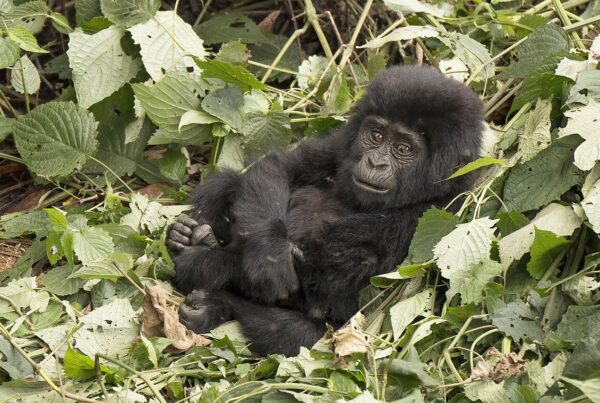
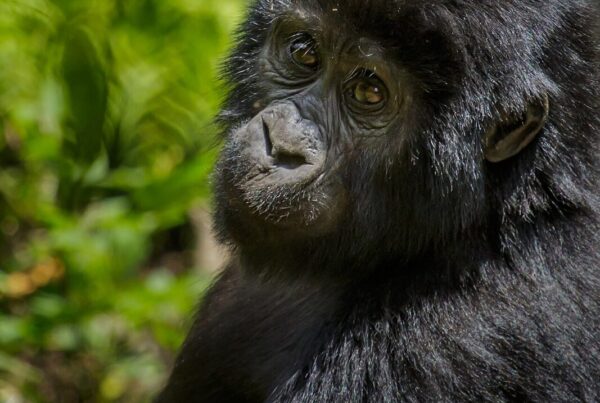
The route climbs from Ishasha into the highlands of southwest Uganda, the landscape becoming increasingly dramatic as the road approaches the Virunga volcanic zone. Bwindi Impenetrable National Park announces itself through the density of the forest — a wall of green rising from the hillsides that looks genuinely impenetrable from the road. The gorilla trek that follows is the route’s culmination: after days of savanna game drives, river boat trips, chimpanzee encounters, and crater lake stops, entering the ancient forest on foot and finding a gorilla family is a peak experience that justifies everything that preceded it. The silverback’s gaze — calm, intelligent, ancient in a way that the word barely captures — is the image that stays with you from the Nile to the forest and beyond.
Planning the Route in 2026
The north-to-south route can be driven entirely in a 4WD vehicle with an experienced driver-guide, or combined with internal flights at certain points. Flying from Entebbe to Murchison reduces the road distance at the start of the trip and allows more time at each destination. The circuit is best done in ten to twelve days to avoid rushing. In 2026, with tourism numbers lower than usual at the southern end of the route, gorilla permits and Bwindi lodge availability are better than they have been in years. Murchison Falls and Queen Elizabeth in the north are operating at normal levels, providing the full experience that makes this route Uganda’s most comprehensive and rewarding safari circuit. This route is a masterclass in African wildlife diversity. Right now, it is also one of Africa’s most accessible.