Updated
Mountain Gorilla Social Structure: Life in a Gorilla Family
The Family Group: Core of Gorilla Society
Mountain Gorilla Social Structure: Life in a Gorilla Family The Family Group: Core of Gorilla Society Mountain gorillas are highly social animals whose lives are organised around the family group — a stable, long-term association of individuals dominated by one or more silverback males. Mountain gorillas are highly social animals whose lives are organised around the family group — a stable, long-term association of individuals dominated by one or more silverback males. Understanding gorilla social structure is essential for interpreting the behaviour you observe during trekking encounters and for appreciating the sophisticated social world these animals navigate daily. Gorilla family life is characterised by strong bonds, clear hierarchies, and patterns of alliance and competition that have been studied in detail through decades of observation in Bwindi and the Virungas.
Group Composition
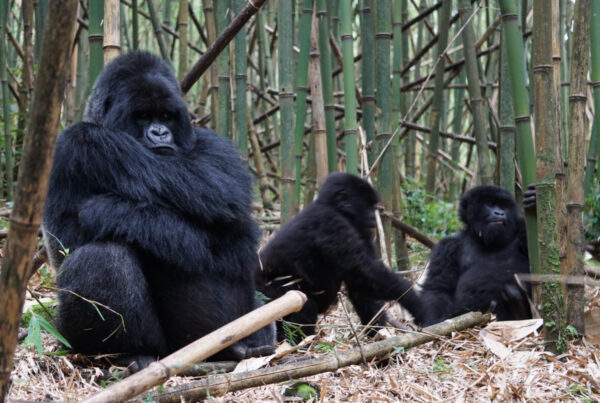
A typical mountain gorilla family group consists of 5 to 30 individuals, including one or more silverback males, adult females, blackback males (adolescent to sub-adult males), juveniles, and infants. The average habituated group in Bwindi numbers approximately 9 to 12 individuals, though group size varies considerably. Uganda Wildlife Authority currently manages trekking permits for over a dozen habituated groups in Bwindi, ranging from compact groups of 5 to 6 members to extended families of 20 or more.
Most gorilla groups are uni-male — led by a single silverback who is the primary or sole breeding male. Multi-male groups, containing two or more adult silverbacks, do occur and tend to be larger. In multi-male groups, the dominant silverback retains primary reproductive access while subordinate males occupy intermediate social positions, sometimes breeding opportunistically. When the dominant silverback ages or is challenged, a subordinate male from within the group may succeed to dominance — providing continuity of group leadership that benefits the entire family.
The Silverback: Leader and Protector
The silverback’s role in mountain gorilla social structure is both comprehensive and indispensable. He makes the group’s day-to-day decisions: when to move, where to forage, when to rest, and which direction to travel when threats require retreat. His spatial knowledge of the home range guides the group’s foraging efficiency. His presence deters rival males and predators. His social authority mediates conflicts between group members.
The silverback’s importance to group cohesion is demonstrated most clearly when he dies or is incapacitated. Groups that lose their silverback without a successor male in place typically fragment: females may leave with their offspring to join other groups or follow male offspring who attempt to establish new groups. Group integrity is bound to the silverback’s functional leadership in ways that make his survival a group-level conservation concern.
Adult Females: The Social Core
Adult females are the reproductive and social core of the gorilla group. Female mountain gorillas are not as strongly bonded to each other as to the silverback — female-female relationships range from tolerant to competitive, particularly in competition for the silverback’s grooming attention and proximity to resources. However, females do form alliances, particularly between those with shared histories in the group, and long-term female residents often form loose coalitions that influence group dynamics.
Female mountain gorillas are what biologists call philopatric in some contexts but also show transfer behaviour: some females remain in their birth group, while others transfer to different groups, particularly when the birth group’s silverback dies or when a more attractive silverback in a neighbouring group presents an opportunity for improved reproductive prospects. This transfer behaviour introduces gene flow between groups and prevents extreme inbreeding.
Juvenile Social Life: Learning Through Play
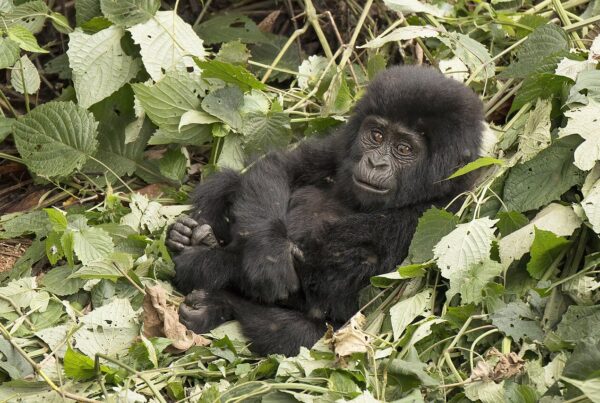
Juveniles occupy a distinct social niche in the gorilla family — old enough for significant independence but still under maternal supervision, and primarily engaged in the play behaviour that develops physical skills and social knowledge. Juvenile play groups cut across family subgroupings: young gorillas from different maternal lineages within the group play together, forming peer relationships that may persist into adulthood.
Play behaviour in juvenile gorillas involves wrestling, chasing, climbing, and social vocalising. It is energetically costly and occasionally results in minor injuries, but it serves developmental functions that researchers believe are essential for both physical competence and social intelligence. A juvenile gorilla that does not engage in adequate social play may lack the social skills required for effective adult function in a complex group — similar in some ways to the developmental deficits observed in humans and other social mammals raised in social isolation.
Social Bonds and Grooming
Grooming — the behaviour of carefully parting another individual’s fur to remove debris and ectoparasites — is the primary mechanism through which social bonds are maintained and alliances managed in gorilla groups. The time allocation that individuals invest in grooming partners is not random: it maps onto the social relationships that matter most to each individual’s reproductive and survival interests.
Females who groom the silverback frequently maintain closer social proximity to him and may receive preferential access to food patches. Subordinate males who groom dominant males invest in relationships that may provide tolerance and delayed reproductive opportunities. Even infants engage in rudimentary grooming behaviour with their mothers and siblings, beginning the social skills that will shape their adult relationships.
Group Stability and Change
Mountain gorilla family groups are relatively stable over years and decades, but they are not static. Births, deaths, transfers, and the occasional group split or merger all alter group composition over time. Long-term monitoring studies have documented groups that persisted essentially intact for over 20 years, as well as groups that experienced dramatic reorganisation following the death of a dominant silverback.
Group stability generally benefits reproductive success: stable groups with experienced members and known home ranges tend to be more reproductively successful than newly formed or frequently disrupted groups. Conservation efforts that protect group stability — by reducing silverback mortality, managing tourist encounters carefully to avoid group disruption, and maintaining the habitat continuity that allows stable home ranges — directly support the social conditions in which mountain gorillas thrive.
Final Thoughts
The gorilla family group you visit in Bwindi is not a random assembly of individuals — it is a society with history, hierarchy, alliances, and relationships that have developed over years. Every gorilla in the group has a social position, a set of relationships, and a history of interactions that shape its behaviour in the moment you observe it. Understanding this social complexity transforms the trekking encounter from wildlife spectacle to genuine insight into one of the most sophisticated social systems in the primate world.