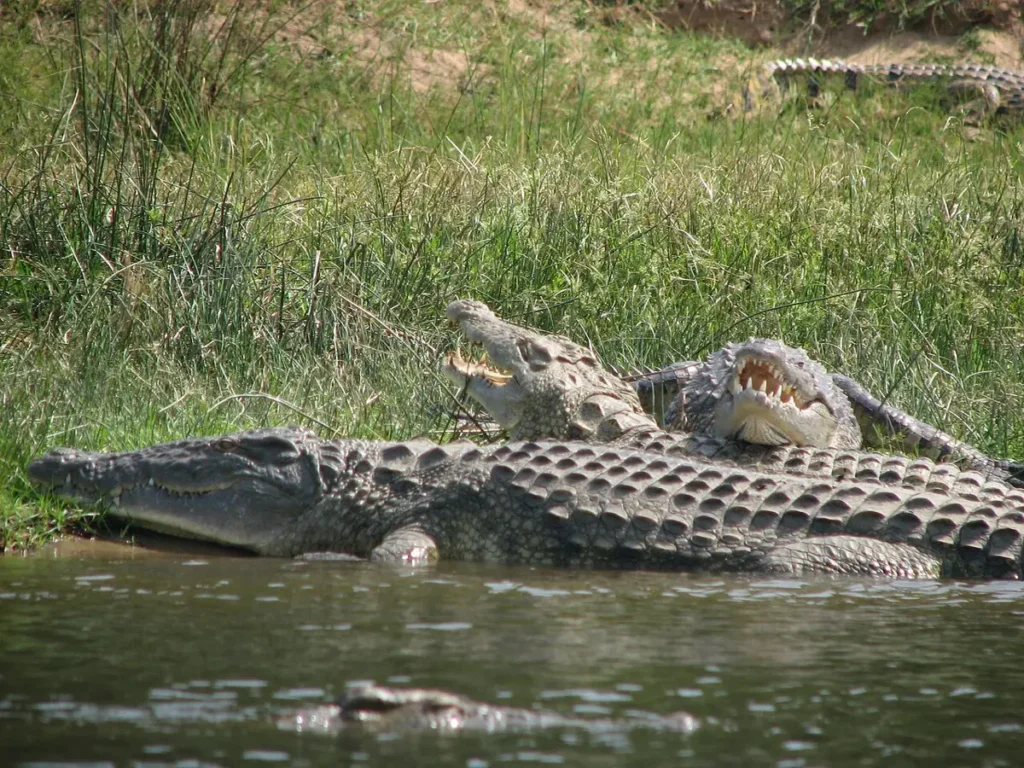
The Nile crocodile is the largest reptile in Africa, one of the most successful predators on the continent, and an animal that has remained essentially unchanged for 200 million years. While dinosaurs rose and fell, while continents drifted, while mammals diversified and humans evolved, the crocodile’s body plan persisted — because it works. Uganda’s waterways, particularly the Nile, the Kazinga Channel, and the shores of Lake Victoria, hold substantial Nile crocodile populations that can be observed at close range from safari boats. Here is everything you need to know.
Physical Characteristics and Size
Nile crocodiles (Crocodylus niloticus) are among the largest living reptiles. Adult males typically reach 4 to 5 metres in length and weigh 400 to 700 kilograms. Exceptional individuals have been recorded at over 6 metres and close to 1,000 kilograms — though animals of this size are increasingly rare due to hunting pressure on large individuals over the past century. Females are substantially smaller, typically reaching 3 to 3.8 metres.
The body is heavily armoured with osteoderms — bony plates embedded in the skin — that provide protection against predators and physical trauma. The jaws exert one of the highest bite forces of any animal on Earth: up to 5,000 pounds per square inch in large adults, sufficient to crush bone. Paradoxically, the muscles responsible for opening the jaws are extremely weak — a rubber band can hold a crocodile’s mouth shut. The crocodilian jaw is adapted for a single direction of extreme force.
Lifespan and Growth
Nile crocodiles are among the longest-lived reptiles. In captivity, individuals have survived beyond 70 years, and wild lifespans of 45 years or more are documented. Growth is continuous throughout life but slows significantly with age. Young crocodiles grow rapidly — reaching 1 metre in their first year — but the giant specimens seen in large rivers represent decades of steady accumulation.
This longevity has important implications for crocodile ecology. A large old male in a river system has reproductive experience and territorial knowledge accumulated over decades. His removal — through hunting or human conflict — does not just reduce numbers but removes irreplaceable ecological experience from the population.
Hunting Behaviour
Nile crocodiles are ambush predators of extraordinary patience. They can remain motionless at the water’s surface for hours, with only the eyes, nostrils, and a strip of back visible, waiting for prey to approach the water’s edge. When prey comes within range, the attack is explosive — a burst of acceleration that covers several metres in a fraction of a second, powered by the tail and hind legs.
The initial strike is a grab with the jaws. For prey too large to swallow immediately, the crocodile performs the “death roll” — spinning rapidly in the water to disorient the prey and tear off manageable pieces. Multiple crocodiles may join a feeding event, each spinning in opposite directions as they grip the same carcass. Large prey may be wedged under submerged logs or rocks to soften before consumption — crocodiles cannot chew, only swallow, and prefer prey at a manageable size.
Diet and Prey
Young crocodiles eat insects, small fish, frogs, and crustaceans. As they grow, their prey base expands to include larger fish, birds, turtles, and small mammals. Large adults are capable of taking prey up to the size of a zebra, giraffe, or large buffalo — though such large kills are relatively rare and often require the cooperative feeding of multiple individuals. Fish remain the primary food source for most adult crocodiles throughout their lives, and massive concentrations of Nile perch, tilapia, and catfish in Uganda’s waterways support large crocodile populations.
Breeding and Parental Behaviour
Nile crocodiles are among the most attentive reptilian parents. Females excavate nest mounds near the water’s edge, deposit 25 to 80 eggs, and guard the nest aggressively throughout the 80-to-90-day incubation period. Temperature during incubation determines sex — warmer nests produce predominantly males. At hatching, the female responds to the chirping calls of hatchlings, carefully excavates the nest, and carries the young to water in her mouth. She may guard the juvenile group for several months, and some females have been observed maintaining loose associations with juveniles for up to two years.
Nile Crocodiles in Uganda
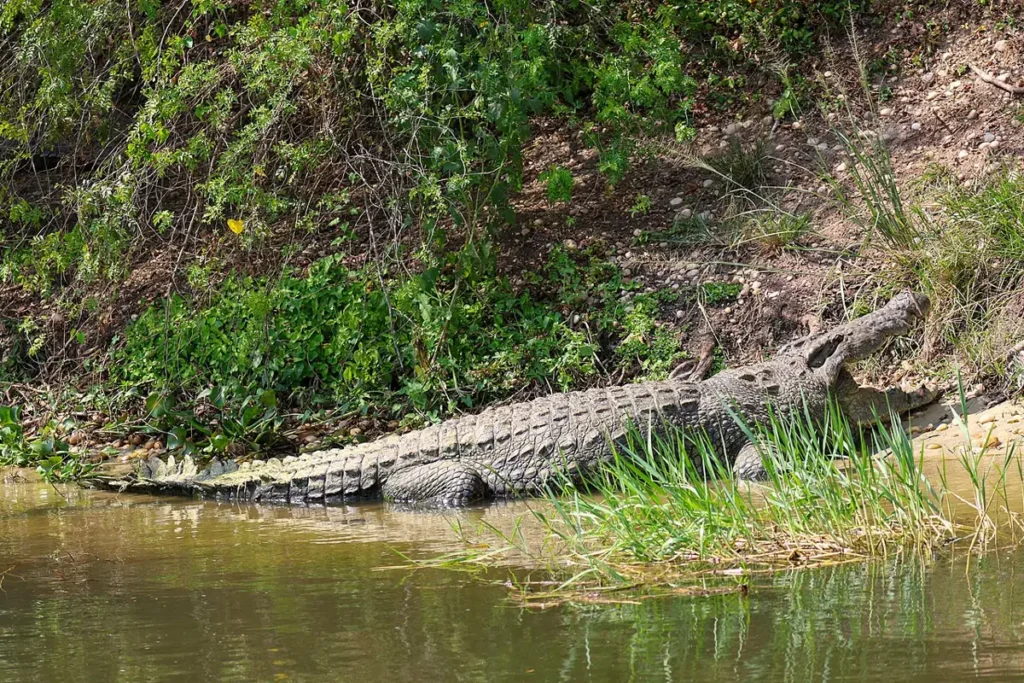
Uganda’s Nile River — particularly the stretch below Murchison Falls where the Nile enters Lake Albert — holds one of the most impressive concentrations of Nile crocodiles in East Africa. Boat trips on the lower Nile allow close approaches to animals basking on the banks: enormous individuals, scarred from decades of territorial combat, absolutely still in the equatorial sun. The Kazinga Channel in Queen Elizabeth National Park similarly offers reliable crocodile sightings from the water.
Seeing a large Nile crocodile at close range — the ancient, armoured body, the cold intelligence in those vertically slit pupils, the absolute economy of movement of something that has not needed to evolve in 200 million years — is an experience that puts human evolutionary history in useful perspective. We are very new here. The crocodile was here long before us, and with any luck, will be here long after.