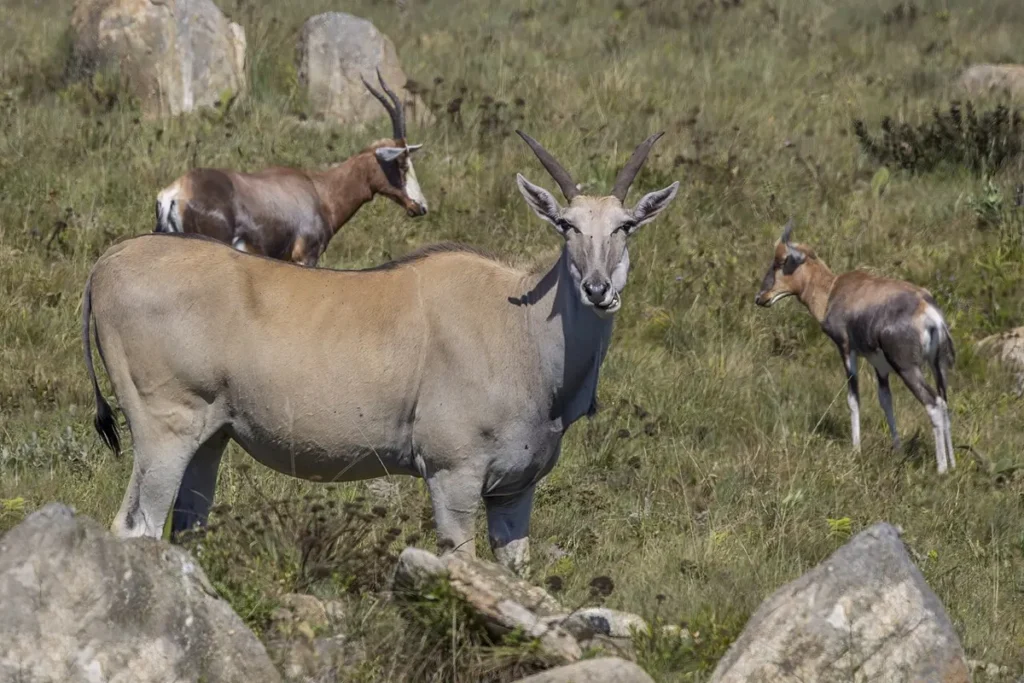
The common eland is the largest antelope in Africa — and one of the most impressive large mammals on the continent. An adult bull eland, standing 1.7 metres at the shoulder and weighing up to 900 kilograms, combines the mass of a large ox with the elegance of a spiral-horned antelope and the surprising athleticism of an animal that can jump two metres from a standing start despite its enormous weight. Uganda’s savanna parks, particularly Kidepo Valley in the northeast, hold eland populations that offer encounters with this remarkable species at its finest.
Physical Description
The common eland (Tragelaphus oryx) is unmistakable. Adults have a tawny-to-grey coat with faint white vertical stripes on the body sides. Both sexes carry spiralled horns that diverge outward, reaching 60 to 100 centimetres in females and up to 130 centimetres in males. Males develop a prominent dewlap — a hanging fold of skin under the throat — and a tuft of dark hair on the forehead. Large adult bulls develop a blue-grey colouration and a heavier, more muscular appearance with age.
One of the most distinctive sounds associated with eland is the clicking of their knee joints when they walk — a sound produced by tendons snapping over the knee bones, audible at considerable distance. The function of this sound is debated: it may communicate information about individual size and dominance to other eland without requiring visual contact, a potentially valuable signal in thick vegetation.
Ecology and Behaviour
Eland are mixed feeders — consuming grass, browse, fruit, and tubers depending on seasonal availability. This dietary flexibility allows them to exploit a wider range of habitats than specialists and makes them resilient to seasonal food scarcity. They are also highly water-efficient — in dry conditions, they can meet most of their water requirements from their food, enabling them to occupy semi-arid habitats where other large bovids cannot persist.
Despite their size, eland are mobile and sometimes migratory. Herds move seasonally across large areas following rainfall and vegetation quality. In Kidepo Valley National Park, eland herds of dozens to several hundred individuals move through the Narus and Namamukweny valleys in seasonal patterns that local rangers have documented for generations. The sight of a large eland herd moving across the Kidepo landscape — their clicking knees audible from a distance, the bulls’ dewlaps swinging — is one of Uganda’s less-celebrated but genuinely spectacular wildlife moments.
Jumping Ability
The eland’s jumping ability is one of its most surprising characteristics given its size. An adult eland can clear a fence 1.5 to 2 metres high from a standing start — a physical feat that seems implausible for an animal weighing 500 to 900 kilograms. This ability has made eland both a management challenge in areas where they are semi-domesticated and an impressive safari sighting when a herd demonstrates it while moving through fenced areas.
Eland in Uganda
Eland are present in Uganda primarily in Kidepo Valley National Park and in smaller numbers in some savanna areas of northern Uganda. Kidepo’s vast, wild landscape provides ideal eland habitat — open savanna, mixed woodland, and the rocky terrain of the Narus Valley that provides cover and water. The combination of eland, Rothschild’s giraffe, African wild dogs, cheetah, and the full savanna suite in Kidepo makes it one of Africa’s most compelling national parks, and the journey to reach it — 700 kilometres from Kampala — filters out casual visitors in a way that preserves the park’s wilderness character. Eland encountered in Kidepo have a wariness and wildness that more accessible park populations have partly lost.