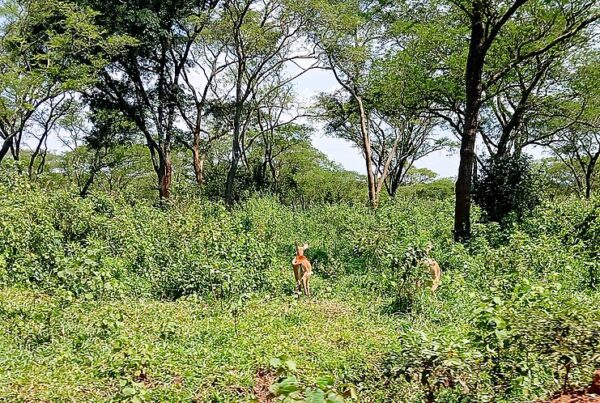
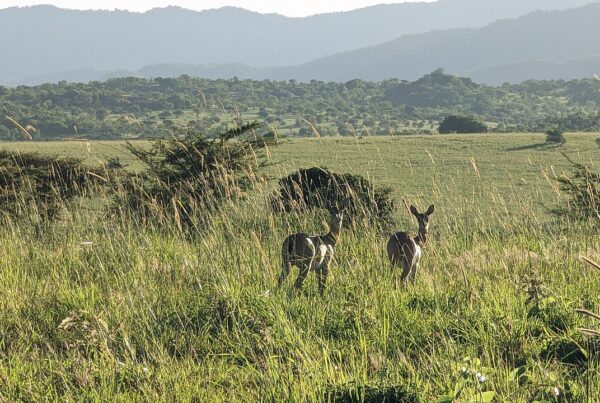
The giant forest hog (Hylochoerus meinertzhageni) is Africa’s largest wild pig species and one of Bwindi Impenetrable National Park’s most impressive forest mammals. Despite weighing up to 275 kilograms and standing nearly one metre at the shoulder, the giant forest hog is remarkably secretive and difficult to observe. Most gorilla trekkers who visit Bwindi never see one—they are more often detected by the damage they leave in vegetation, the tracks in soft soil, or the sound of movement in dense undergrowth—but understanding this animal enriches appreciation of the forest ecosystem in which gorillas live.
Physical characteristics and identification
The giant forest hog’s most distinctive features are its massive head, with elongated facial glands that create swellings below the eyes that are unique among African pigs, and its long, coarse, dark brown to black coat—unusual in a pig family whose other African members are relatively sparsely haired. The tusks are large but less prominent than those of warthogs; the boar’s tusks curve upward and outward to approximately 35cm in length. The animal’s girth is extraordinary: a large adult boar is as heavy as a small horse, and its passage through understorey vegetation leaves clearings and broken stems that reveal its presence even when the animal itself has retreated into cover.
Males are significantly larger than females, with the family groups typically comprising a dominant boar, several sows, and their offspring. Farrowing occurs in dense vegetation, and piglets are born with striped coats—a camouflage pattern that disappears as they mature over several months. Litters of two to four piglets are typical, with higher survival rates than smaller pig species due to the parents’ size and defensive capability.
Diet and ecological role
Giant forest hogs are predominantly grazers in Bwindi’s context—an unusual trait for a forest mammal—feeding extensively on grasses, herbs, and sedges in clearings, forest edges, and the high-altitude grassland patches within the park. They also consume roots, tubers, fallen fruits, and occasionally invertebrates unearthed by rooting. Their heavy rooting activity in forest floor areas aerates soil, exposes seeds to light, and creates disturbance patches that accelerate plant succession in ways that affect other species in the community.
Leopards are the primary predator of giant forest hog adults in Bwindi, though even adult leopards rarely attempt a healthy full-grown boar. African wild dogs, now absent from Uganda, historically preyed on younger animals. The young are vulnerable to a wider range of predators including pythons, crowned eagles, and opportunistic carnivores. The species’ size and group defensive behaviour—boars will stand their ground against predators, using their bulk and tusks aggressively—provide substantial protection that smaller pig species lack.
Interactions with gorillas
Mountain gorillas and giant forest hogs overlap in habitat and compete for some food resources, particularly forest fruits and Aframomum pith. Observed interactions between the two species are typically avoidance: both are large, potentially dangerous animals that prefer not to engage with each other directly. Rangers who track habituated gorilla groups occasionally note hog family groups in the vicinity, with both species moving around each other without direct confrontation. The gorillas’ size and the boars’ defensive capability create a mutual respect that generally prevents aggressive encounters.
How to maximise your chance of a sighting
Giant forest hogs are most active at dawn and dusk and are occasionally seen in clearings and on grassy patches within the park during early morning trekking hours. The Ruhija sector, with its higher altitude and more open vegetation structure, may offer slightly better sighting opportunities than the dense low-altitude forest around Buhoma. Asking your ranger guide to point out signs of giant forest hog presence—rooting areas, tracks, dung, and vegetation damage—transforms an invisible species into a present reality even when direct sighting is not achieved. The ranger guides know the signs well and enjoy sharing their knowledge of species that most visitors overlook in their focus on the gorillas.
- Giant Forest Hog Uganda: Africa’s Largest Wild Pig Facts
- The eastern lowland gorilla: Africa’s largest primate and its forest home
- African forest elephants of Bwindi: the hidden giants of the impenetrable forest
- African mahogany and the forest giants of Bwindi: Uganda’s timber trees
- African wild ginger and other medicinal plants of Bwindi’s forest floor
- African wild ginger and forest floor herbs: the medicinal plants of Bwindi’s understorey
- Gorilla Behaviour in the Wild: Understanding the Gentle Giants of Africa
- World Wildlife Day 2026: Protect Medicinal and Aromatic Plants – Conserving Health, Heritage and Livelihoods in Uganda’s Gorilla Forests
- Are There Other Animals on the Gorilla Trek in Bwindi? Forest Wildlife Beyond the Gorillas
- The Last Wild Place on Earth: Why Bwindi Forest Will Break Your Heart