The safari vehicle is one of the defining images of African wildlife tourism. Roof hatches open, cameras deployed, a pride of lions regarded from the comfortable elevation of a Land Cruiser — this is the experience that most people picture when they imagine Africa’s wildlife. It is a real and often extraordinary experience. But there is a significant difference, in depth and quality of engagement, between watching wildlife from a vehicle and walking into a forest on foot to spend an hour at close range with wild great apes. This difference is worth examining honestly for anyone thinking about what they want from an Africa trip.
The Distance Problem
Vehicle-based safari maintains a structural distance between observer and animal. This distance is partly physical — you are elevated, enclosed, and separated from the ground environment — and partly psychological. The vehicle creates a sense of safety and separation that changes how you observe. You are watching a nature film in three dimensions, not participating in an ecosystem. The animals may be close in photographic terms but they are behaviorally distant — they ignore the vehicle as a feature of their environment rather than engaging with you as a presence.
This is not a criticism of vehicle-based safari. The distance is partly what makes it practical and safe to observe lions, elephants, and buffalos at close range. But it is a real limitation on the depth of the encounter. You are an observer, not a participant. The animal’s world continues around you, but you are not in it.
What Foot-Based Trekking Changes
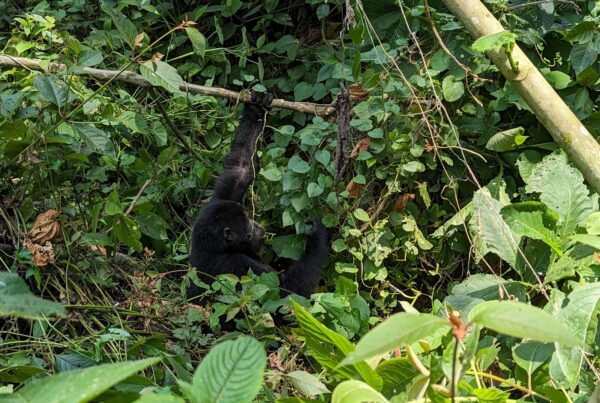
Gorilla trekking eliminates the vehicle entirely. You walk into the forest on foot, following a ranger guide and trackers who have located the gorilla family’s position. You are subject to the same physical conditions as the forest — the mud, the slope, the density of vegetation, the effort of movement. When you reach the gorillas, you crouch or stand at ten metres, at ground level, in their environment. The boundary between your world and the gorillas’ world is as thin as any wild encounter permits.
The gorillas are habituated to human presence — they have been observed by rangers and researchers for years and accept close human proximity without stress. But they are fully wild. Their behaviour is entirely natural. They feed, rest, nurse infants, play, and interact with each other as if you were not there, except when they choose to interact with you — looking directly at you, moving toward or away from you, using you as part of their environmental awareness. The encounter is reciprocal in a way that vehicle-based wildlife viewing is not.
The Meaning of Shared Space
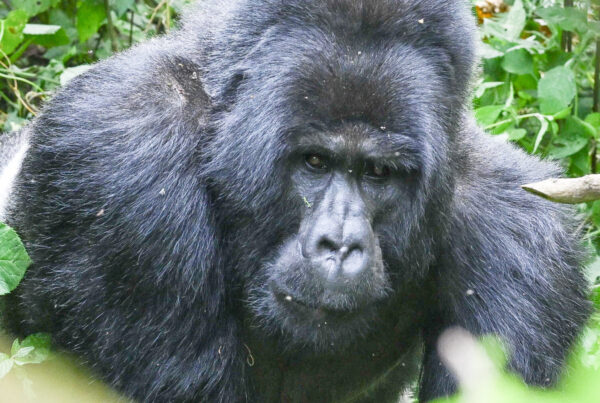
There is a specific quality to sharing physical space with an animal rather than observing it from outside. The gorillas breathe the same air you breathe. You can hear their vocalisations as acoustic events rather than through a camera’s microphone. When the silverback moves through vegetation twenty metres away, the sound and movement are real and immediate, not mediated by distance. When a juvenile approaches within two metres of your feet before its mother calls it back, the proximity is an event you register in your body, not just your eyes.
This is what travellers consistently describe as the most significant aspect of the gorilla encounter: not the visual spectacle, which is considerable, but the sense of actual presence in the same space as a wild animal. The experience of being seen by a gorilla — noticed, evaluated, and accepted by an animal that could choose to move away — is qualitatively different from any amount of vehicle-based observation of any other species.
The Genetic Proximity Factor
Gorillas share 98% of human DNA. In a vehicle-based encounter with a lion or elephant, the animal is impressive but clearly other — its behaviour organised around drives (hunger, fear, territory) that are familiar in principle but remote in form from human experience. The gorillas’ behaviour is organised around social relationships that are recognisably similar to human social dynamics: the management of status and authority by the silverback, the care and attention of mothers to infants, the playfulness and limit-testing of adolescents, the social repair that follows conflict. Observing gorilla society at close range is, in some real sense, observing a version of the processes that shape human societies — and doing so without a vehicle between you and the observation.
The Cost of Meaning
The gorilla permit costs $800 USD for international visitors in Uganda in 2027. The trek is physically demanding. The forest is genuinely difficult terrain. These costs — financial and physical — are part of what creates the meaning of the encounter. An experience that requires no effort and costs nothing tends to be perceived as worth nothing. The gorilla trek asks something of you — the preparation, the journey, the physical effort of the walk, the financial commitment of the permit — and returns something proportionate. Many travellers describe it as the most significant experience they have ever had. Very few describe it as merely impressive or as simply another box ticked on an Africa itinerary. The meaning is inseparable from the conditions that create it.
Frequently Asked Questions
Uganda is home to the mountain gorilla (Gorilla beringei beringei), one of two subspecies of eastern gorilla. They live exclusively in the Virunga volcanic highlands (Uganda/Rwanda/DRC) and Bwindi Impenetrable Forest (Uganda only). Mountain gorillas are the only gorilla subspecies that cannot survive in captivity — every individual you can trek is a wild animal.
The standard gorilla trekking permit gives you exactly 1 hour with the gorilla family. This time begins when you make first contact with the family — the ranger signals the start. The Gorilla Habituation Experience gives 4 hours with a semi-wild family. The walk to find the gorillas can take 30 minutes to 5 hours depending on where the family has moved.
Stay calm, crouch down slowly, avoid direct eye contact, and remain quiet. Do not run — running triggers a chase response. Rangers accompanying your group manage close approaches. Habituated gorillas are accustomed to humans and almost never make contact, but a charging silverback is managed by staying still and following ranger instructions immediately.
A maximum of 8 visitors per habituated gorilla family per day for standard trekking. The Gorilla Habituation Experience has a maximum of 4 visitors per family per day. These limits are set by UWA to minimise stress on the gorilla families and maintain the quality of the experience.
Uganda is home to the mountain gorilla (Gorilla beringei beringei), one of two subspecies of eastern gorilla. They live exclusively in the Virunga volcanic highlands (Uganda/Rwanda/DRC) and Bwindi Impenetrable Forest (Uganda only). Mountain gorillas are the only gorilla subspecies that cannot survive in captivity — every individual you can trek is a wild animal.