Uganda records over 1,000 bird species — more than the entire continent of North America, and more than all of Europe. For a country smaller than the United Kingdom, this figure is extraordinary. It reflects Uganda’s position at the intersection of multiple African ecological zones, its range of habitats from savannah to rainforest to wetland to Afroalpine moorland, and its preservation of key forest ecosystems that hold specialist bird communities found nowhere else. For birdwatchers, Uganda is not simply a good destination for African birding. It is one of the five or six most important birding destinations on earth.
The Numbers in Context
Over 1,000 bird species in 241,000 square kilometres gives Uganda a species density that few countries anywhere can match. Colombia — famous as the world’s most bird-rich country by total species — covers over 1.1 million square kilometres to hold its approximately 1,900 species. Uganda achieves a comparable density to Colombia’s most bird-rich regions in a fraction of the land area. The comparison is not to diminish Colombia but to contextualise the concentration of what Uganda offers.
Of Uganda’s 1,000-plus species, 24 are Albertine Rift endemics — species found only in the rift valley and its escarpment forests, with no other location in their range. For birdwatchers pursuing a Uganda trip list, these endemics represent the most compelling specific targets: species like the African green broadbill, the Grauer’s broadbill, the Shelley’s crimsonwing, the Rwenzori turaco, and the Kivu ground thrush, most of which can only be seen in the Bwindi or Kibale forest systems.
Key Birding Sites
Bwindi Impenetrable National Park holds the highest concentration of Albertine Rift endemic birds in Uganda. The forest’s interior — particularly the canopy and understory — supports species that require large areas of intact montane forest, including several turacos, the African green broadbill, and a range of sunbirds, francolins, and warblers specific to the Albertine Rift zone. Birding in Bwindi requires patience and skill — the forest’s density makes visibility challenging — but the species available here are found at no other site in Uganda.
Kibale National Park is outstanding for forest birding at lower altitude, with a different species composition from Bwindi. The Bigodi Wetland Sanctuary adjacent to Kibale is one of Uganda’s most productive single birding sites — a community-managed wetland that holds Papyrus Gonolek, White-winged Warbler, Carruthers’ Cisticola, and a range of waterbirds in addition to the forest edge species of the surrounding woodland. Bigodi can realistically produce 120-plus species in a full-day visit.
Murchison Falls National Park holds excellent savannah and riverine birding: Shoebill stork, Goliath heron, African skimmer, Grey-headed kingfisher, and the full range of Uganda’s savannah raptors including Martial eagle and Bateleur. The boat trip to the base of Murchison Falls is as productive for birds as it is for mammals, with hundreds of birds visible along the river banks in a single four-hour excursion.
The Shoebill
No birding guide to Uganda is complete without extended discussion of the shoebill (Balaeniceps rex). This extraordinary bird — named for the massive shoe-shaped bill that distinguishes it from every other species in the world — has a global population of between 5,000 and 8,000 individuals, concentrated primarily in Uganda, South Sudan, and the DRC. Uganda’s Mabamba Swamp on the northern shore of Lake Victoria is the most reliable site in the world for shoebill encounters.
The shoebill is sought by birdwatchers from every continent because it is one of those birds that photographs cannot quite prepare you for. At one metre in height, with a bill that looks designed for a much larger animal, it stands motionless in the papyrus for hours before making slow, deliberate movements that suggest something between a crane and a pterodactyl. The encounter, from a dugout canoe at close range in Mabamba’s channels, is among the most extraordinary single-species wildlife experiences in Africa.
Combining Birding With Gorilla Trekking
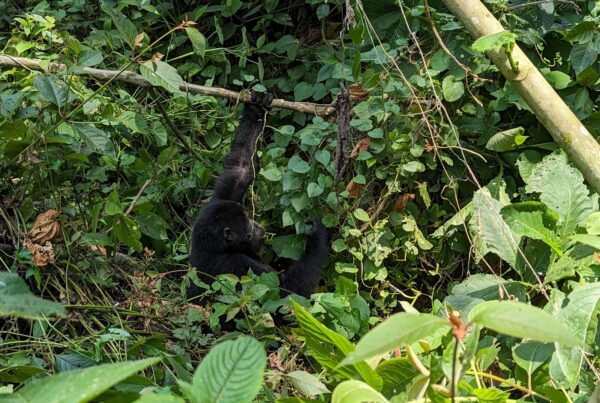
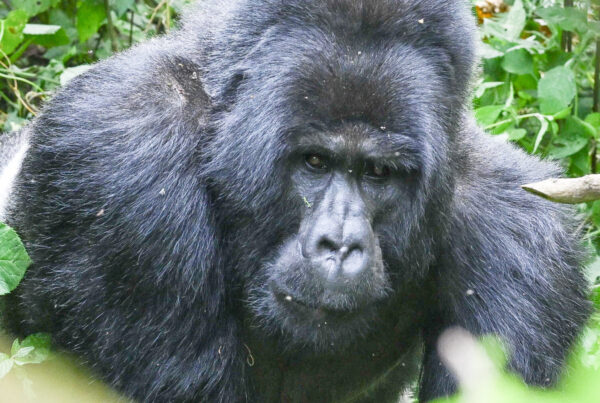
For birdwatchers visiting Uganda, the combination of birding and gorilla trekking is natural and logical. Bwindi and Kibale — the two primary gorilla and chimpanzee trekking sites — are also Uganda’s two most important forest birding sites. A gorilla trek day can be supplemented with early morning forest birding before the 7am briefing and guided birding walks on non-trek days. Many of the Albertine Rift endemics are best found on the guided forest walks that lodges near Bwindi offer as alternatives to the trekking experience.
A two-week Uganda birding and gorilla itinerary — combining Bwindi, Kibale, Mabamba, Queen Elizabeth, and Murchison Falls — can realistically produce 500 species and more. For visiting birders with a specific African life list objective, this target is achievable and includes multiple species unavailable anywhere else on earth. Uganda is not a supplementary African birding destination. For anyone serious about African birds, it is a primary one.
Frequently Asked Questions
Kibale Forest National Park, near Fort Portal, has the highest density of chimpanzees in Africa and is Uganda’s premier chimpanzee destination. The standard chimp trekking permit costs $300 FNR. The Chimpanzee Habituation Experience at Kibale ($400 FNR) gives 4 hours with a habituated community — Uganda’s only chimp habituation programme.
Yes — the gorilla + chimp combination is Uganda’s most popular primate itinerary. A typical 8-day route: Entebbe → Kibale Forest (2 nights, chimp trekking) → Queen Elizabeth National Park (2 nights, game drives) → Bwindi (2 nights, gorilla trekking) → Entebbe. Charter flights on any leg reduce travel time significantly.
Uganda has 13 primate species. Commonly seen: olive baboon, vervet monkey, red-tailed monkey, black-and-white colobus, L’Hoest’s monkey, grey-cheeked mangabey. Golden monkeys are found at Mgahinga. Kibale Forest has the highest primate diversity of any East African forest. A dedicated primate safari can tick 7–8 species in a single itinerary.
Uganda has over 1,060 recorded bird species — one of the highest counts of any country in Africa. Bwindi alone has 350+ species including 23 Albertine Rift endemics. Murchison Falls, Queen Elizabeth, and the wetlands around Entebbe round out a world-class birding circuit. The African green broadbill and Shelley’s crimsonwing are Bwindi specialities.
Uganda is home to the mountain gorilla (Gorilla beringei beringei), one of two subspecies of eastern gorilla. They live exclusively in the Virunga volcanic highlands (Uganda/Rwanda/DRC) and Bwindi Impenetrable Forest (Uganda only). Mountain gorillas are the only gorilla subspecies that cannot survive in captivity — every individual you can trek is a wild animal.