Updated
In global discussions about tropical forest conservation, the Amazon dominates. Its size, its biodiversity, its carbon storage, and the political drama of its deforestation rate have made it the reference point for tropical forest loss worldwide. But Africa’s great forests — the Congo Basin, the Guinean forests of West Africa, and the mountain forests of the Albertine Rift — are equally significant for global climate systems, atmospheric carbon, and biodiversity conservation, and they receive a fraction of the scientific, political, and public attention that the Amazon commands. Understanding why Africa’s forests matter at this scale is important context for anyone thinking about what gorilla tourism in Uganda contributes to.
The Scale of the Congo Basin
The Congo Basin rainforest covers approximately 3.3 million square kilometres — the second largest continuous tropical rainforest on earth. It spans six countries: DRC, Republic of Congo, Cameroon, Gabon, Central African Republic, and Equatorial Guinea, with fragments extending into other neighbouring states. It contains 10,000 plant species, 400 mammal species, 1,000 bird species, and 700 fish species. It is the largest reservoir of biodiversity in Africa and one of the most significant on earth.
The Congo Basin stores approximately 30 billion tonnes of carbon — more than five years of total global carbon emissions at current rates. Its forests are currently considered a net carbon sink, absorbing more carbon dioxide from the atmosphere than they release, though this status is threatened as deforestation accelerates. The implications for global climate of a Congo Basin that becomes a carbon source rather than a sink are significant and increasingly discussed in climate science literature.
The Amazon Comparison
The Amazon is larger — approximately 5.5 million square kilometres of tropical forest, compared to the Congo Basin’s 3.3 million. It also stores more carbon in absolute terms. But the Amazon has experienced faster and more visible deforestation: approximately 17% of its historical area has been deforested, with the annual rate peaking in the early 2000s and remaining high despite policy interventions. The Congo Basin has lost a smaller proportion of its historical extent, making it — for now — a relatively more intact tropical forest system.
The difference in attention is partly attributable to politics: Brazil’s deforestation has been the subject of intense international media coverage, while the DRC’s forest loss — driven by different dynamics including subsistence farming and charcoal production rather than large-scale industrial agriculture — has been less visible internationally. The outcome in carbon and biodiversity terms is comparable.
The Albertine Rift Forests
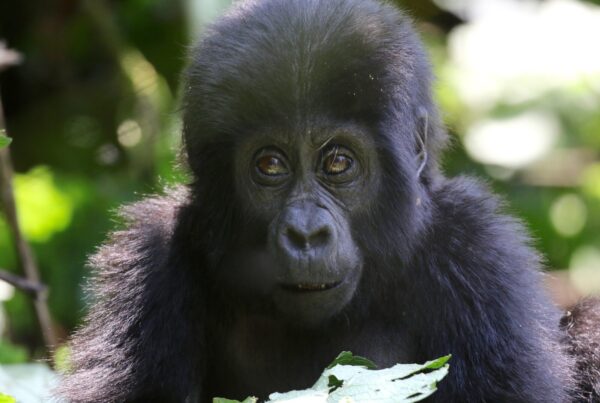
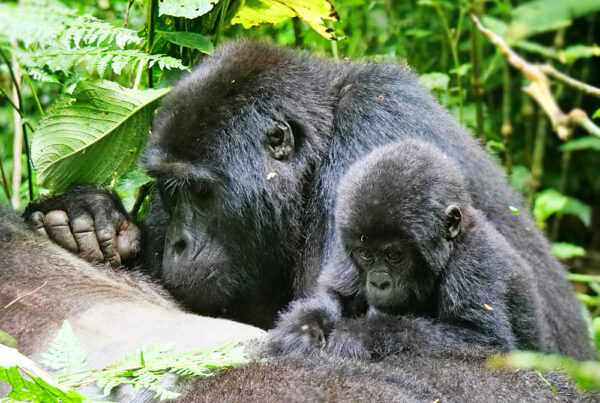
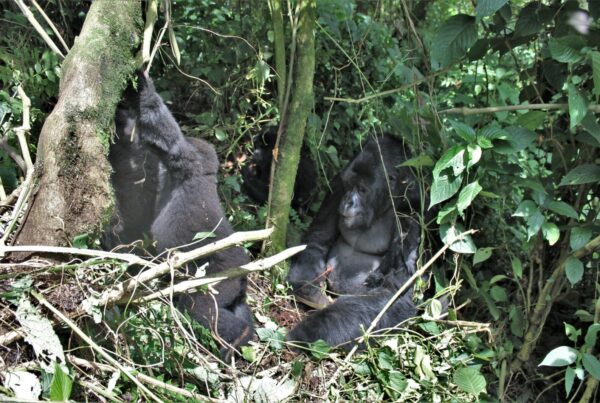
Within the larger Congo Basin system, the mountain forests of the Albertine Rift — including Bwindi in Uganda, Nyungwe in Rwanda, and the Virunga Massif forests — are disproportionately significant for biodiversity. These forests have more endemic species per unit area than any other region in continental Africa. They have been isolated on the rift escarpment for millions of years, allowing species to evolve in relative independence from the lowland forest. They contain the mountain gorilla — a species that exists nowhere outside these specific forest fragments.
The Albertine Rift forests are also more threatened per unit area than the Congo Basin as a whole, because they are surrounded by some of Africa’s most densely populated farming communities. The land pressure on Bwindi’s borders is intense and constant. The protection of these forests requires active, funded conservation effort — which is exactly what gorilla trekking permit revenue provides.
What Tourism Contributes
The connection between gorilla tourism and forest conservation is direct and documented. Permit revenue funds rangers. Rangers prevent encroachment. Encroachment prevention maintains forest integrity. Forest integrity maintains the biodiversity and carbon storage functions that give the forest its global significance. The $800 USD gorilla permit in Uganda in 2027 is a small payment against an enormous value — but it is the marginal payment that makes the difference between a ranger force that is funded and one that is not, between a park boundary that is patrolled and one that is abandoned to agricultural encroachment.
Africa’s forests are not receiving the international attention or the conservation investment their significance warrants. In their absence, gorilla tourism — and the permit revenue it generates — is doing more to protect specific, critical pieces of African forest than any other single mechanism. The Amazon gets the headlines. Bwindi keeps its gorillas through permit fees and the visitors who pay them.
The Congo Basin’s forest — of which Bwindi is the eastern edge — sequesters carbon at a rate that makes it second only to the Amazon in global significance, and the financing mechanisms that convert this sequestration into cash payments for the forest communities who protect it are among the most promising structural solutions to the deforestation pressure that agricultural expansion creates.