Updated
Africa greatest continent wildlife Uganda is one of the highlights of travelling through Uganda, where the country’s rich food culture reflects its people, landscapes, and agricultural traditions. No continent on earth matches Africa for the breadth, density, and spectacle of its wildlife. The statistics are well known and still staggering: Africa holds five of the world’s ten heaviest land animals, the largest elephant population on earth, more species of antelope than any other continent, and the remaining populations of some of the most critically endangered species alive. What is less frequently discussed is where within Africa the most extraordinary wildlife experiences are concentrated — and the answer, measured by biodiversity per square kilometre, points consistently toward Uganda and the Albertine Rift that runs through its western border.
Why Africa Is the Greatest Continent for Wildlife: Uganda Leads
The Case for Africa
Africa’s wildlife supremacy rests on several converging factors. The continent retained its megafauna through the end of the Pleistocene era, when mass extinctions wiped out large mammals from the Americas, Europe, and northern Asia. Africa’s animals co-evolved with human hunters over millions of years and developed survival strategies — the speed of the cheetah, the social structures of elephant herds, the nocturnal habits of leopards — that allowed them to persist alongside human presence in ways that megafauna elsewhere could not.
Africa also benefits from a diversity of ecosystems compressed into a relatively small geographic range. From the Saharan desert in the north to the Congo Basin rainforest in the centre, from the Great Rift Valley savannah to the Afroalpine moorlands of the Rwenzori mountains, the continent offers habitat types that support an extraordinary range of species. Many of these biomes share borders, creating transition zones of extraordinary richness where species from multiple ecosystems overlap.
Uganda’s Position Within Africa
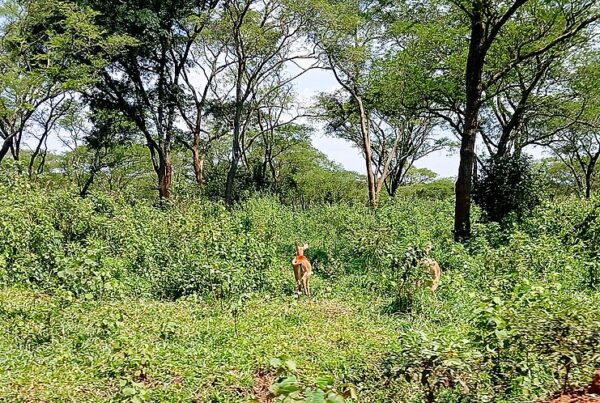
Uganda sits at the intersection of two of Africa’s great ecosystems. To the east, the savannah environment of East Africa extends from Kenya and Tanzania into the open grasslands of Queen Elizabeth National Park and Murchison Falls. To the west, the Congo Basin rainforest reaches across the border into Bwindi, Kibale, and the forests of the Albertine Rift. Uganda is one of the few places on earth where these two great ecosystems — and their associated faunas — exist within a single national boundary.
The result is wildlife density and diversity that no other comparably sized African country approaches. Uganda holds over 1,000 bird species — more than the entire North American continent. It has the highest density of primates anywhere on earth. Its national parks contain big game (elephant, buffalo, hippo, leopard, lion) alongside primates (chimpanzee, gorilla, colobus, baboon), alongside an aquatic fauna (shoebill, Nile crocodile, sitatunga) that is unlike anywhere else. The country offers a complete African wildlife experience within a geography small enough to navigate in a two-week trip.
The Gorillas as the Centrepiece
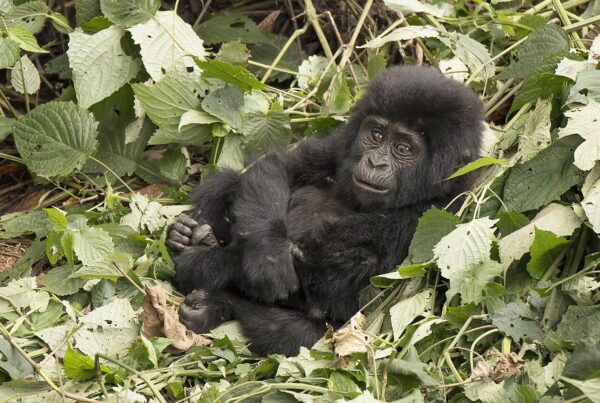
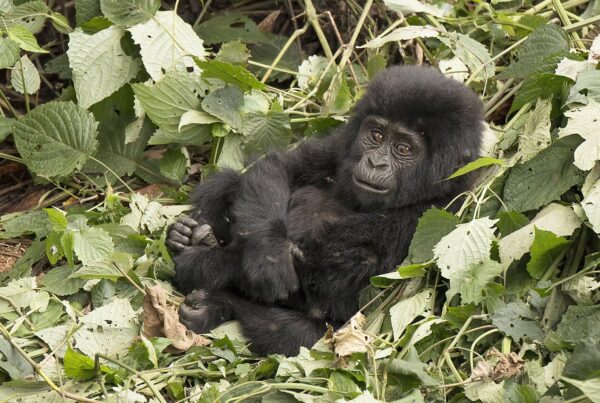
Within Uganda’s extraordinary biodiversity, the mountain gorilla occupies a unique position. Approximately 1,100 mountain gorillas survive on earth — the entire global population of a species. Around half of them live in Uganda’s Bwindi Impenetrable National Park and Mgahinga Gorilla National Park. They cannot be seen in any zoo. The only way to encounter them is to travel to their forest, and the only way to enter that forest is through the regulated permit system managed by the Uganda Wildlife Authority.
The gorilla permit costs $800 USD for international visitors in 2027 — a price that reflects the conservation cost of protecting a critically endangered species in one of Africa’s most biodiverse forests. It is not an arbitrary number. It is the product of calculations about ranger salaries, patrol logistics, habituation investment, and the minimum cost of sustainable management of a forest that is surrounded on all sides by a rapidly growing human population.
Africa’s Wildlife Is Not Guaranteed
The greatness of Africa’s wildlife is real, but it is not permanent. Across the continent, habitat loss, poaching, human-wildlife conflict, and climate change are reducing species populations and shrinking the wild spaces they inhabit. The mountain gorilla’s recovery from approximately 620 individuals in 1989 to over 1,100 today is one of the few genuine conservation success stories on the continent — and it happened because of investment, regulation, and the economic value that gorilla tourism created for the communities living alongside the park.
The Serengeti wildebeest migration still occurs. The Okavango Delta still floods. Bwindi still holds its gorillas. But these experiences are not self-sustaining. They persist because of active human effort — and part of that effort is funded directly by the visitors who come to see them. The $800 permit fee does not go to a multinational corporation. It goes to the Uganda Wildlife Authority, which uses it to fund the rangers, the infrastructure, and the community support programmes that keep Bwindi’s forest intact and its gorillas alive.
Why Uganda in 2027
Africa’s wildlife is not diminishing evenly. Some destinations are becoming more crowded and more commercialised as the global travel industry expands. Others remain genuinely remote, genuinely wild, and genuinely rare in what they offer. Uganda is in the second category. Tourism infrastructure has improved significantly but the visitor numbers remain modest compared to Kenya or South Africa. The experience of being in Bwindi — in a forest with fewer than a hundred human visitors on any given day — is an experience that is becoming harder to find in Africa as the continent’s tourist economy grows.
For anyone serious about experiencing Africa’s wildlife at the level the continent can genuinely offer, Uganda in 2027 is the most compelling single destination. The gorillas are the headline, but the chimpanzees, the shoebills, the tree-climbing lions, and the Nile itself are all part of a country that delivers on Africa’s promise in ways that its more-visited neighbours increasingly struggle to match.