Updated
what gorilla eyes look like gorilla trekking Uganda is one of Africa’s most extraordinary wildlife experiences, connecting travellers with mountain gorillas in their natural forest habitat. People ask me about gorilla trekking in Uganda and they eventually ask the same question: what does it feel like when a gorilla looks at you? I have been trying to answer this precisely since I came back. The experience is specific enough that it deserves a better description than “incredible” or “like nothing else” or the other approximations that travel writing defaults to. This is my most accurate attempt at describing what a gorilla’s eyes look like when they look back at you — and what happens to you when they do.
What a Gorilla’s Eyes Look Like When They Look Back at You: A Description
The Physical Description First
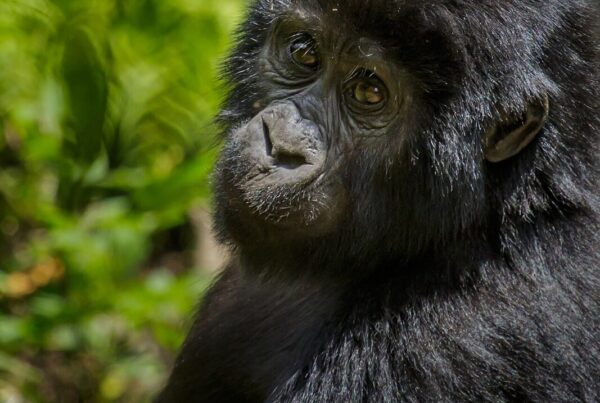
Mountain gorilla eyes are dark brown, almost black in most light. They are set in a face that is deeply expressive in a way that photographs do not fully convey — the brow ridge above them creates a depth of shadow that changes with the angle of the head, and the skin around the eyes has a quality of texture that reads, in a way you do not expect, as aged. Not old in a diminished sense — aged in the sense of having accumulated experience. The eyes themselves are calm. Not passive — calm, in the way that very settled things are calm: without effort, without performance, without the vigilance that anxiety produces.
The gorilla I am describing was the dominant silverback of the Rushegura family at Buhoma sector, Bwindi Impenetrable National Park, Uganda. I was there on a permit that cost $800 USD, on a trek that took three hours to reach him, and the moment when he looked directly at me lasted approximately twenty seconds. I am describing those twenty seconds.
The Intelligence in the Look
The thing that is hardest to prepare for is the intelligence. Not because we expect gorillas to be unintelligent — anyone who has read anything about great apes knows they are cognitively sophisticated. But knowing this and being looked at by it are different experiences. When the silverback looked at me his gaze was not an animal glance — the brief, registering look that most wildlife gives you before returning to what it was doing. It was an assessment. Brief, unhurried, and thorough. He looked at me the way a person looks at something new that they need to categorise — not threatening, not fearful, but genuinely considering.
What he concluded about me I cannot know. He looked for twenty seconds and then looked away, which I choose to interpret as finding me unremarkable rather than insufficiently interesting. The guide later told me that the silverback looks at every member of a new group when they arrive — a quick assessment of whether any individual requires particular attention. I was assessed and found to require none. I found this, strangely, reassuring.
The Emotional Response to Being Looked At
I did not expect the emotional response. I had read accounts of gorilla encounters and many described emotional reactions — tears, awe, a feeling of connection. I assumed this was the travel writing tendency toward sentiment rather than a literal description of what happened. I was wrong. When the silverback looked at me I felt something I can only describe as recognition — not that he recognised me specifically, but that what was doing the looking was recognisably a mind. An old mind, in a very large body, looking at something new through eyes that had seen a great deal, and finding the new thing neither threatening nor particularly remarkable.
The recognition of another mind looking at you from inside a creature so different from you produces a specific cognitive and emotional response. It disrupts, briefly but completely, the ordinary human assumption that minded experience is primarily a human phenomenon. For twenty seconds I was not at the top of any hierarchy. I was one minded creature being assessed by another, and the other was considerably older, considerably more settled, and considerably less interested in whether I found the encounter meaningful.
What Stays With You
The twenty seconds stay with you more than you expect. I have thought about the silverback’s look on many subsequent occasions — during meetings, during difficult conversations, during periods when I am uncertain about what I am doing or why. The look functions as a reference point: a reminder that there is a very large, very calm, very settled creature in a forest in Uganda who looked at me and found me unremarkable and continued eating his leaves, and that this is a reasonable relationship to have with the contents of my current situation.
The gorilla permit is $800. What a gorilla’s eyes look like when they look back at you is something I can describe but not fully convey. You have to go and find out. Plan your 2027 trip with us.
Frequently Asked Questions
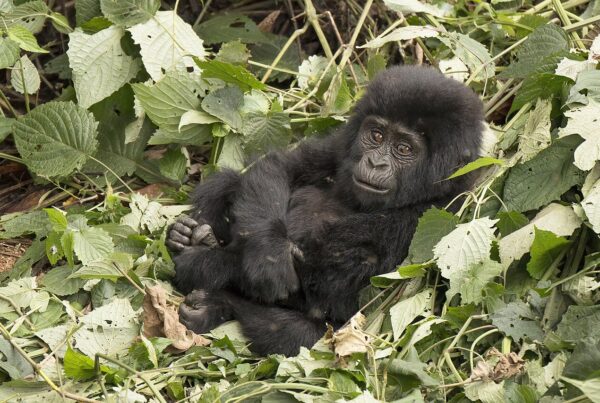
Uganda is home to the mountain gorilla (Gorilla beringei beringei), one of two subspecies of eastern gorilla. They live exclusively in the Virunga volcanic highlands (Uganda/Rwanda/DRC) and Bwindi Impenetrable Forest (Uganda only). Mountain gorillas are the only gorilla subspecies that cannot survive in captivity — every individual you can trek is a wild animal.
The standard gorilla trekking permit gives you exactly 1 hour with the gorilla family. This time begins when you make first contact with the family — the ranger signals the start. The Gorilla Habituation Experience gives 4 hours with a semi-wild family. The walk to find the gorillas can take 30 minutes to 5 hours depending on where the family has moved.
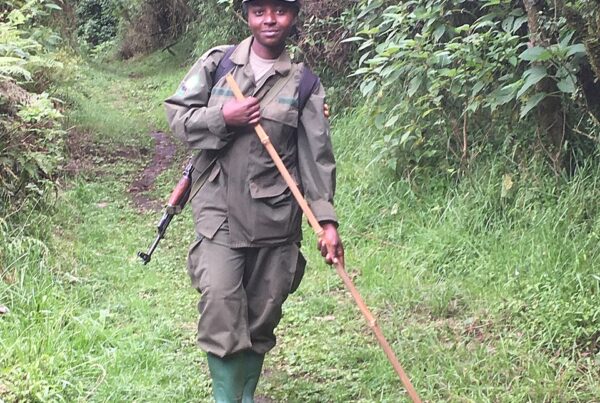
Stay calm, crouch down slowly, avoid direct eye contact, and remain quiet. Do not run — running triggers a chase response. Rangers accompanying your group manage close approaches. Habituated gorillas are accustomed to humans and almost never make contact, but a charging silverback is managed by staying still and following ranger instructions immediately.
A maximum of 8 visitors per habituated gorilla family per day for standard trekking. The Gorilla Habituation Experience has a maximum of 4 visitors per family per day. These limits are set by UWA to minimise stress on the gorilla families and maintain the quality of the experience.
Uganda is home to the mountain gorilla (Gorilla beringei beringei), one of two subspecies of eastern gorilla. They live exclusively in the Virunga volcanic highlands (Uganda/Rwanda/DRC) and Bwindi Impenetrable Forest (Uganda only). Mountain gorillas are the only gorilla subspecies that cannot survive in captivity — every individual you can trek is a wild animal.