The woman who trekked to see gorillas six weeks after chemotherapy had been told, by three separate people, that she was not well enough to go. Her oncologist was cautious. Her daughter was worried. Her husband had offered, multiple times, to postpone the trip they had been planning for two years. She went anyway. And what happened in Bwindi Impenetrable Forest six weeks after her final treatment session is the kind of story that makes you reconsider what people are capable of when they decide something matters enough.
The Trip That Almost Did Not Happen
Linda and her husband Mark had booked their Uganda gorilla trekking permits eighteen months before her diagnosis. The booking had been straightforward — two permits, a two-week itinerary covering Bwindi, Kibale, and Queen Elizabeth National Park, a lodge selected after more research than either of them had done for anything in years. Then came the diagnosis, six months after booking, and the question of whether to go became considerably more complicated.
Chemotherapy ran from October through March. She finished her final session on a Wednesday. Their Uganda flight was booked for six weeks later, in mid-May.
The Medical Advice
Her oncologist did not say she could not go. He said he had concerns. The trek itself — physically demanding, in a remote area with limited medical facilities — was the main issue. He recommended a more conservative approach: perhaps postpone, perhaps replace the trekking with a lodge-based safari. Linda listened to all of this carefully, asked several specific questions about the actual risks she would face, and made her own assessment.
The actual risks, as far as she could establish, were manageable. She was in remission. Her blood counts had recovered to acceptable levels. The main risk was physical exhaustion on a demanding trek. This was a risk she had decided she was willing to take.
The Preparation
In the six weeks between her final treatment and the Uganda flight, Linda did what she always did with challenges: she prepared methodically. She walked every day, starting with thirty minutes and building to two hours. She hired a personal trainer for four sessions focused specifically on hill walking and core strength. She contacted Uganda Gorilla Trekking to discuss porter availability in detail and established exactly what support would be available on the trek.
“I was not going to arrive unprepared and then fail because of something I could have fixed in advance,” she said. “If I was going to fail, I wanted it to be because of something genuinely outside my control.”
Arriving in Uganda
Uganda arrived as a sensory event. The warmth, the greenness, the smell of the air at Entebbe Airport at ten in the evening. Their driver, a man named Solomon, was waiting. He had a flask of tea in the car and opinions about the best restaurants in Kampala, both of which he deployed over the two-hour drive to the city.
Linda described feeling, for the first time in six months, like herself. Not a patient, not a person in recovery, not someone being handled carefully by people who loved her. Just herself, in a new place, at the beginning of something.
The Trek: What Happened
They were assigned to the Habinyanja family — a large, well-habituated group at the Buhoma sector of Bwindi. Their guide was Christine, who had been working with this family for a decade and was known among the guides as someone who managed the physical demands of the trek with particular sensitivity to visitors’ individual fitness levels.
Linda had hired a porter. Mark had hired a porter. They set off at eight in the morning.
The Difficult Section
At the ninety-minute mark, Linda hit a wall. The slope was steep, the vegetation was dense, and her legs, still recovering their strength, were not responding the way she wanted them to. She stopped and told Christine she needed a few minutes.
“Christine sat down with me,” Linda said. “She didn’t check her watch. She didn’t look anxious. She just sat down and pointed out a bird in the tree above us and named it and told me something about it. She gave me time to breathe.”
They sat for ten minutes. Then Linda stood up, adjusted her grip on her trekking poles, and said she was ready to continue. Christine said: “Good. We are very close now.”
They were.
The Habinyanja Family
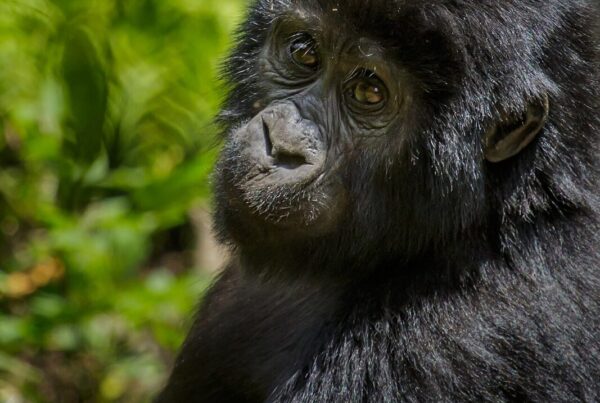
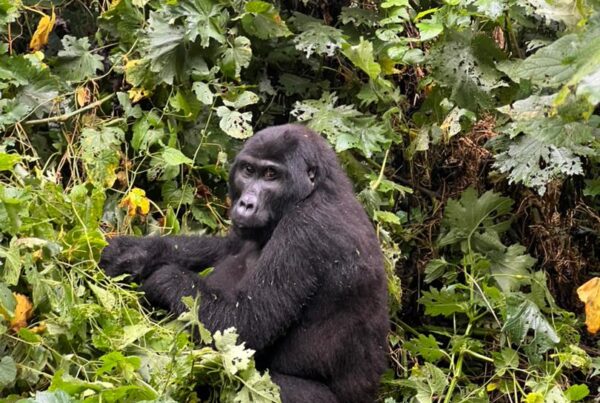
The family was in a valley below the ridge — feeding, spread through the vegetation in the loose configuration of a group at ease. The silverback, Rwigema, was visible at the far end of the clearing. Infants were visible. The sounds and smells of the group were immediate and physical.
Linda sat down on a low rock and watched. Mark stood beside her. Christine was nearby, quietly providing names and context for what they were seeing.
An infant gorilla — three months old, Christine estimated — was with its mother about four metres away. The mother was eating. The infant was doing what infants do: gripping, looking, existing in the uncomplicated present tense of the very young.
Linda did not speak for the full hour. Mark said afterward that she was crying for most of it, though quietly, in the way of someone who has decided that this particular response does not need to be managed.
What She Said Afterward
Over lunch at the lodge, Mark asked what she had been thinking during the hour. She thought about this for a while before answering.
“I was thinking that it was real,” she said. “I know that sounds obvious. But for six months, everything has been about what might happen in the future — the treatment, the recovery, the statistics, the prognosis. In that forest, with those animals, there was no future and no past. There was just what was in front of me. I had not had that in a long time.”
She also said something about the infant. “That baby has no idea what is going on in the world. No idea about illness or hospitals or prognosis. It is just alive, completely, right now. I needed to see that. I needed to be in the presence of something that has no concept of the things I have been afraid of.”
The Rest of the Trip
They continued with the full itinerary. Kibale Forest for chimpanzee trekking — “noisier than the gorillas, completely joyful, completely different,” Linda said. Queen Elizabeth National Park for the tree-climbing lions and the boat safari on the Kazinga Channel. Two final nights at a lodge on the edge of Lake Victoria.
On the last evening, Linda said she felt ready to go home. Not because Uganda had ended, but because something had changed that she wanted to bring back with her.
The Oncology Follow-Up
Three weeks after returning, Linda had her first post-treatment oncology appointment. Her oncologist asked how the trip had been. She showed him photographs of the Habinyanja family. He looked at them for a long time.
“He said I looked well,” Linda said. “I told him I was. He said: ‘I see that.’ That was the best conversation I had had in the preceding eight months.”
Why She Shares This Story
Linda asked me to include one specific note in telling her story. There are people, she said, who are in or recently through significant medical treatment who are considering a trip that others are warning them against. She is not a doctor and cannot give medical advice. But she has a piece of experiential advice:
“Get the clearance, do the preparation, hire the support. And then go. The thing you are afraid of missing might be exactly what you need.”
Planning a Gorilla Trek After Medical Treatment
Uganda Gorilla Trekking works with visitors of all physical conditions and can advise specifically on porter availability, trek difficulty, and which gorilla families and sectors of the park are most manageable for those with reduced stamina. The permit fee is $800 per person. Porters make the physical demands significantly more manageable.
Contact Uganda Gorilla Trekking to discuss your specific situation and plan accordingly. The gorillas are there, the forest is intact, and the experience is available to those who prepare well enough to show up.
Frequently Asked Questions
Minimum: 3 days (arrive, travel to Bwindi, trek, return — very rushed). Recommended: 5–7 days to include proper travel time and a buffer day. If combining with Kibale chimps or a game park, allow 8–12 days. The 8-hour road journey from Kampala to Bwindi means a 3-day trip involves almost no rest.
A popular 7-day itinerary: Day 1 — Arrive Entebbe, transfer to Kampala or Entebbe hotel. Day 2 — Fly or drive to Bwindi. Days 3–4 — Gorilla trekking (one or two treks), forest walks. Day 5 — Return to Entebbe via Kampala or direct charter. Days 6–7 — Optional Entebbe or Kampala city time before departure.
Yes, but they are in different countries. A combined itinerary typically routes Entebbe (Uganda gorillas) → Nairobi or Kilimanjaro (Tanzania/Kenya safari) with a connecting flight between legs. Allow 10–14 days total. Alternatively, Uganda’s own Queen Elizabeth National Park offers excellent big game alongside the gorilla experience without the international connection.
Near Bwindi: Batwa Cultural Experience (indigenous forest walk with the Batwa community), guided birding walks (350+ species), forest nature walks, waterfall hikes, community village visits. Within 2–3 hours of Bwindi: Lake Bunyonyi (canoeing, island walks), Mgahinga (golden monkey trekking, Virunga volcano hiking).
Uganda is home to the mountain gorilla (Gorilla beringei beringei), one of two subspecies of eastern gorilla. They live exclusively in the Virunga volcanic highlands (Uganda/Rwanda/DRC) and Bwindi Impenetrable Forest (Uganda only). Mountain gorillas are the only gorilla subspecies that cannot survive in captivity — every individual you can trek is a wild animal.