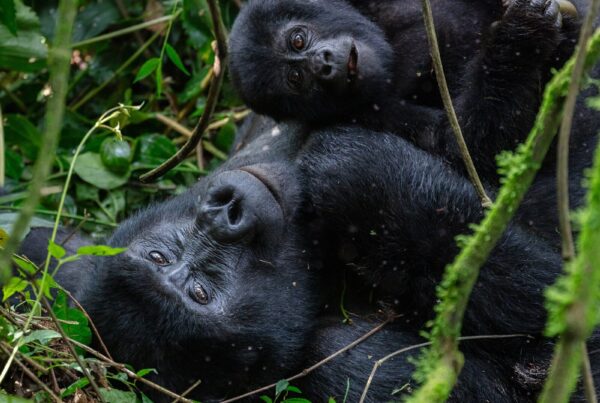
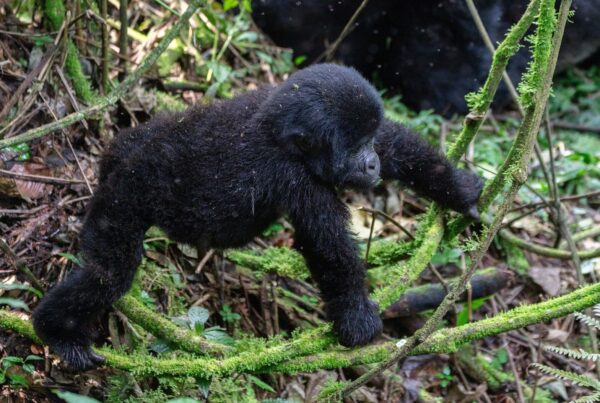
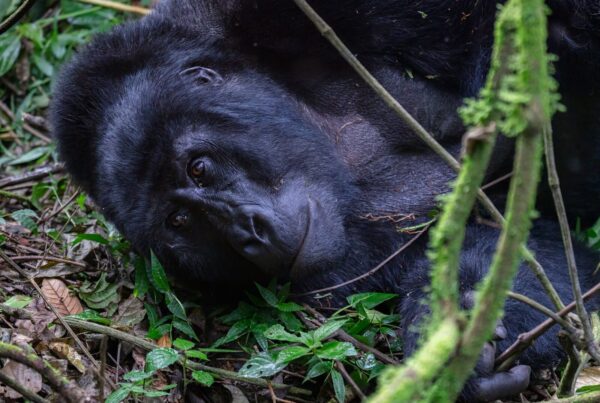
When gorilla trekking tourists find a gorilla family in Bwindi Impenetrable National Park, the encounter feels like a discovery. In reality, the family’s location has been known, within a radius of a few hundred metres, since the previous day. Some gorilla families carry GPS telemetry devices — small transmitters attached to custom-fitted collars worn by one individual (usually an adult female) — that allow UWA rangers and researchers to track family movements remotely. Other families are located by experienced trackers who follow footprints, nesting sites, and forest sounds with an accuracy that rivals the technology. This post describes both methods: the technology behind gorilla tracking and the human skill that complements it.
GPS Telemetry: How It Works
GPS telemetry in gorilla conservation uses collars fitted with GPS receivers that log the gorilla’s position at set intervals and transmit that data via VHF radio signal to a receiver at UWA’s tracking stations, or via satellite link for more advanced units deployed in recent years. The data appears as a series of coordinate points on a map, showing where the gorilla — and by extension, the family she travels with — was at each logging interval. This gives rangers a starting point each morning that significantly reduces the time spent locating a family before trekking groups arrive.
Not all habituated families in Bwindi carry GPS collars. Collaring requires anaesthesia, which carries risk, and the Mountain Gorilla Veterinary Project’s protocol for collar fitting is rigorous. Collars must fit correctly — not so tight as to restrict movement or cause injury, not so loose as to be removable by the gorilla — and must be checked periodically for fit as the gorilla grows or changes weight. In practice, at any given time, four to six habituated families in Bwindi have a collared individual, while the remainder are tracked by traditional methods.
Traditional Tracking: The Human Technology
The gorilla trackers who locate families without GPS collars use a skill set developed over decades of observation. They begin at the family’s last known sleeping location — the nest site where the group slept the previous night — and follow the trail of signs that a moving gorilla group leaves: flattened vegetation, knuckle prints in soft soil, scat, food remains (chewed leaves and stems discarded as the gorillas fed), and the distinctive smell of gorilla presence in still air. In a group of 15 to 20 individuals, a family’s passage through vegetation leaves marks that experienced trackers can read as fluently as text on a page.
Emmanuel, our senior guide, describes traditional tracking as “reading the forest’s memory.” The signs are not always fresh or obvious. A family that moved quickly in the previous evening’s rain may have left faint tracks that a tracker must interpret across 200 metres of forest floor, factoring in wind direction, soil type, and the family’s known preferences for different microhabitats at different times of day. The skill is deeply contextual — it depends on knowledge of a specific family’s behaviour patterns that only years of observation can build.
Camera Traps: The Overnight Evidence
Camera trap networks provide a third tracking method used in combination with GPS and traditional tracking. Fixed camera traps at known wildlife movement corridors within habituated family ranges capture photographic evidence of family locations at night — the hours when GPS transmitters may be logging but when ranger presence is minimal. Camera trap data helps rangers confirm family composition, check for injuries or illness in individual gorillas, and identify non-habituated gorillas or unusual individuals that move through habituated family ranges.
In 2027, the camera trap network in Bwindi includes approximately 80 active units across the four trekking sectors, managed jointly by UWA and partner research organisations. Data from these cameras is reviewed daily by UWA monitoring staff and feeds into the population database that forms the foundation of annual population censuses. Individual gorillas are identified by facial features — the unique patterns of nose-bridge wrinkles that function as a gorilla fingerprint — allowing population databases to track births, deaths, and family movements over years with increasing accuracy.
What This Means for Your Trek
When you set out for your gorilla trek in 2027, your guide has access to tracking data from the previous day — GPS coordinates, tracker report, and sometimes camera trap confirmation — that tells them where to start. The family is not random. The encounter is not a coincidence. It is the product of monitoring technology, traditional skill, and years of institutional knowledge that places you, with high reliability, in the presence of a known family in a known location. Understanding the systems behind the encounter does not diminish it. It deepens it — by revealing the extent of the investment, in technology and human expertise, that makes it possible.
Frequently Asked Questions
A silverback is a mature male mountain gorilla (12+ years old) whose saddle-area back hair has turned silver-grey — a visible sign of adulthood. The silverback leads and protects his family group, decides when and where the group moves, and mediates conflicts. Each habituated gorilla family in Uganda has at least one silverback.
Adult male mountain gorillas weigh 140–200kg and stand 1.5–1.8m tall. Their arm span can reach 2.3 metres. Females are significantly smaller at 70–113kg. Mountain gorillas are the largest living primates. Despite their size, mountain gorillas are generally peaceful and only become aggressive if threatened.
Habituated silverbacks are accustomed to small groups of human visitors and generally ignore the trekking group. You may see the silverback feeding, resting, grooming family members, or moving the group through the forest. Direct eye contact should be avoided. If a silverback charges or bluff-charges, rangers instruct visitors to crouch down, avoid eye contact, and stay still.
A blackback is a sub-adult male gorilla (8–12 years old) whose hair has not yet turned silver. Blackbacks have not reached full maturity and typically live in the family group until they leave to establish their own. A silverback is a fully mature male, larger, dominant, and recognisable by the silver saddle. Both may be present in a single habituated family.
Uganda is home to the mountain gorilla (Gorilla beringei beringei), one of two subspecies of eastern gorilla. They live exclusively in the Virunga volcanic highlands (Uganda/Rwanda/DRC) and Bwindi Impenetrable Forest (Uganda only). Mountain gorillas are the only gorilla subspecies that cannot survive in captivity — every individual you can trek is a wild animal.