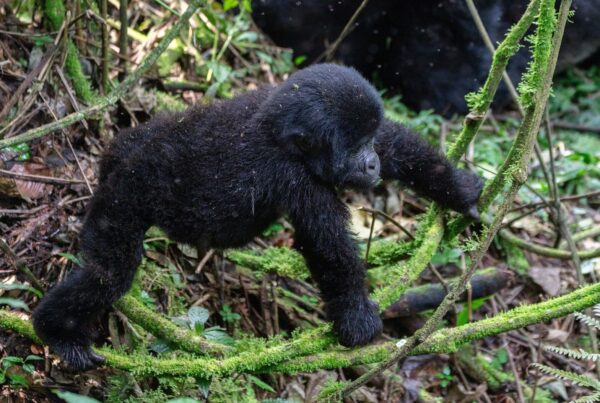
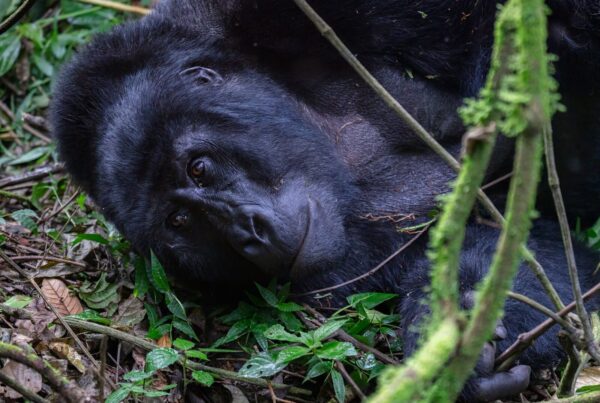
The relationship between mountain gorillas and the humans who protect them is, under normal circumstances, a managed distance. The seven-metre rule, the face masks, the controlled approach — these exist to maintain a boundary that protects the gorillas from human disease and maintains a wildness that is both ethically appropriate and practically necessary for long-term conservation. Occasionally circumstances produce exceptions to this distance. The case of the orphaned gorilla at the Ngamba Island Chimpanzee Sanctuary’s sister facility in Uganda — and the documented relationship between the juvenile and a specific care ranger over five years — is one such exception, and it raises questions about the nature of cross-species bonds that conservation managers continue to grapple with.
Gorilla Orphans and Conservation Centres
Mountain gorilla orphans are rare precisely because the conservation model that protects habituated groups is effective. The situations that produce orphaned gorillas — poaching, group disruption, sudden maternal death — are uncommon in Uganda’s protected areas. When they do occur, orphaned gorillas below the age at which they can survive independently require intensive care that cannot be provided by wild groups and must be handled by specialist conservation facilities.
The orphan in this account was found at approximately eight months of age near the boundary of Bwindi’s Buhoma sector — the circumstances of his separation from his family were unclear, though the absence of his mother was confirmed by UWA trackers who identified him as belonging to a habituated group and found no corresponding missing adult female in the monitoring records. He was malnourished and dehydrated when found and required immediate veterinary intervention.
The Care Programme
Mountain gorilla orphans in Uganda are managed under protocols developed by UWA and Gorilla Doctors in coordination with international conservation organisations. The protocol for an infant too young to be reintegrated into a wild group involves intensive daily care — feeding, health monitoring, social stimulation — provided by a small team of designated care rangers who are screened for health, trained in gorilla behaviour, and committed to extended periods of close contact with the animal.
The care ranger assigned to this juvenile was a UWA employee who had previously worked as a tracker in the Buhoma sector. His assignment to the care programme was initially for a three-month rotation. He remained for five years — by his own request and with UWA’s approval — because the bond that developed between him and the juvenile was assessed as beneficial to the juvenile’s psychological development and detrimental to disrupt.
The Bond
The bond was documented by researchers through behavioural observation and is described in conservation literature as a secure attachment in the psychological sense — the juvenile showed reduced stress indicators in the ranger’s presence, sought proximity to him during novel or threatening situations, and displayed the social confidence associated with secure attachment in the exploration of new environments. The ranger, by his own account, experienced the relationship as having the emotional qualities of a significant long-term relationship, while maintaining the professional awareness that the goal was always the juvenile’s eventual rehabilitation to a social group rather than dependency on a human.
The juvenile was eventually transferred to a facility working toward social group integration. The ranger returned to tracker work at Buhoma. The gorilla trekking permit costs $800. The rangers who make the system work carry commitments that are not fully captured by job descriptions. What this ranger gave, over five years in a care facility, is part of the same story.
Frequently Asked Questions
The global mountain gorilla population is approximately 1,100 individuals — one of the smallest populations of any great ape. They exist in two separate populations: one in the Virunga Massif spanning Uganda, Rwanda, and DRC; and one in Bwindi Impenetrable Forest (Uganda only). The population has grown from approximately 620 in the 1980s, largely due to tourism-funded conservation.
Uganda Wildlife Authority directs 20% of every gorilla permit fee to communities adjacent to Bwindi and Mgahinga. These funds pay for school construction, healthcare programmes, borehole maintenance, and community microfinance. Permit revenue also funds ranger salaries, anti-poaching patrols, and the research teams that monitor gorilla health daily.
The Batwa (also called Twa) are an indigenous forest people who lived inside Bwindi for thousands of years until it was gazetted as a national park in 1991. Conservation displaced them from their ancestral forest. Gorilla tourism revenue now funds Batwa cultural programmes and livelihoods. The Batwa Cultural Trail at Buhoma sector is run by the Batwa community and is one of the most authentic cultural experiences near Bwindi.
Mountain gorillas are classified as Endangered on the IUCN Red List — one step down from Critically Endangered, which they held until 2018. Their population has grown consistently since the 1980s, making them one of the few great ape populations increasing in number. This recovery is directly attributed to the conservation funding generated by gorilla tourism.
Uganda is home to the mountain gorilla (Gorilla beringei beringei), one of two subspecies of eastern gorilla. They live exclusively in the Virunga volcanic highlands (Uganda/Rwanda/DRC) and Bwindi Impenetrable Forest (Uganda only). Mountain gorillas are the only gorilla subspecies that cannot survive in captivity — every individual you can trek is a wild animal.