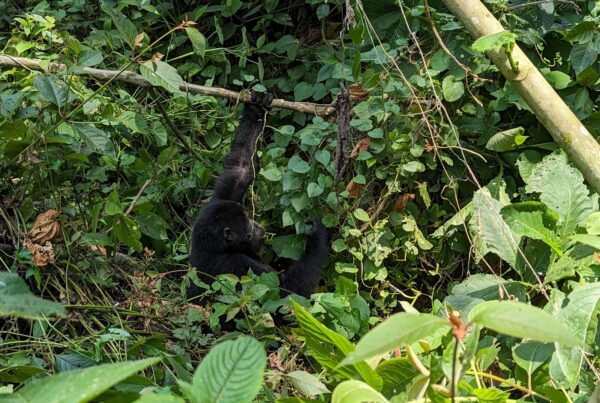
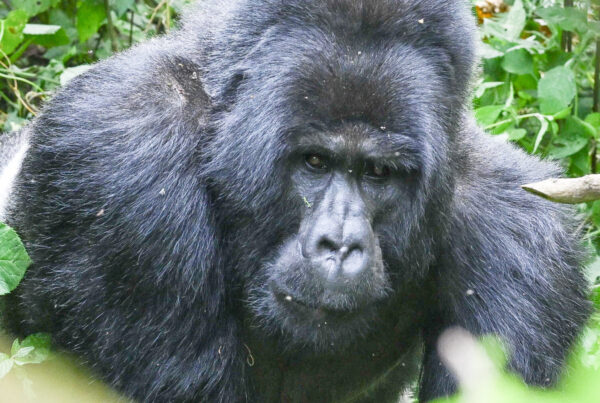
If gorilla trekking in Uganda is the world’s finest wildlife encounter, the only experience that comes close — and it does come genuinely close — is encountering wild orangutans in Borneo or Sumatra. Both are encounters with great apes in tropical forest. Both involve physical engagement (trekking to find the animal). Both offer the quality of mutual recognition between human observer and a primate with demonstrably complex social intelligence. And both have conservation dimensions that make the experience more than tourism. This post examines why orangutans are the closest competition to gorillas, what each offers that the other cannot, and which experience a traveller who can only do one should choose.
The Orangutan: What Makes the Encounter Special
Orangutans — Bornean and Sumatran — are the only great apes outside Africa. They are solitary rather than social: adult males are almost entirely alone except during mating encounters, and females travel with dependent offspring for the seven to eight years of infant development, one of the longest parental investment periods of any mammal. In the wild, orangutans are almost exclusively arboreal — the largest tree-dwelling mammals on earth. Encountering one in the forest canopy, watching it move through the trees with a combination of power and grace that no other animal achieves, is genuinely extraordinary.
The semi-habituated orangutans at rehabilitation centres like Sepilok in Sabah (Malaysian Borneo) can be observed at closer range and with greater predictability than truly wild individuals. Wild orangutan trekking in Tanjung Puting (Indonesian Borneo) or Gunung Leuser (Sumatra) offers the rarer, more challenging experience of encountering individuals in primary rainforest with far less certainty of a close encounter. The best wild orangutan experiences — a flanged male in full display, a mother with an infant that approaches the trail to investigate — are as emotionally powerful as anything wildlife travel offers.
Gorilla vs Orangutan: Key Differences
The fundamental difference between gorilla and orangutan encounters is the social context of the animal. Gorillas are deeply social — they live in family groups of 8 to 25 individuals, they groom each other, they play, they have relationships with specific individuals that are visible to observers over an hour’s watching. The encounter with a gorilla family is an encounter with a community. The social complexity is immediately legible.
Orangutans are solitary. A wild orangutan encounter is typically an encounter with a single individual, or a mother and one infant. The context is less immediately rich in social behaviour, though the intelligence visible in a single orangutan’s behaviour — the tool use, the problem-solving, the apparent evaluation of the observer — is as striking as anything gorillas display. The encounter is more intimate in the sense of being with one individual; less rich in the sense of missing the family drama that gorilla encounters provide.
Reliability of Encounter
Gorilla trekking in Uganda guarantees the encounter. The gorilla families are habituated, tracked daily, and within known ranges. Your guide knows approximately where they are each morning. The encounter is not uncertain. Wild orangutan encounters in Borneo or Sumatra are significantly less reliable — a full day of trekking in Tanjung Puting might yield a distant sighting, a brief encounter, or an extraordinary close approach depending entirely on where individual animals have decided to move. Semi-habituated orangutans at rehabilitation centres are more reliable but the encounter is less wild.
Conservation Context
Conservation Context
Mountain gorilla conservation is succeeding: populations growing, management effective, community benefit programmes functional. Orangutan conservation faces a significantly more difficult situation. Bornean orangutans have lost approximately 50 percent of their population in the last 60 years due to deforestation from palm oil agriculture, logging, and land conversion. Sumatran orangutans are critically endangered. The orangutan encounter carries a conservation urgency — “see them before habitat loss makes wild encounters impossible” — that gorilla trekking, with its success narrative, does not.
Which Should You Do?
If you can do both, do both — they are genuinely different experiences that complement each other. If you must choose: gorilla trekking offers the guaranteed encounter, the richer social context, the clearer conservation success narrative, and the physical engagement of the trek. The gorilla encounter has a higher floor and is more reliably extraordinary. The best orangutan encounters may have a comparable ceiling — but the ceiling is less reliably reached. For a single great ape experience in 2027, gorilla trekking in Uganda is the more reliable investment. Contact us to plan yours.
Frequently Asked Questions
Kibale Forest National Park, near Fort Portal, has the highest density of chimpanzees in Africa and is Uganda’s premier chimpanzee destination. The standard chimp trekking permit costs $300 FNR. The Chimpanzee Habituation Experience at Kibale ($400 FNR) gives 4 hours with a habituated community — Uganda’s only chimp habituation programme.
Yes — the gorilla + chimp combination is Uganda’s most popular primate itinerary. A typical 8-day route: Entebbe → Kibale Forest (2 nights, chimp trekking) → Queen Elizabeth National Park (2 nights, game drives) → Bwindi (2 nights, gorilla trekking) → Entebbe. Charter flights on any leg reduce travel time significantly.
Uganda has 13 primate species. Commonly seen: olive baboon, vervet monkey, red-tailed monkey, black-and-white colobus, L’Hoest’s monkey, grey-cheeked mangabey. Golden monkeys are found at Mgahinga. Kibale Forest has the highest primate diversity of any East African forest. A dedicated primate safari can tick 7–8 species in a single itinerary.
Uganda has over 1,060 recorded bird species — one of the highest counts of any country in Africa. Bwindi alone has 350+ species including 23 Albertine Rift endemics. Murchison Falls, Queen Elizabeth, and the wetlands around Entebbe round out a world-class birding circuit. The African green broadbill and Shelley’s crimsonwing are Bwindi specialities.
Uganda is home to the mountain gorilla (Gorilla beringei beringei), one of two subspecies of eastern gorilla. They live exclusively in the Virunga volcanic highlands (Uganda/Rwanda/DRC) and Bwindi Impenetrable Forest (Uganda only). Mountain gorillas are the only gorilla subspecies that cannot survive in captivity — every individual you can trek is a wild animal.