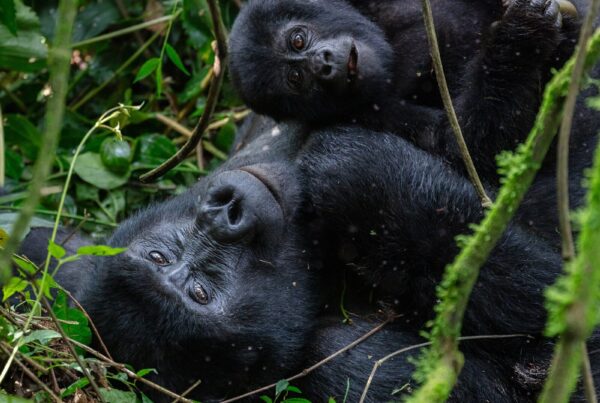
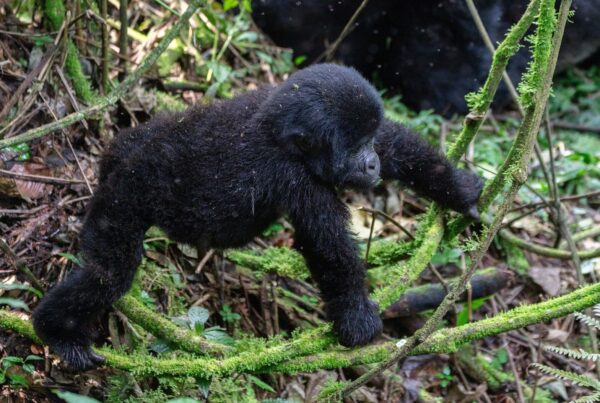
Physical confrontation between silverback mountain gorillas is genuinely rare — the elaborate system of chest-beating, bluff charges, and vocalisation that dominates gorilla social signalling exists precisely because it resolves dominance conflicts without the costs of direct combat. When a fight does occur between two dominant males — typically when separate gorilla groups encounter each other in overlapping range — the violence is brief, intense, and accompanied by sounds that witnesses describe as shaking the forest floor. Rangers always position trekking groups at a safe distance and manage these situations calmly. See the gorilla families overview for each family’s social structure and Bwindi’s management framework for how encounters are handled.
- Frequency: direct fights between silverbacks are rare — display behaviour resolves most disputes
- Trigger: typically two separate groups encountering each other in overlapping ranges
- Display sequence: chest-beating → branch breaking → bluff charges → direct contact (rare)
- Injury risk: adult males can inflict serious wounds — gorilla canines are formidable weapons
- Tourist safety: rangers position groups away from confrontations and can relocate quickly if needed
Physical confrontation between silverback mountain gorillas is rare. The elaborate system of display behaviour — chest beating, bluff charges, vocalisation, the breaking of vegetation — exists precisely to resolve dominance contests without the costs of direct fighting. When two silverbacks do make physical contact, however, the event is extraordinary in scale and intensity, and the accounts of the few trekking visitors who have witnessed such confrontations describe experiences that bear no resemblance to anything else available in wildlife tourism. This is a composite account drawn from documented incidents at Bwindi, describing what happens when the display fails and two silverbacks fight.
The Conditions That Produce Fights
Silverback confrontations that escalate to physical contact occur most often when a solitary or newly independent male attempts to steal a female from an established group. The established silverback’s motivation is absolute — he will defend his females with his life if necessary. The challenger’s motivation is equally powerful — female access is the entire purpose of his social existence. When the display phase fails to deter the challenger, or when the challenger is willing to accept the risks of direct contact, physical fighting follows.
The confrontation described by trekking visitors at Bwindi occurred at the boundary of two habituated groups’ ranges. A solitary silverback had been observed by trackers in the area for several days — his presence had been noted as a potential interaction risk by UWA rangers before the trekking group departed. This is standard procedure: trackers communicate the location of all gorillas in a sector each morning, and rangers accompanying trekking groups are aware of potential interaction scenarios before they arise.
The Display Phase
The trekking group — eight visitors, two guides, two rangers — encountered the habituated family in a clearing at the edge of the established group’s range. Within minutes of their arrival the family silverback became alert and began chest beating — a response that the guides immediately recognised as directed at something outside the trekking group’s field of view. Rangers moved the trekking group to higher ground for both safety and visibility.
The solitary silverback appeared at the clearing’s edge approximately fifteen minutes later. He was smaller than the family silverback but young — the compact musculature of a male in his physical prime rather than the settled bulk of a mature dominant. The two males faced each other across approximately twenty metres of clearing. The chest beating from both animals was audible, witnesses reported, at a volume that exceeded anything they had expected — a sound described as something between a bass drum and a physical impact, felt as much as heard.
The Fight
The charge from the challenger was fast — faster than most observers of gorilla footage expect from an animal of that size. The family silverback met it. The physical contact lasted approximately thirty seconds: biting, grappling, the specific targeted attack at the arms and face that characterises gorilla fighting. Both animals sustained wounds — the challenger received a deep bite to his right forearm that would be treated by Gorilla Doctors the following day; the family silverback received a laceration above his left eye.
The fight ended when the challenger disengaged and retreated into the forest. The family silverback stood for several minutes in the open, chest beating toward the retreated male. His family gradually reconvened around him. The trekking group, maintained at a safe distance by the rangers throughout, observed the entire sequence.
What Witnesses Reported
The accounts collected from trekkers present describe a consistent emotional response: awe combined with a physical response — elevated heart rate, shaking hands, involuntary vocalisation during the fight itself. Several described it as the most viscerally affecting wildlife experience of their lives. All described watching a family silverback defend his family with his body as something that shifted their understanding of gorilla social reality from abstract knowledge to direct experience. The gorilla permit costs $800. Most treks do not include this. Some do.
Why do silverbacks fight each other?
Silverback conflicts arise from competition over females and group leadership. When two gorilla groups encounter each other in overlapping ranges, the dominant males display aggressively — chest-beating, vocalising, charging — in a contest of perceived size and strength. Most of these encounters end without physical contact because one silverback reads the other’s displays as indicating a size and strength advantage he cannot overcome, and retreats. When the assessments are close — two silverbacks of similar size and condition — the contest can escalate to direct physical contact, with biting and grappling that can cause serious injuries to both animals.
What happens to gorilla families when silverbacks fight?
During a fight between silverbacks, the rest of each group typically retreats. Females move their infants away from the conflict zone, juveniles follow adults, and the group cohesion temporarily breaks down. After the confrontation, the winning silverback’s group typically remains intact. If females from the losing group choose to follow the victorious male — which does happen — group composition changes. In cases where the losing silverback is killed or severely incapacitated, infanticide can follow as the victorious male eliminates the previous male’s offspring to bring females back into reproductive cycle.
Are tourists at risk if two silverbacks fight near them?
No — rangers trained specifically for these situations manage them immediately. When groups encounter each other and confrontation begins, rangers move trekking groups away from the conflict to a safe observation point. Habituated gorillas do not target human observers during intra-species conflicts — the contest is between the gorillas. The danger is being too close to fast-moving large animals in a small space, which rangers prevent by relocating groups quickly. The experience of witnessing a silverback confrontation from a ranger-managed position is described by those who have seen it as one of the most dramatic wildlife events possible.
How do rangers respond when two gorilla groups encounter each other during a trek?
Rangers with tracking experience read the build-up to group encounters before they become confrontations — they know the ranges of each family and the current location of neighbouring groups. When two groups are moving toward each other, rangers can often steer the trekking group away from the likely encounter point. If an encounter is underway when the trekking group arrives, rangers position visitors at a safe distance — typically 30+ metres rather than the standard 7 — and watch how the situation develops. Radio communication between ranger teams means multiple groups are aware of what is happening across the forest simultaneously.
Can a silverback beat a human in a fight?
A silverback is estimated to be 6–10 times stronger than a physically fit adult human and weighs 160–200kg. The question is largely academic because gorilla trekking is designed so that this situation never arises — habituated gorillas do not attack human observers who follow ranger instructions, and rangers position groups so that visitor safety is never dependent on a gorilla choosing not to act. The relevant protocol is not how to resist a gorilla attack; it is how to behave so that no gorilla ever has reason to perceive you as a threat. Rangers brief every group on this before the trek begins.
- Game Drives in Kidepo Valley National Park: Into Uganda’s Wildest Frontier
- Blackback Gorilla Height: Standing Tall in the Shadows of Silverbacks
- Do All Gorillas Become Silverbacks?
- Is It Safe to Travel to Uganda? Safety Advice for Tourists
- What Languages Are Spoken in Uganda? Communication Tips for Tourists
- Uganda Visa and Entry Requirements for Tourists: Complete Guide
- Is Uganda Safe for Tourists in 2026? An Honest Travel Safety Guide
- How Uganda Competes with Rwanda for Gorilla Tourists: The Battle of Volcanoes
- How Many Tourists Visit Uganda Each Year for Gorillas? Tourism Statistics Explained
- Silverbacks Turn Grey at 11 to 13 Years Old: The Biology Explained