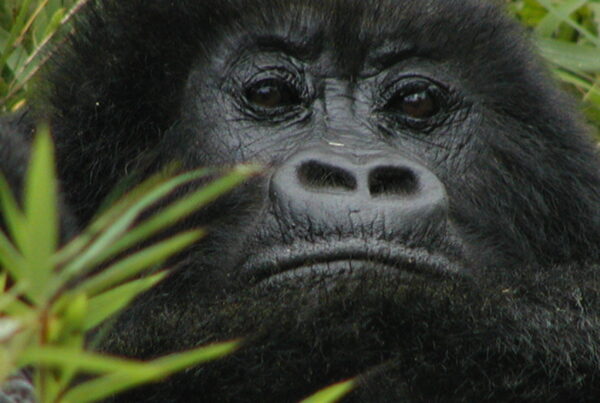
You have watched the videos. The silverback turning to face the camera. The infant tumbling through undergrowth. The family group going about their morning in the mist. The guide whispering commentary in a voice just above silence. You have watched them multiple times. They are extraordinary. They are also not what it is like to be there.
The gorilla video is a compression of the experience into its most visual and most shareable moments. It provides colour and movement and a sense of the scale of the animals. What it cannot provide is the smell of the forest — the wet earth and decaying vegetation and the specific animal smell of the gorillas themselves. It cannot provide the physical sensation of effort — the legs that are tired from the climb, the breath that is slightly laboured in the forest air. It cannot provide the silence that exists between the moments worth filming. And it cannot provide the response in your own body to the proximity of an animal that your nervous system recognises, at some level older than conscious thought, as kin.
The Gap Between Video and Reality
The gap between the gorilla video and the gorilla encounter is not a matter of quality. Even the best gorilla footage, shot on professional equipment and edited by skilled filmmakers, misses something essential. The camera flattens the three dimensions of the encounter into two. It compresses the hour into minutes. It selects the visual peaks and discards the quiet majority. It removes you from the experience and positions you as an observer of an observation — one further step from the thing itself.
Most gorilla trekking veterans describe the video watching, in retrospect, as having created expectations that the actual encounter then exceeded dramatically. Not because the videos were poor, but because the video-encoded expectation was still a video expectation — calibrated to screen experience rather than physical experience. The reality, when it arrived, was physically present in ways that screens cannot be.
How to Make the Transition From Watching to Going
The transition from gorilla video consumer to gorilla trekking participant requires one concrete action: contacting a licensed tour operator and asking for a quote. Not committing to a booking. Not paying anything. Simply making the contact that transforms “I would like to go” into “I know what going actually involves in specific, concrete terms.”
The information that a real quote provides — specific dates, specific costs, specific itinerary structure, specific permit availability — is qualitatively different from the information available through research and video watching. It makes the trip real rather than hypothetical. Most people who make the contact find that the trip is more accessible than the research phase suggested — that the logistics are manageable, the cost is within reach of a realistic saving plan, and the dates are available.
The Permit That Turns the Screen Off
The $800 Uganda gorilla permit in 2027 is the specific commitment that turns the screen off and turns the forest on. It is the decision point at which the video-watching phase ends and the going phase begins. Everything that follows — the flight, the drive, the trek, the hour with the gorillas — is the experience that the videos were trying and failing to convey.
The difference between watching and being there is the difference the permit purchases. Contact us today. The videos will still be there when you get back. They will look different.
Frequently Asked Questions
A versatile zoom lens in the 24–200mm range (or equivalent on crop sensor) works for most forest conditions. A fast lens (f/2.8) handles the low light under the forest canopy. Mirrorless cameras with fast autofocus track gorilla movement well. Flash is strictly prohibited. Bring a rain cover — the forest is damp year-round.
Set: Shutter priority at minimum 1/250s (to freeze movement), Auto ISO with a ceiling of 6400, continuous autofocus, burst mode. Shoot in RAW for post-processing flexibility. In the dense understorey, light is limited — prioritise shutter speed over aperture. Wide-angle shots require patience as gorillas occasionally approach very close.
UWA guidelines require a minimum 7-metre distance from gorillas at all times. In practice, gorillas regularly approach the human group on their own — rangers manage this by repositioning the group when needed. Most trekkers end up photographing gorillas at 3–10 metres. Infant gorillas sometimes approach even closer, which rangers discourage gently.
Yes — video cameras and smartphone video are permitted. Flash is the only restriction. A monopod is useful for steadier video in low light. If you plan serious video work (wildlife documentary standard), consider the Gorilla Habituation Experience ($1,800) which gives 4 hours to film natural behaviour in a smaller group of just 4 visitors.
Uganda is home to the mountain gorilla (Gorilla beringei beringei), one of two subspecies of eastern gorilla. They live exclusively in the Virunga volcanic highlands (Uganda/Rwanda/DRC) and Bwindi Impenetrable Forest (Uganda only). Mountain gorillas are the only gorilla subspecies that cannot survive in captivity — every individual you can trek is a wild animal.