Silverbacks turn grey at 11 to 13 years old, and the greying is not a gradual process of aging but a relatively rapid change that marks a specific developmental milestone — the transition from blackback to silverback status — that carries profound social meaning in gorilla family life. Understanding when and why gorillas develop their silver colouring, what the silver saddle signals to other gorillas, and how it changes the animal’s social position illuminates one of the most visually distinctive features of the species and one of the most important structural elements of mountain gorilla social organisation.
The Developmental Sequence
Male mountain gorillas go through several distinct developmental stages, each with a corresponding physical appearance and social status.
Infant (0-3 years)
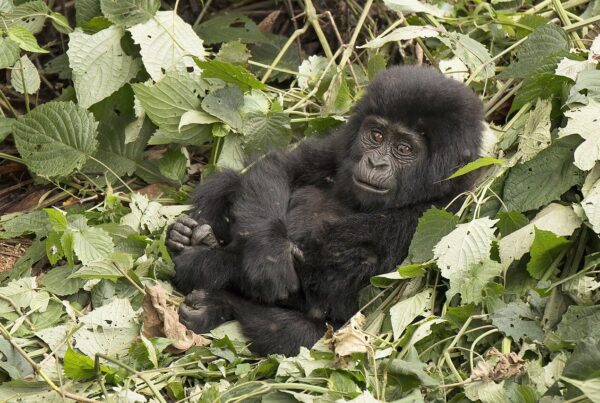
Infant males are indistinguishable from infant females by casual observation. Both have sparse, dark fur and the distinctive white or pale rump patch that marks young animals. The infant period is characterised by complete maternal dependence.
Juvenile and Sub-Adult (3-8 years)
After weaning at three to four years, males enter the juvenile period. They are physically active, socially exploratory, and beginning to develop the musculature that will eventually distinguish adult males from females. The fur is uniformly dark at this stage.
Blackback (8-12 years)
The blackback stage — named for the still-black back of the developing male — is characterised by significant increases in body size and musculature. Blackbacks are clearly distinguishable from adult females by their size and the developing broadness of their shoulders, but they have not yet developed the saddle of silver hair that characterises mature males. Social status during this period is subordinate to the dominant silverback.
Silverback (11-13+ years)
The silver colouring develops on the back — from the lower back to the hips and thighs — typically between 11 and 13 years of age, though there is individual variation. The greying is caused by a natural change in melanin production in the hair follicles of this specific area, and the rate of change from first visible silver to full silver saddle varies between individuals. The transition to full silverback status typically takes one to two years.
What the Silver Signals
The silver saddle is not decorative. It is a reliable signal of reproductive maturity and social status that is visible from a distance in the dense forest environment where gorillas live.
To Females
For adult females within or outside the group, the silver saddle signals reproductive maturity. Males with silver saddles are candidates for fatherhood and group leadership; blackbacks and juveniles are not. Female mate choice in mountain gorillas is influenced by silverback status — females that transfer between groups consistently move toward established silverbacks rather than blackbacks, even when blackbacks are physically larger than might be expected.
To Other Males
For other males, the silver signals that a male has reached the competitive social stage. A newly silvered male may challenge an existing silverback for group leadership or may leave to establish his own group — the two primary life history paths available to mature males. The silver is visible evidence of competitive standing.
To the Group
Within a family group, the silver saddle visually identifies the dominant male even at a distance or in dense vegetation. In a forest where visibility is often limited, a reliable distance-readable dominance signal is socially useful. The silver saddle functions, in this reading, like the colour signals of other species — a reliable honest indicator of status that is energetically costly to fake.
Multiple Silverbacks in One Group
Larger gorilla groups sometimes contain more than one silverback — a dominant male and one or more subordinate adult males who have not yet left to form independent groups. In these multi-male groups, the silverbacks can be distinguished by the extent and brightness of their silver saddles: the dominant male’s saddle is typically more extensive and brighter, while subordinate males may have less complete silvering that reflects their subordinate status.
The relationship between the dominant silverback and subordinate silverbacks in the same group is complex. Subordinates may assist in group defence, contribute to monitoring and early warning of threats, and have limited reproductive opportunities. In exchange, they benefit from the group’s collective protection and food resources. The relationship is one of conditional tolerance rather than egalitarian partnership.
Human Analogies and Cautions
The silver hair connection to status and age makes gorillas an irresistible target for human analogies. Grey-haired authority figures across many human cultures are described as silverbacks — the term has become a metaphor in business writing and popular culture. The analogy is imprecise but not meaningless: in both gorillas and humans, visible signs of age can correlate with increased social authority, though the mechanisms and degrees are very different.
The caution is the usual one about cross-species analogies: gorilla social authority is not primarily about wisdom, experience, or social skill, as age-authority in human societies often is. It is primarily about physical competitive capability. The silverback is dominant because he can win fights, not because he has accumulated social capital over decades. As he ages past his physical prime and younger males begin to challenge him, his authority depends increasingly on the social inertia of established relationships and decreasingly on physical dominance — which is perhaps where the analogy to human experience becomes more applicable.
Seeing the Silver in Bwindi
During a gorilla trek, the silver saddle of the dominant male is often the first clear identifying feature you will see from a distance. In the dappled light of the Bwindi forest, the silver stands out against the dark vegetation with a visual quality that is, in person, considerably more impressive than photographs suggest. The saddle is broader and brighter than static images convey — it is the visual anchor of the family group, the thing that organises the visual field and draws the eye to the most important individual in the clearing.
Uganda gorilla trekking permits are $800 per person. Contact Uganda Gorilla Trekking to book your permit. Look for the silver. It is the beginning of understanding what you are seeing.