Every great waterfall has a story that goes beyond the physics of water falling over rock. Niagara is a story about industrial power and honeymoon tourism. Victoria Falls is a story about colonial naming and the audacity of the Zambezi. Murchison Falls is something different — a story about the relationship between Africa’s most important river and a landscape that has survived everything that human history has thrown at it, including decades of war, the near-extinction of its wildlife, and now the pressures of oil development and climate change.
Murchison Falls sits in the far north of Uganda, where the Victoria Nile — the section of the Nile that flows between Lake Victoria and Lake Albert — squeezes through a seven-metre gap in the ancient basement rock of the Western Rift escarpment and drops forty-three metres in a roar of white water and spray that can be heard, on quiet mornings, from several kilometres away. It is, by the measure of water forced through a given opening, the most powerful waterfall in the world.
The River Above the Falls
The approach to Murchison Falls from the south — the route most visitors take, coming from Kampala and the Budongo Forest chimpanzee sector of the park — passes through savanna landscape that feels progressively more remote as Kampala recedes in memory. Murchison Falls National Park, Uganda’s largest at nearly 4,000 square kilometres, was the site of some of the worst wildlife losses during Uganda’s years of conflict. Elephant populations that numbered in the thousands were reduced to a few hundred individuals by ivory poachers during the Amin era and its aftermath. The hippo population, which had been among the largest on the Nile, was similarly devastated.
The recovery of Murchison’s wildlife over the past three decades is one of conservation’s better African stories. Elephant numbers have grown to over 1,500 individuals, hippos are again abundant along the Nile banks, and the lion population — which had been functionally extinct in the park by the 1990s — has recovered to viable numbers through natural recolonisation from neighbouring areas. The park is not what it was before the conflict years, but it is increasingly a functioning ecosystem rather than an empty landscape haunted by its former abundance.
The Nile Boat Safari
The standard approach to Murchison Falls for most visitors is by boat — a launch trip up the Victoria Nile from the jetty near Paraa Lodge to the base of the falls. This is one of the great wildlife boat experiences in East Africa, comparable to the famous Kazinga Channel boat safari in Queen Elizabeth National Park but with a different ecological character. The Nile banks in Murchison are lined with hippos, Nile crocodiles of impressive size, elephants that come to drink in the late afternoon, buffaloes, waterbuck, Uganda kob, and an extraordinary diversity of waterbirds.
The boat moves slowly, the animals are habituated to its passage, and the light on the Nile in the morning and late afternoon is photographic in ways that professional wildlife photographers consistently rate among the best in Uganda. The climax of the trip is the approach to the falls themselves — first heard, then felt as vibration in the water, then seen as a wall of white rising from the river ahead. The spray reaches the boat several hundred metres from the falls, cooling the air and coating surfaces with fine mist. Up close, the power of the water through the seven-metre gap is physically impressive in a way that photographs do not adequately convey.
The Falls’ Colonial History
The falls were named by Samuel Baker, the British explorer who became the first European to reach them in 1864. Baker named them after Sir Roderick Murchison, president of the Royal Geographical Society, in the same gesture of patronage that led African geographical features across the continent to carry the names of British administrators and geographers who had never seen them. The local name, Kabarega Falls — after Kabarega, the Bunyoro king who controlled the territory when Baker arrived — was used by Ugandans throughout the colonial period and was restored as the official name during the Amin era, before reverting to Murchison in later years.
The naming dispute is not merely symbolic. It encodes a real historical argument about whose presence in a landscape matters — the explorers who arrived, named things, and left, or the kingdoms and communities that had lived there for generations before exploration. Uganda’s national park still carries Baker’s tribute to Murchison, and the falls that bear that name were known by their Bunyoro name for centuries before Baker arrived. Both histories are real. The landscape holds them simultaneously without resolving the argument.
The Oil Development Question
Murchison Falls National Park sits adjacent to Uganda’s largest oil deposits, discovered in the Lake Albert basin in the 2000s and now the subject of major development infrastructure. The construction of the East African Crude Oil Pipeline — which will carry oil from the Albertine Rift basin through Tanzania to the Indian Ocean port of Tanga — passes through or near protected areas in Uganda, raising conservation concerns that have been the subject of significant international attention and pressure.
The tension between oil development and conservation in and around Murchison Falls is genuine and has no easy resolution. The oil represents economic development revenue that Uganda’s government considers essential for its development objectives. The park represents irreplaceable biodiversity and a wildlife tourism resource that generates significant long-term economic value. Managing both simultaneously is a challenge that Uganda shares with other African countries where resource extraction interests and conservation interests intersect in the same landscape.
The Top of the Falls
Less visited than the base but equally spectacular is the top of Murchison Falls, reached by a short walk from the falls viewpoint on the northern bank of the Nile. Standing at the top, looking down through the gap through which the river forces itself, creates a vertiginous sense of scale — the volume of water passing through this opening, the speed with which it moves, the drop to the churning pool below — that the boat trip from below only partially prepares you for. The surrounding vegetation at the top of the falls is different from the riverside savanna — moist, dense with spray-loving plants, cool even in the hottest part of the day.
The Night Drive Experience
Murchison Falls National Park offers some of Uganda’s best game drives, particularly along the northern bank of the Nile where savanna wildlife concentrates around the river. Lions are regularly seen in the Buligi triangle, and the combination of lions, elephants, giraffes (Rothschild’s giraffes — one of Africa’s most endangered subspecies — were reintroduced to Murchison and are now thriving), buffaloes, and abundant antelopes creates a classic savanna wildlife experience that complements the Nile boat safari rather than duplicating it.
Night drives in the park’s buffer zones produce different wildlife — nocturnal species invisible to daytime visitors including civets, genets, bushbabies, and occasionally leopards. The quality of night sky visible from Murchison’s remote savanna — away from any significant light pollution — is one of the darkest and most star-filled available anywhere near a major African tourism destination.
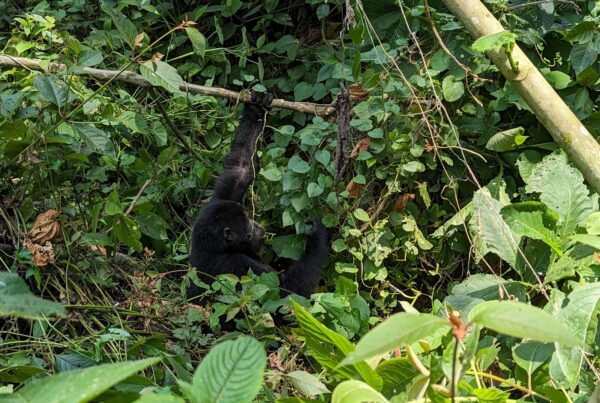
For visitors combining Murchison with gorilla trekking at Bwindi — the classic Uganda northern-southern circuit — the contrast between the two parks is one of the experiences’ great appeals. Bwindi is intimate, forested, and quiet; Murchison is vast, open, and dramatic. The gorilla experience requires patience and altitude; Murchison rewards long gazes across open water and savanna. Together they represent the full range of what Uganda offers — and what makes this landlocked country, against all expectations, one of the most extraordinary places on Earth to encounter wildlife.
Frequently Asked Questions
Uganda is home to the mountain gorilla (Gorilla beringei beringei), one of two subspecies of eastern gorilla. They live exclusively in the Virunga volcanic highlands (Uganda/Rwanda/DRC) and Bwindi Impenetrable Forest (Uganda only). Mountain gorillas are the only gorilla subspecies that cannot survive in captivity — every individual you can trek is a wild animal.
The standard gorilla trekking permit gives you exactly 1 hour with the gorilla family. This time begins when you make first contact with the family — the ranger signals the start. The Gorilla Habituation Experience gives 4 hours with a semi-wild family. The walk to find the gorillas can take 30 minutes to 5 hours depending on where the family has moved.
Stay calm, crouch down slowly, avoid direct eye contact, and remain quiet. Do not run — running triggers a chase response. Rangers accompanying your group manage close approaches. Habituated gorillas are accustomed to humans and almost never make contact, but a charging silverback is managed by staying still and following ranger instructions immediately.
A maximum of 8 visitors per habituated gorilla family per day for standard trekking. The Gorilla Habituation Experience has a maximum of 4 visitors per family per day. These limits are set by UWA to minimise stress on the gorilla families and maintain the quality of the experience.
Uganda is home to the mountain gorilla (Gorilla beringei beringei), one of two subspecies of eastern gorilla. They live exclusively in the Virunga volcanic highlands (Uganda/Rwanda/DRC) and Bwindi Impenetrable Forest (Uganda only). Mountain gorillas are the only gorilla subspecies that cannot survive in captivity — every individual you can trek is a wild animal.