Updated
gorillas mirror self-recognition test self-awareness cognition is a subject central to Uganda’s wildlife tourism, where mountain gorilla conservation and responsible visitor experiences go hand in hand. Gorillas can recognise themselves in mirrors — a cognitive ability that places them in an extremely select group of animals and that has significant implications for how we understand gorilla self-awareness, consciousness, and the evolutionary origins of the human capacity for self-reflection. The mirror self-recognition test, developed by psychologist Gordon Gallup Jr. in 1970, is one of the most widely used indicators of self-awareness in animal cognition research, and the evidence for gorilla performance on this test — while more complex and controversial than the headline “gorillas pass the mirror test” suggests — reveals genuine insights about primate cognition that are directly relevant to the experience of a gorilla encounter in Bwindi.
Gorillas Can Recognise Themselves in Mirrors: A Rare Animal Ability
The Mirror Test: What It Is and What It Shows
The mirror self-recognition (MSR) test involves presenting an animal with a mirror and observing whether it responds to the reflection as if it were a different animal (social behaviour: approaching, threatening, vocalising at the reflection) or as if it recognises the reflection as itself (self-directed behaviour: using the mirror to inspect its own body, particularly areas not normally visible).
A modified version of the test — the “mark test” — involves placing a distinctive mark on the animal’s body in a location that can only be seen in a mirror, under anaesthesia so the animal does not notice the placement. Animals that subsequently inspect or attempt to remove the mark while looking in the mirror are classified as recognising themselves.
Passing the MSR test is considered evidence of a certain level of self-awareness — the capacity to form a concept of “self” as distinct from “other” — that is theoretically linked to other cognitive capacities including self-reflection, empathy, and perspective-taking.
The Evidence for Gorillas
The evidence for gorilla MSR is more nuanced than for chimpanzees or orangutans, and this nuance is itself instructive. Initial studies using the mark test produced mixed results with gorillas: some individuals showed self-directed behaviour, others did not, and the performance was less consistent than studies with chimpanzees had found. This inconsistency led to early conclusions that gorillas might lack the self-recognition capacity found in other great apes.
The Complication: Social Signals
Later research identified a methodological issue: gorillas are highly sensitive to the social signals transmitted by direct eye contact, and a mirror presents what looks, from the outside, like an ongoing act of direct eye contact with an unknown individual. For an animal for whom direct eye contact is a potential challenge signal, spending extended time in front of a mirror may be socially aversive — not because the gorilla does not recognise itself, but because the social signal of the reflection makes mirror engagement uncomfortable.
When researchers modified the testing conditions to reduce the social-signal problem — using smaller mirrors that showed only part of the body, placing mirrors at angles that reduced the eye contact impression — gorilla self-directed behaviour increased significantly. Individual gorillas have been documented using mirrors to inspect their teeth, examine areas of skin not normally visible, and manipulate their faces in ways consistent with self-recognition.
What This Means
The gorilla MSR results, properly interpreted, suggest that gorillas have self-recognition capacity but that the expression of that capacity in the mirror test context is modulated by their social cognition — specifically, by the powerful social meaning they assign to eye contact. They are not “failing” the test; they are showing a different response to its conditions than chimpanzees, for reasons related to gorilla social cognition rather than limited self-awareness.
Self-Awareness Beyond the Mirror Test
The MSR test is one indicator of self-awareness, but not the only one. Other evidence for gorilla self-awareness includes:
Body Awareness
Gorillas in captivity have been observed using tools to manage their own physical condition — using sticks to probe wounds, using objects to avoid touching wet surfaces, using mirrors to examine their faces and teeth. These behaviours imply a sense of bodily self that is distinct from simple reflex.
Social Self-Concept
Gorillas in complex social situations behave in ways consistent with having a social self-concept — a sense of their own position within the group hierarchy and the effect of their actions on others. The strategic social behaviour of high-ranking gorillas — managing relationships, forming alliances, mediating conflicts — implies a capacity for perspective-taking that is at least functionally similar to human social intelligence.
Why This Matters for the Gorilla Encounter
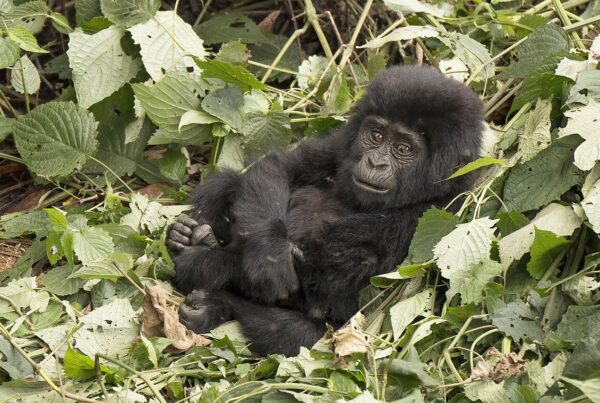
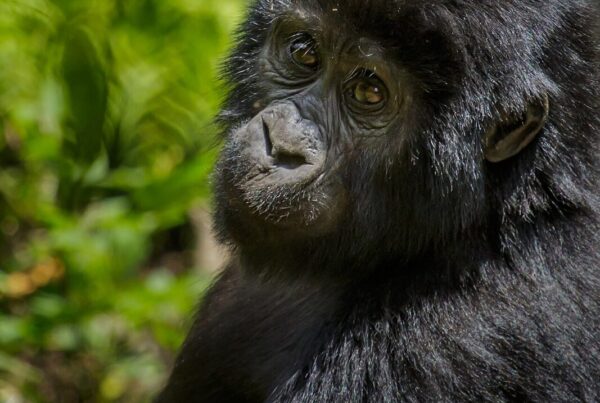
The mirror self-recognition evidence is one piece of the broader picture of gorilla cognition that makes the trekking encounter so specifically profound. When a gorilla looks at you during an hour in Bwindi, you are not being processed by a reflex system or a simple stimulus-response machine. You are being looked at by something with a self-concept — something that has an “I” that is looking at a “you.”
The nature of that “I” — whether it involves phenomenal consciousness, whether there is “something it is like” to be a gorilla looking at a human — cannot be established by any currently available scientific method. But the behavioural evidence for a rich inner life is substantial, and the mirror test results are part of that evidence.
Planning Your Visit
Uganda gorilla trekking permits are $800 per person. Contact Uganda Gorilla Trekking to book your permit. When a gorilla looks at you in Bwindi, look back. Something is there, looking. The mirror test says so.