The Reality of Gorilla Behaviour Toward Humans
Mountain gorillas have a reputation in popular culture that does not match the experience of the thousands of people who visit habituated families every year in Uganda, Rwanda, and DRC. Films, historical accounts, and generalised fear of large primates have created an impression of gorillas as dangerous, aggressive animals. The reality — carefully established through decades of research and tourism management — is considerably more nuanced and considerably less alarming than the popular image suggests.
Habituated vs Non-Habituated Gorillas
The distinction between habituated and non-habituated gorillas is fundamental to any discussion of gorilla danger. Habituated mountain gorilla families have undergone years of careful conditioning to human presence, during which researchers spent months gradually approaching the group, behaving non-threateningly, and demonstrating through consistent peaceful behaviour that humans are not a threat. This process — which takes 2 to 5 years per family and requires highly trained researchers — produces groups where gorillas have largely neutralised their fear and threat responses to human presence at appropriate distances.
Non-habituated gorillas, by contrast, respond to humans as to any potential threat: with alarm, avoidance, or in some cases threat displays and charges. Encounters with non-habituated gorillas in the forest are unpredictable and should be treated as encounters with wild, potentially dangerous animals. Fortunately, non-habituated gorillas in areas with human activity typically retreat from human presence rather than advancing.
Silverback Charges: Display vs Attack
The most common source of gorilla-related alarm for trekking visitors is the mock charge — a display behaviour in which a silverback charges toward perceived threats at speed, often stopping short of contact or deflecting to the side. This charge is a communication, not an attack: it signals displeasure, asserts dominance, and tests the threat level of an intruder. A silverback that charges and stops, beats his chest, and then returns to his group has communicated that you are too close, too loud, or too behaviourally alarming — and has decided you are not a sufficient threat to warrant actual contact.
Trekking guides train visitors to respond to mock charges by crouching low, avoiding eye contact, and remaining still — behaviours that signal submission and non-threat in gorilla communication. A crouching, still human presents no competitive challenge to a silverback and the charge typically ends. The guides’ calm, experienced management of these situations is one of the primary safety factors in gorilla trekking: their ability to read gorilla behaviour and direct visitor response in the critical moments of an interaction determines whether a display remains a display or escalates.
Documented Incidents
Injuries from habituated gorilla encounters are extremely rare given the volume of visits — several thousand annually across all trekking programmes — but they are not nonexistent. The most common injuries involve gorillas making physical contact with visitors during displays: a shove, a bite to a limb, or a knock from a passing silverback in full display charge. These contacts are typically brief and do not reflect predatory or sustained aggressive intent — they are the incidental consequences of a large, fast animal moving through space at close range.
Fatalities from gorilla trekking encounters are essentially unknown in the modern, professionally managed trekking programmes in Uganda and Rwanda. Historical accounts of gorilla killings are almost entirely from the pre-habituation era, when encounters with non-habituated gorillas were unpredictable and often involved hunters or researchers who provoked defensive responses.
Rules That Keep You Safe
The safety record of gorilla trekking is not accidental — it is the product of carefully designed protocols that manage risk at every stage of the encounter. The seven-metre minimum distance reduces both disease transmission risk and the likelihood of gorillas feeling threatened by close human proximity. The one-hour visit limit prevents habituation fatigue and reduces cumulative stress on the gorilla families. The maximum eight visitors per visit limits the sensory overload of a large human group and keeps visitor behaviour manageable for guides.
Health screening before visits — visitors with respiratory illness are asked not to trek — protects gorillas from disease while also removing individuals who may be physically less able to manage the physically demanding trek. Masking in some parks adds a disease barrier that also reduces the visible human face, which can reduce stress responses in gorillas familiar with masked rangers but less accustomed to the variety of human faces they encounter during tourism.
What Gorillas Actually Think of You
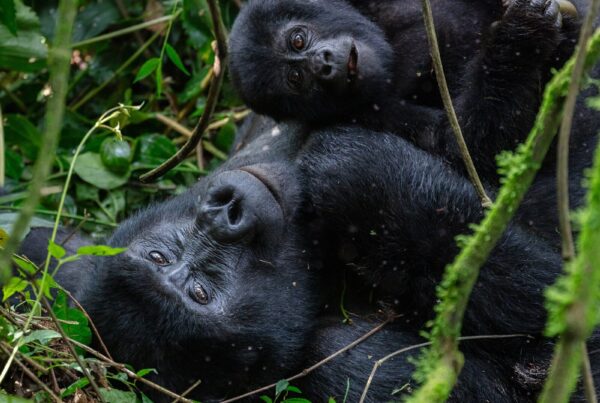
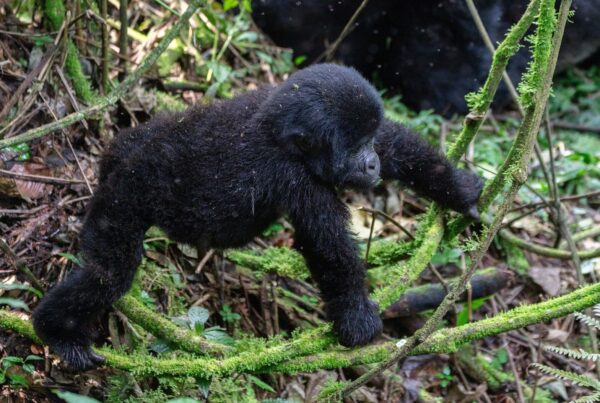
Habituated mountain gorillas in Bwindi and the Virungas are accustomed to small groups of quiet, stationary humans arriving in their vicinity, observing for approximately an hour, and departing. Most habituated families respond to this pattern with what field researchers describe as benign tolerance: they continue feeding, socialising, and resting, occasionally glancing at the visitor group before returning to their activities. Young gorillas may approach from curiosity, requiring guides to gently redirect them. Silverbacks may assess the group with a direct gaze before demonstrating their indifference by continuing to eat.
This is not tame behaviour — these are wild animals responding within their evolved behavioural repertoire to a stimulus (small groups of non-threatening humans) that their experience has classified as non-dangerous. The calm of the encounter reflects the success of the habituation process and the discipline of visitors and guides in maintaining behaviour that the gorillas’ experience categorises as safe.
Final Thoughts
Mountain gorillas are powerful wild animals capable of serious injury if provoked or threatened. They are also, in the context of a properly managed trekking encounter, among the most peaceful and rewarding wildlife experiences available anywhere on Earth. The safety record of gorilla trekking in Uganda over 30 years of managed tourism is a testament to the combination of gorilla intelligence, thorough habituation, expert guiding, and well-designed protocols. Visit with respect, follow guide instructions, and you will encounter animals that are far less dangerous, and far more remarkable, than popular imagination suggests.