Updated
Mountain Gorilla Diet: What Do Gorillas Eat in Bwindi?
The Gorilla’s Vegetarian Feast
Mountain gorillas are primarily herbivores, and their diet is one of the most studied aspects of their ecology. In Bwindi Impenetrable National Park, researchers have catalogued over 100 plant species in the gorilla diet, reflecting the extraordinary botanical diversity of this ancient forest. Understanding what gorillas eat — and why — reveals a sophisticated relationship between these animals and their environment that has taken millions of years to develop.
The Core Staples: Leaves and Stems
The foundation of the mountain gorilla diet is foliage — leaves, stems, and shoots of herbaceous plants, trees, and shrubs. In Bwindi, key dietary staples include the leaves and stems of plants from the families Acanthaceae, Urticaceae, and various forest floor herbs. Wild celery (Peucedanum linderi), a plant that thrives in the forest understorey and along stream margins, is among the most consistently consumed species across all habituated groups.
Stems and piths form a significant portion of the diet, particularly during seasons when other foods are less abundant. Gorillas use their powerful jaws and dextrous hands to strip bark from certain tree species and extract the nutritious cambium layer beneath — behaviour that leaves characteristic marks on forest trees that researchers use to identify gorilla presence and habitat use.
Bamboo: A Seasonal Delicacy
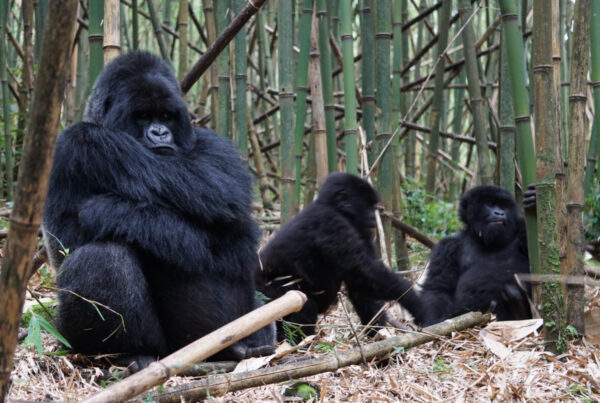
In areas where bamboo occurs within gorilla home ranges, bamboo shoots represent a highly valued seasonal food. Young bamboo shoots are extremely nutritious — high in protein relative to most foliage — and gorillas actively seek them out during the brief annual period when new shoots emerge. The gorillas’ preference for bamboo shoots when available demonstrates their capacity for selective, opportunistic foraging that prioritises the most nutritionally dense foods available at any given time.
Fruit: A Nutritional Supplement
Mountain gorillas consume fruit when available, though it constitutes a smaller proportion of their diet than in western lowland gorillas or chimpanzees. Figs are among the most sought-after fruit species — Ficus trees in Bwindi regularly attract gorilla groups when fruiting, and groups may travel considerable distances to access productive fig trees. The appeal of fig fruit lies partly in its high sugar and calorie content, which provides energy that complements the lower-calorie but bulk foliage that makes up most meals.
The relatively low fruit consumption in mountain gorillas (compared to western lowland gorillas, where fruit can constitute 25 to 30% of the diet) reflects the ecology of montane forest. Fruit is less abundant and less reliably distributed at high altitudes than in lowland tropical forest. Mountain gorillas have evolved a dietary strategy less dependent on fruit availability, giving them greater dietary flexibility and resilience than more fruit-dependent great apes.
Protein Sources: Insects and Occasional Finds
Mountain gorillas occasionally consume invertebrates — particularly ants, termites, and caterpillars — when encountered while foraging through vegetation. These items are not deliberately sought through the sustained tool-use techniques seen in chimpanzees, but are consumed opportunistically when found on plant material being processed for foliage. The protein contribution of insect consumption is likely small but nutritionally valuable, particularly for growing juveniles and lactating females with elevated protein requirements.
Gorillas also consume soil and decaying wood from time to time — behaviours described as geophagy (soil eating) and xylophagy (wood eating). These behaviours are thought to provide minerals, particularly calcium and sodium, that may be limiting in the gorilla’s predominantly plant-based diet. Salt licks in African forests are well documented for many herbivores, and mountain gorillas’ mineral-seeking behaviour represents an equivalent strategy adapted to a forest environment.
Daily Feeding Patterns
Mountain gorillas spend approximately six to eight hours per day foraging and feeding — a substantial portion of their waking hours. The daily routine typically involves an initial morning feeding period following nest departure, a midday rest period when the group sunbathes, grooms, and socialises, and an afternoon feeding period before the group moves to construct night nests. This bimodal feeding pattern maximises food intake while allowing time for the social interactions that maintain group cohesion.
The silverback leads the group’s daily movement between food patches, drawing on his knowledge of the home range to navigate efficiently between productive areas. His foraging decisions involve trade-offs between distance to food, food quality, and the overall nutritional state of the group — a process of dynamic environmental assessment that researchers have studied as a model of optimal foraging behaviour in great apes.
Nutritional Requirements
Adult male mountain gorillas require approximately 18,000 to 20,000 kilocalories per day — a massive energy budget that their bulk herbivore strategy meets through sheer volume of food intake. To consume enough low-calorie foliage to meet this requirement, a silverback may process 25 to 30 kilograms of plant material daily. Their large hindgut and specialised gut microbiome ferment the cellulose-rich vegetation, extracting energy through microbial fermentation in a process somewhat analogous to ruminant digestion.
This high intake, combined with the relatively poor caloric density of much of their diet, is why gorillas spend so much of their day eating. Unlike predators who consume large, high-calorie prey items and can then rest for extended periods, gorillas must eat almost continuously during their active hours to maintain energy balance. The result is an animal that is simultaneously one of the most time-constrained foragers and one of the most selective — constantly choosing between available food items based on nutritional return.
Diet and Conservation
Understanding gorilla diet informs conservation planning in practical ways. Habitat management decisions that affect plant community composition directly affect food availability. Invasive species that displace preferred food plants reduce habitat quality even within technically protected areas. Seasonal variation in food availability influences gorilla movement patterns and their likelihood of exiting park boundaries to forage in adjacent farmland — a source of human-wildlife conflict that community engagement programmes work to manage.
Climate change projections that model shifts in plant community composition at high altitudes are assessed partly through the lens of their effects on gorilla food availability. Plants that gorillas currently depend on as dietary staples may shift their distribution ranges in response to changing temperatures and rainfall — a cascading effect that requires proactive management responses to ensure food security for a species that cannot simply relocate to a new habitat.
Final Thoughts
The mountain gorilla’s diet is a reflection of its environment — diverse, plant-rich, and calibrated to the specific botanical community of Bwindi’s ancient forest. Watching a gorilla family feed in Bwindi, moving methodically through a patch of forest herbs or reaching deliberately for a favourite stem, you are watching an animal that knows exactly what it is looking for and why. This intimate knowledge of the food landscape is part of what makes mountain gorilla ecology so extraordinary and their protection so essential.