Updated
Mgahinga Gorilla National Park is Uganda’s smallest national park, just 34 square kilometres in the far south-west, where Uganda meets Rwanda and DR Congo. It covers the Ugandan slopes of three extinct Virunga volcanoes, Muhabura, Gahinga and Sabyinyo, and offers gorilla trekking with one habituated family, golden monkey tracking, volcano climbs and the Batwa Trail. Here is what to expect and how to plan a visit.
Where it is and how to get there
The park lies about 14 km from Kisoro town, which has a small airstrip with scheduled flights from Entebbe; see our guide to Kisoro. By road, Kisoro is around 9 to 10 hours from Kampala, or roughly 3 hours from Kigali via the Cyanika border, which makes Mgahinga popular with travellers flying into Rwanda. Mgahinga was gazetted as a national park in 1991 and is part of the wider Virunga Conservation Area shared with Rwanda’s Volcanoes National Park and DR Congo’s Virunga National Park.
Gorilla trekking in Mgahinga
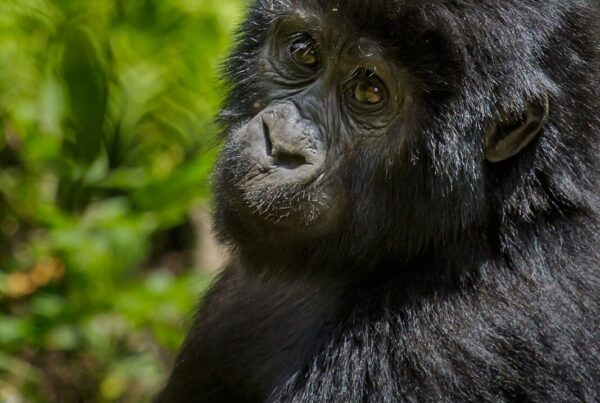
Mgahinga has one habituated gorilla family, the Nyakagezi group, so only eight permits are sold each day. The gorilla permit costs US$800, or US$600 in April, May and November. Treks start at Ntebeko gate and climb through farmland and bamboo forest on the lower slopes of the volcanoes. The family has in the past moved across the border for long periods, though it has stayed in Uganda in recent years. If you cannot get a Mgahinga permit, Bwindi’s southern sectors are close by; read Bwindi vs Mgahinga.
Golden monkeys
Mgahinga is the only place in Uganda to track the endangered golden monkey, a bamboo specialist found only in the Virunga region. Tracking is easier than a gorilla trek, usually a few hours through bamboo near the park gate, and you spend an hour with a habituated troop, which is lively and great for photography. Read more about the golden monkeys of Mgahinga, or see a 3-day gorilla and golden monkey trip.
Volcano hikes
Each of the three volcanoes can be climbed in a long day with a ranger. Mount Gahinga (3,474 m) is the shortest climb and has a swampy crater at the top. Mount Sabyinyo (3,669 m) is the most dramatic, with ladders on the final ridges and a summit where Uganda, Rwanda and DR Congo meet. Muhabura (4,127 m) is the highest and hardest, a full day’s climb to a small crater lake with views across the Virungas. Good fitness and warm, waterproof clothing are essential.
The Batwa Trail
The Batwa, forest hunter-gatherers, lived in this area before it became a national park and lost access to the forest when it was gazetted. On the Batwa Trail, Batwa guides show how their communities hunted, gathered plants and honey, and lived in the forest, ending at Garama Cave, once a refuge. Fees support the community; see the Batwa trail experience.
When to go and where to stay
Mgahinga can be visited all year; the drier months of June to September and December to February make volcano climbs easier, and permits sell out first then. There are a few lodges and community camps near the park gate, and more choice in Kisoro and around nearby Lake Mutanda; see Lake Mutanda. Many visitors combine Mgahinga with a gorilla trek in Bwindi’s Rushaga or Nkuringo sectors.
Frequently asked questions
One habituated family, the Nyakagezi group, so only eight gorilla permits are available each day.
Yes. Mgahinga is the only place in Uganda to track the endangered golden monkey.
Gahinga (3,474 m), Sabyinyo (3,669 m) and Muhabura (4,127 m), each as a long day hike with a ranger.
About three hours by road via the Cyanika border crossing to Kisoro, then a short drive to the park.