Bwindi’s Birding and Gorilla Hub
Ruhija sector in the northeastern portion of Bwindi Impenetrable National Park is the sector that most appeals to visitors who combine gorilla trekking with serious wildlife interest beyond the gorillas themselves. Ruhija sits at higher elevation than Buhoma, in the zone of high montane forest that is the stronghold for Bwindi’s most sought-after Albertine Rift endemic birds. It is also less visited than Buhoma and more intimate in atmosphere — a smaller community, fewer tourists, and a quieter forest that some visitors prefer to the more developed tourism environment of the main Buhoma hub.
Location and Access
Ruhija is located in the northeast of Bwindi, approximately 26 kilometres from the town of Kabale on a road that climbs through tea estates and highland forest to an elevation of around 2,350 metres — making it the highest of Bwindi’s four sector headquarters. From Kampala, the route follows the Kampala-Mbarara-Kabale highway before turning south toward Bwindi. Kihihi airstrip, approximately 50 kilometres from Ruhija, is the nearest landing option for those flying in.
The road to Ruhija from Kabale is partially dirt road and can be slow in wet conditions, but the drive through highland tea country and montane forest is scenic. The approach from Kabale town takes approximately 1 to 1.5 hours depending on road conditions. Several itineraries combine Ruhija with Lake Bunyonyi (approximately 35 kilometres from Ruhija via Kabale) to create a southwestern Uganda trip that includes gorilla trekking, birding, and lake recreation.
Gorilla Families in Ruhija
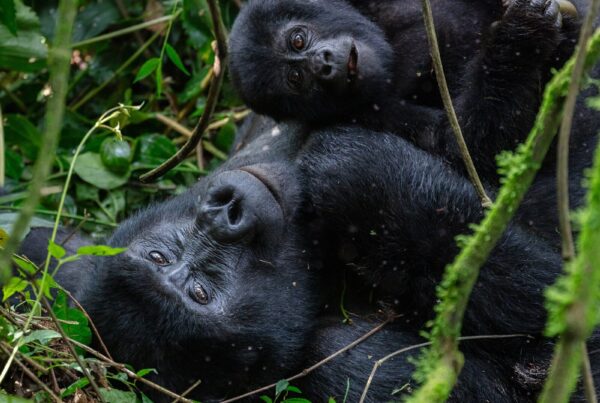
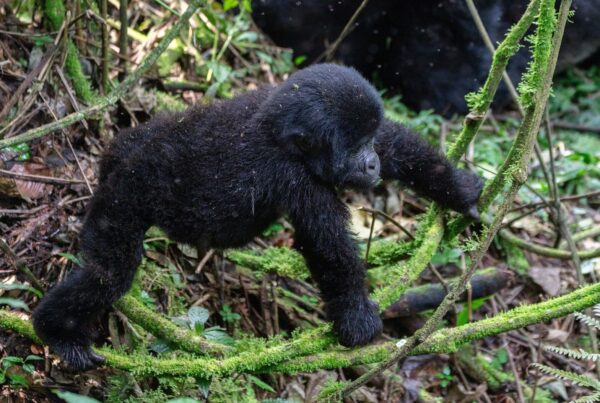
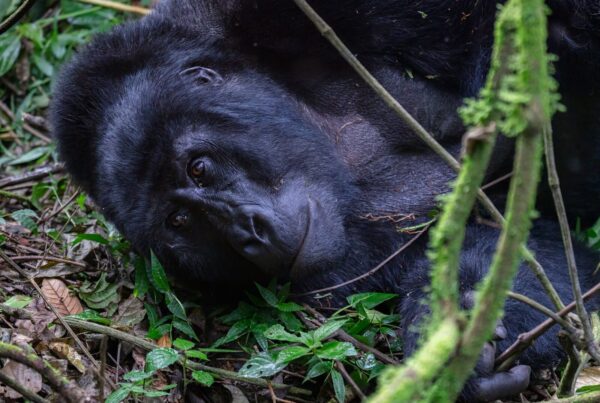
Ruhija sector has several habituated gorilla families including the Oruzogo group, the Mukiza group, and the Bitukura group — the latter known for periods of particularly settled, accessible behaviour that has made it popular with wildlife photographers. Ruhija families generally occupy forest at higher elevations than Buhoma families, which contributes both to the sector’s birding quality (more altitude-restricted endemic birds in the high forest zone) and to the character of the gorilla encounters, which occur in the atmospheric, moss-heavy montane forest of the upper Bwindi zone.
Trek times in Ruhija are similar to other sectors — typically 1 to 3 hours each way, though some families are regularly encountered closer to the trailhead. The terrain is steep in places, as the sector’s high elevation means that many family home ranges involve significant vertical movement. Physical preparation is advisable for Ruhija treks, and porter engagement is available and recommended.
Birding at Ruhija
Ruhija’s status as one of East Africa’s premier birdwatching destinations is well-established in the birding community. The high montane forest zone around the sector headquarters supports a remarkable concentration of Albertine Rift endemic birds — species whose global range is restricted to the highland forest of the Albertine Rift and which are found nowhere else on Earth. The combination of altitude, forest type, and forest quality at Ruhija creates conditions where many of these species are encountered more reliably than anywhere else in Uganda.
Key species to look for at Ruhija include the African green broadbill — considered the jewel of Bwindi’s endemic birds, a tiny, jewel-green insectivore with a cobalt beak — as well as Grauer’s warbler, Chapin’s flycatcher, Shelley’s crimsonwing, Rwenzori nightjar, Kivu ground thrush, and numerous other Albertine Rift endemics. These birds are best seen on early-morning walks in the forest around the sector headquarters or on guided birding walks offered by UWA rangers and specialist birding guides.
The possibility of combining a morning gorilla trek with an afternoon birding walk in the same high montane forest is one of Ruhija’s most compelling attractions for wildlife-oriented visitors. Few places in the world offer the opportunity to spend a morning with mountain gorillas and an afternoon searching for endemic birds whose world distribution is measured in square kilometres — but Ruhija does.
The Community at Ruhija
The community at Ruhija is smaller and less tourism-developed than the Buhoma community, reflecting the sector’s lower visitor numbers. Community tourism activities available in Ruhija include guided village walks, interactions with local craftspeople, and forest edge walks that explore the community-forest boundary. The lower visitor pressure compared to Buhoma means a quieter, less commercialised community interaction that some visitors find more authentic than the more developed community tourism products of the larger sectors.
Several community groups operate around Ruhija that benefit from gorilla trekking revenue, including women’s craft cooperatives and community conservation programmes that engage local schools in biodiversity education. The revenue sharing from gorilla permits goes to community development projects in Ruhija as in all Bwindi sectors, supporting infrastructure and services in a community that has relatively limited alternative economic development compared to more urbanised parts of Uganda.
Where to Stay in Ruhija
Accommodation options at Ruhija are more limited than in Buhoma or Rushaga, reflecting the sector’s smaller scale. Ruhija Gorilla Friends Resort and several other properties offer accommodation at the forest edge at mid-range price points. The accommodation at Ruhija is generally less luxurious than the best Buhoma properties, but the forest setting, the birding immediately outside the lodge grounds, and the quieter atmosphere compensate for the simpler facilities.
Some visitors to Ruhija choose to stay in Kabale town (approximately 26 kilometres away) where a wider range of hotels and services is available, and drive to Ruhija for the trek and birding. The larger, more developed Lake Bunyonyi resort area is also within reasonable distance for those who want lake accommodation as a base for Ruhija day trips.
Planning a Ruhija Visit
Ruhija gorilla permits are generally easier to obtain on shorter notice than Buhoma permits, reflecting the sector’s lower visitor numbers. This makes Ruhija an excellent option for visitors whose travel timing is less certain or who have been unable to secure Buhoma permits for their preferred dates. The quality of the gorilla encounter is the same; only the volume of other tourists differs.
For birders, timing a Ruhija visit for the early morning hours — arriving the evening before to be in position at first light — maximises birding opportunities in the hours before the gorilla trek briefing begins. Specialist birding guides can be arranged through accommodation properties or through UWA advance booking, and their knowledge of specific bird locations and behaviour significantly improves the chance of seeing the most sought-after species.
Final Thoughts
Ruhija sector offers a Bwindi experience that is quieter, more naturalist-oriented, and more altitude-rich than the more visited alternatives. For visitors who combine gorilla trekking with serious interest in the natural world — birds, mammals, forest ecology — Ruhija provides a depth of wildlife experience that the mainstream Buhoma experience does not quite match. In the high montane forest where the endemic birds sing and mountain gorillas feed on altitude-restricted vegetation, Ruhija feels like one of the more special places in a continent of special places.
Frequently Asked Questions
Bwindi has four gorilla trekking sectors: Buhoma (north — most established, best infrastructure), Ruhija (east — highest altitude, cooler), Rushaga (south — most gorilla families, home of the GHEX), and Nkuringo (southwest — most dramatic scenery, most challenging terrain).
Buhoma is generally recommended for first-timers: it has the widest range of lodge accommodation, the most established trekking infrastructure, and moderate terrain. Rushaga is best if you want the Gorilla Habituation Experience. Nkuringo offers the most dramatic views but the steepest descent. Ruhija is quieter and sits at the highest altitude.
You cannot choose a specific family, but you can specify a sector when booking your permit. UWA assigns you to a habituated family within your chosen sector each morning at the briefing. Rangers track the family’s overnight position before your group departs, so by the time you enter the forest, the family’s location is known.
Bwindi is approximately 480–530km from Kampala depending on the sector — roughly 8–9 hours by road. Charter flights from Entebbe to Kihihi Airstrip (for Buhoma/Ruhija) or Kisoro Airstrip (for Rushaga/Nkuringo/Mgahinga) take 50–60 minutes and cost $250–$350 per person on shared charters.
Bwindi currently has over 20 habituated gorilla families spread across its four sectors, making it the most gorilla-dense trekking destination in the world. Rushaga sector alone has more than 6 habituated families. New families are periodically added to the habituation programme as the gorilla population grows.