Updated
gorilla trekking Uganda digital detox is one of Africa’s most extraordinary wildlife experiences, connecting travellers with mountain gorillas in their natural forest habitat. I am going to describe my relationship with social media before Uganda honestly, because the transformation is only meaningful if the starting point is. I was checking my phone approximately 200 times per day. I know this because my phone reported it. I was not doing this because I wanted to — I was doing it because the compulsive checking had become the default behaviour of any unoccupied moment, and there were very few moments that were not unoccupied enough to produce the reflex. I was not present in my own life. I was documenting it at one remove, consuming other people’s documentation at the same remove, and experiencing the aggregate as a relationship with reality that was increasingly unsatisfying and decreasingly escapable. Gorilla trekking in Uganda interrupted this in a way that nothing else had managed.
I Was Addicted to Social Media Until I Stood in Bwindi Forest for an Hour
Why Gorilla Trekking Specifically
I had tried other interventions. Digital detox weekends that lasted until Sunday evening. Weekday phone-free hours that collapsed when something arrived that felt urgent. What these approaches shared was that they required me to resist the pull of the phone in an environment where the phone’s world was always one unlock away. What gorilla trekking in Uganda provided was an environment so fundamentally incompatible with the phone’s world that resistance was replaced by simple irrelevance. There is no signal in Bwindi Impenetrable National Park. More importantly, there is nothing in the phone’s world that is more interesting than what is in the forest.
The Permit and the Logistics
I booked through a licensed Uganda Tourism Board operator. The gorilla trekking permit costs $800 USD per person — the fixed price set by Uganda Wildlife Authority. I flew into Entebbe, chartered to Kihihi airstrip, and drove to a lodge near Buhoma sector. The logistics were handled by my operator; I arrived in Uganda with a simple itinerary and nothing to organise on arrival. The relief of having nothing to organise was its own form of release from the phone — one of the primary uses of the phone is managing complexity, and the trip had been simplified to the point where there was no complexity to manage.
The First Twenty-Four Hours Without Signal
The lodge at Buhoma has WiFi in the main building. I used it once, briefly, on the first evening. After that I left my phone in the room. This was not a dramatic decision and required no heroic willpower — I genuinely did not want to be on my phone. The forest edge was visible from the lodge, the birdsong was extraordinary, the evening light over the hills was a specific, living thing, and the phone’s world had nothing to offer that was competitive with any of this. The compulsive checking did not stop because I was disciplined. It stopped because there was something better to look at.
The Trek
I carried my phone on the trek for the camera — a decision I do not regret and would repeat. What I did not do was check it between taking photographs. There was nothing to check. The forest occupied my full attention for three hours before we reached the gorilla family, not because I was effortfully maintaining focus but because the forest is a sensory environment that rewards the quality of attention you give it with a proportionate quality of response. The more carefully I listened and looked, the more I heard and saw. This is the opposite of the social media dynamic, where more attention produces more noise rather than more signal.
The Hour in the Forest
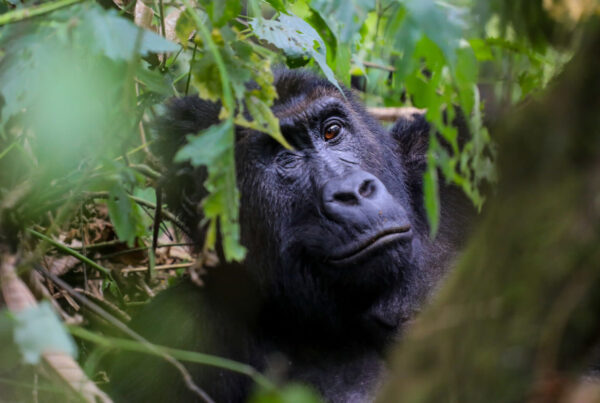
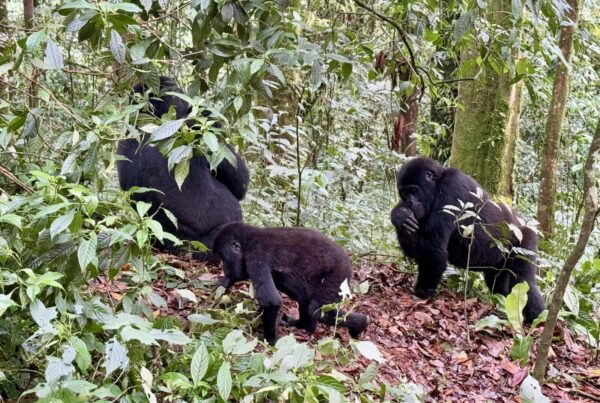
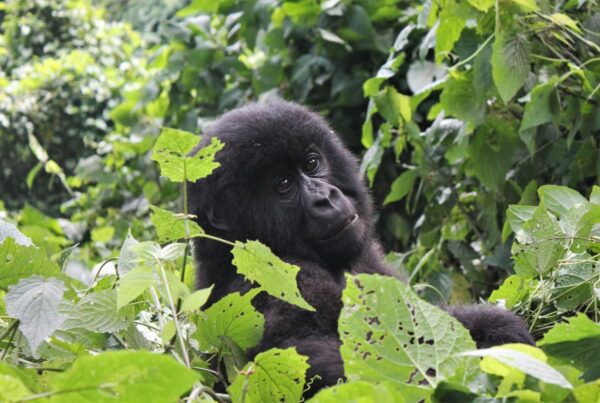
The Habinyanja family was feeding when we found them — a large group, visible across a clearing. I took photographs for perhaps twenty minutes of the sixty. For the remaining forty minutes I put the phone in my jacket pocket and watched with nothing between me and the gorillas except my own eyes and whatever the air between us consisted of. I cannot describe this experience adequately. What I can say is that it was completely real in a way that photographed experience is not. The gorillas were not images. The forest was not a backdrop. I was not a viewer. I was a temporary, humble, thoroughly insignificant presence in the middle of something that did not need me to be there and that I was enormously grateful to be part of.
What Changed When I Returned
My phone checking frequency dropped significantly in the weeks after Uganda. Not to zero — the habits of years do not dissolve in a week. But the compulsive quality of it changed. The phone had, before Uganda, felt like a tether to something essential. After Uganda, it felt like what it actually is: a useful tool for specific purposes that requires no particular reverence. The forest had demonstrated, conclusively and experientially, that there are things happening in the world that are more interesting and more real than anything available on a phone, and that access to them requires putting the phone down.
I still take photographs. I still use social media. I check my phone approximately sixty times per day according to my most recent report, which is down from 200 and still more than I would like. The gorillas were not a cure. They were a reference point — a specific, remembered experience of full presence that I return to when the compulsive checking reasserts itself. The reference is useful. The $800 permit produced it. I consider it a reasonable exchange.