One of Africa’s Most Ancient Forests
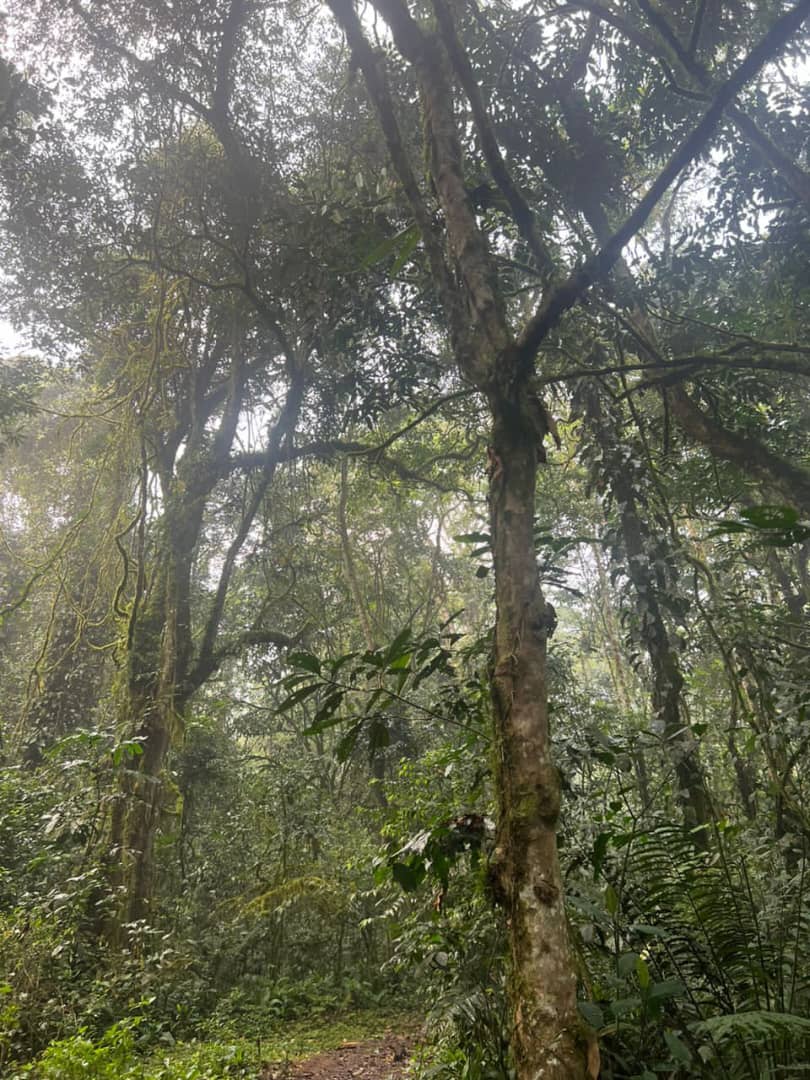
Bwindi Impenetrable National Park is not merely old — it is ancient in the truest sense. Scientific evidence suggests that Bwindi’s forest has existed continuously for approximately 25,000 years, making it one of the oldest surviving tropical forests in Africa. While most of the continent’s forests were dramatically reduced or eliminated during the last Ice Age, Bwindi endured as a refugium — an island of ecological stability in a changing world — sheltering species that would otherwise have been lost forever.
Understanding Bwindi’s age and geological history explains much about what makes it exceptional: why it harbours such extraordinary biodiversity, why the mountain gorillas that evolved within it are so adapted to forest life at altitude, and why its preservation is irreplaceable.
The Last Ice Age and Africa’s Forest Refugia
Approximately 18,000 to 25,000 years ago, during the last glacial maximum, global temperatures dropped significantly and rainfall patterns shifted. Across Africa, the great tropical forests that had once stretched across the continent contracted dramatically. Most of central Africa’s lowland forests retreated, replaced by savannah, scrub, and grassland.
Certain elevated areas, however, maintained sufficient rainfall and temperature stability to sustain forest cover throughout this period. These areas became refugia — ecological islands where forest species survived while the surrounding landscape transformed. Scientists have identified several of these refugia across Africa, and Bwindi is considered one of the most important.
The evidence comes from pollen analysis in lake sediment cores extracted from lakes within and near the park. These cores contain a continuous record of vegetation going back tens of thousands of years. The pollen record for Bwindi shows unbroken forest cover for at least 25,000 years, through periods when surrounding areas were dominated by non-forest vegetation. This continuity is remarkable and scientifically significant.
Why Continuous Forest History Matters for Biodiversity
The reason Bwindi is so extraordinarily biodiverse — supporting over 1,000 flowering plant species, 350 bird species including 23 Albertine Rift endemics, and more mammal diversity per square kilometre than almost any other protected area in Africa — is directly connected to its age. Continuous forest cover over 25,000 years means continuous evolutionary pressure, uninterrupted species adaptation, and the accumulation of ecological complexity that young forests simply cannot develop.
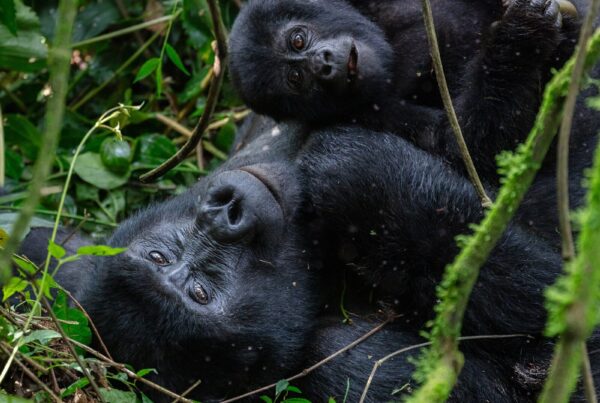
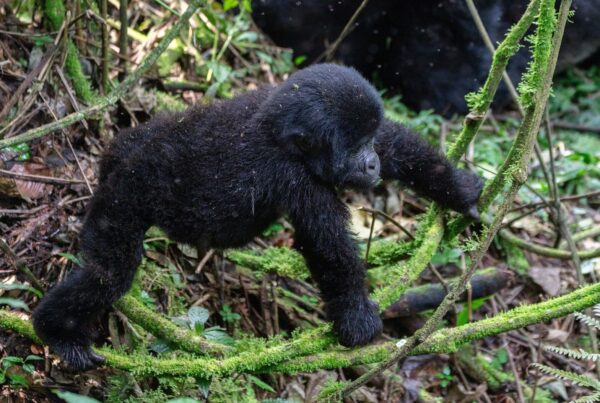
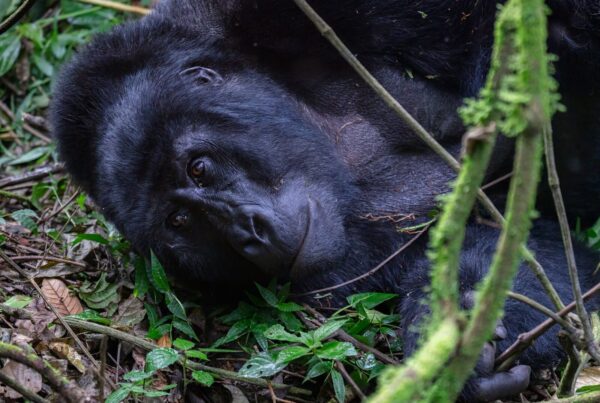
Species that were isolated in Bwindi during the Ice Age evolved in relative separation from populations elsewhere. Some became endemic — found nowhere else on Earth. Others developed unique genetic lineages that, while not yet formally recognised as separate species, represent evolutionary distinctiveness that would be lost if the forest were destroyed. The mountain gorilla itself may owe some of its adaptations to altitude and dense forest life to the pressures of Bwindi’s ice-age isolation.
The Geological Setting
Bwindi sits within the Albertine Rift, the western arm of the East African Rift System, at elevations ranging from approximately 1,160 metres to 2,607 metres. The Rift’s complex geology — volcanic activity, tectonic uplift, and varied soils — created the diverse micro-habitats that allowed so many species to coexist and differentiate.
The forest’s location at the junction of the Congo Basin and the East African highlands placed it at the intersection of two major biogeographic zones. Species from both zones found refuge and habitat in Bwindi, contributing to a species mix that is unique globally. The Albertine Rift is recognised as one of the world’s biodiversity hotspots, and Bwindi is its crown jewel.
Human History in and Around Bwindi
The Batwa people, a forest-dwelling ethnic group, lived within what is now Bwindi for thousands of years before the park was established. Archaeological evidence suggests continuous human habitation in and around the forest for at least 2,000 years, and oral traditions among Batwa communities indicate a much longer relationship with the forest. The Batwa hunted forest species, gathered plants, and developed intimate knowledge of the forest’s ecology over generations.
When Uganda Wildlife Authority gazetted Bwindi as a national park in 1991 and excluded the Batwa from their traditional territory without adequate compensation or alternative livelihoods, it created a social injustice that conservation organisations have been working to address ever since. Community benefit sharing programmes, Batwa cultural tourism, and land rights advocacy represent ongoing attempts to reconcile the park’s conservation needs with the rights of the people displaced by its establishment.
UNESCO World Heritage Status
In 1994, UNESCO inscribed Bwindi Impenetrable National Park on the World Heritage List, recognising its outstanding universal value for biodiversity and its importance as a habitat for the endangered mountain gorilla. The inscription cited the forest’s high biodiversity, its ancient age, its role as an Ice Age refugium, and its significance for human-gorilla coexistence research.
UNESCO World Heritage status provides international recognition and, to some extent, political protection. It signals to the global community that Bwindi’s preservation is not merely Uganda’s responsibility but a shared global obligation. The designation also brings access to UNESCO’s networks of conservation expertise and, occasionally, financial support for specific projects.
The Forest Today
Despite 25,000 years of survival, Bwindi faces modern threats that its geological resilience cannot address alone. Agricultural encroachment along park boundaries, climate change-driven shifts in rainfall, and the disease transmission risk from the tourism that funds its protection all require active management. The park’s 321 square kilometres are surrounded by some of the most densely populated farmland in Africa.
The Uganda Wildlife Authority, international conservation organisations, and local communities work continuously to maintain the integrity of this ancient forest. Every gorilla permit purchased contributes to that work, funding the patrols, veterinary programmes, and community development initiatives that make continued preservation possible.
Final Thoughts
When you stand at the edge of Bwindi’s forest — looking at trees that have grown in this place for centuries, home to gorillas that evolved here over thousands of years, above soils that have supported forest life since before the last Ice Age — you are in the presence of something genuinely ancient. The 25,000-year age of Bwindi is not a boast; it is a geological fact that explains everything remarkable about this place. Protecting it is one of conservation’s most urgent responsibilities.