The Question Behind the Encounter
When you spend one hour with a habituated mountain gorilla family in Bwindi, a question naturally arises: does the silverback recognise the ranger who has visited him every day for years? Does the mother remember the researcher who observed her give birth? Can gorillas distinguish between familiar and unfamiliar humans, and does that distinction carry meaning for them?
The answer, supported by decades of field research, is yes — with important nuances. Mountain gorillas do recognise individual humans, and the recognition extends beyond mere familiarity to something that resembles relationship. Understanding this recognition deepens appreciation for what gorilla habituation represents.
What Research Tells Us About Gorilla Memory
Gorillas are among the most cognitively sophisticated non-human primates. Their brains share approximately 98% of DNA with human brains, and studies of both wild and captive gorillas demonstrate memory capabilities that rival those of great apes generally considered more intelligent, including chimpanzees.
In captive settings, gorillas have demonstrated long-term recognition of humans they have not seen for years. Koko, the famous sign-language gorilla at the Gorilla Foundation in California, recognised individual researchers who visited years after their previous contact, responding differently to familiar faces than to strangers. While captive conditions differ significantly from the wild, the cognitive architecture underlying this recognition is the same.
In the wild, field researchers at the Dian Fossey Gorilla Fund’s Karisoke Research Center have documented what appears to be individual gorilla recognition of specific rangers and researchers. Gorillas that tolerate the close approach of long-familiar rangers display significantly more relaxed behaviour than when the same position is occupied by a stranger. This is measurable: physiological stress indicators, vocalisation frequency, and proximity behaviour all differ when gorillas encounter unfamiliar humans versus familiar ones.
How Habituation Reveals the Recognition Mechanism
The gorilla habituation process, which takes two to three years to complete, illuminates how gorilla-human recognition develops. In the early stages of habituation, wild gorillas show fear and aggression when humans approach. Rangers maintain respectful distance and consistent, non-threatening behaviour visit after visit, day after day. Gradually, the gorillas’ responses change: alarm calls become less frequent, the group moves away less often, and silverback displays reduce in intensity and frequency.
This gradual change is not merely the generalised habituation of a population to an abstract stimulus. It is, in key respects, the development of relationships between specific gorillas and specific rangers. The same gorilla that shows relaxed feeding behaviour near its habituated ranger may display vigilance when a different, unfamiliar ranger takes the same position. The distinction is between the individual and the general class of “humans”.
What Rangers Report About Gorilla Recognition
Experienced Bwindi rangers — some of whom have worked with the same gorilla families for over twenty years — consistently report what they interpret as recognition. Silverbacks who have known a specific ranger for years often glance at them briefly and return to feeding, displaying the calm of a familiar presence, whereas the same silverback will conduct a thorough visual assessment of an unfamiliar person in the group.
Some rangers describe incidents in which gorillas appear to notice their absence. When a familiar ranger returns after weeks away due to illness or leave, some gorilla families reportedly show slightly elevated social behaviour — more vocalisation, more attention to the returnee — before settling back to normal. Whether this constitutes genuine recognition of absence and return, or simply a response to a slightly altered routine, is difficult to determine scientifically. But the rangers who observe it day after day find it compelling.
Recognition Versus Relationship
Recognition and relationship are not the same thing, and it is important not to over-attribute human social structures to gorilla cognition. Gorillas recognise individual humans in the same sense that they recognise individual members of their own family — as distinct entities with predictable behaviours and known characteristics. Whether this recognition constitutes anything resembling affection, trust, or friendship in the human sense is a more contested question.
What field research does suggest is that habituated gorillas extend to familiar humans something analogous to the tolerance they extend to known, non-threatening individuals in their own social group. This is not indifference: it is a sophisticated assessment that specific humans are safe, known, and not worthy of the vigilance that strangers require. That assessment is individual-specific, which is the core of recognition.
What This Means for Your Trekking Experience
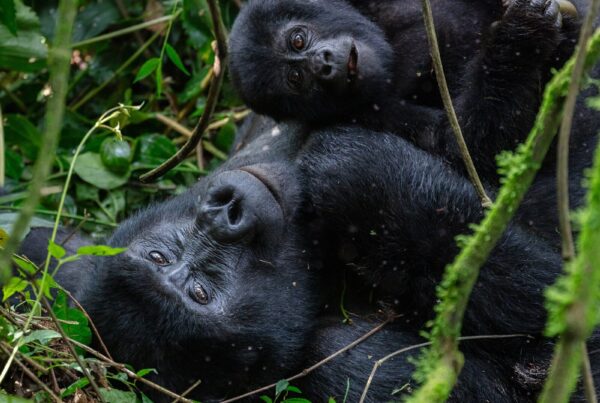
As a visitor spending one hour with a habituated gorilla family, you are not recognised individually. The gorillas know that humans visit regularly; they tolerate human presence within established distance and behavioural norms. But within that hour, you may observe the differential behaviour that reveals how deeply habituated some individuals are: the silverback who barely glances at the ranger standing near him while conducting a more thorough assessment of the trekking group; the female who feeds within metres of the guide as if he is simply a tree.
These moments reveal the underlying recognition infrastructure that makes the entire trekking experience possible. The habituation of each family is built on specific gorilla recognition of specific people, day after day, year after year. When you spend your hour in the forest, you are the beneficiary of that patient, respectful relationship between wild gorillas and the rangers who have earned their trust.
Final Thoughts
Mountain gorillas do recognise humans after repeated visits, and the recognition extends to individual identification of specific familiar humans. This capacity reflects the same cognitive sophistication that makes gorillas compelling in every respect. The habituated families of Bwindi and Mgahinga have not simply become accustomed to humans as a category; they have developed working knowledge of specific individuals, and that knowledge shapes their behaviour in measurable ways. Your hour in the forest is the culmination of those years of carefully built familiarity.