Updated
Do Gorillas Have Emotions? What Science Says
The Emotional Lives of Great Apes
do gorillas have emotions is a subject central to Uganda’s wildlife tourism, where mountain gorilla conservation and responsible visitor experiences go hand in hand. For much of the twentieth century, the scientific consensus held that attributing emotions to non-human animals was anthropomorphism — the projection of human feelings onto creatures that lacked the cognitive architecture to experience them. That consensus has shifted dramatically. Today, a robust body of research across neuroscience, behavioural ecology, and primatology supports the conclusion that great apes, including mountain gorillas, experience emotions in ways that are not merely analogous to but fundamentally continuous with human emotional experience.
This is not sentimentality. It is the finding of peer-reviewed science conducted over decades by researchers who approached the question with the most rigorous scepticism. Understanding what that science says about gorilla emotions enriches every gorilla trekking encounter with genuine insight rather than projection.
The Neurological Basis for Gorilla Emotions
The emotional response systems in the mammalian brain are evolutionarily ancient, predating the divergence of the great apes from the hominin lineage. The limbic system — the brain structures primarily responsible for emotional processing, including the amygdala, hippocampus, and cingulate cortex — is present and functionally similar in all great apes. Mountain gorillas, sharing approximately 98% of their DNA with humans, have a limbic system that is structurally almost identical to our own.
Neuroimaging studies of captive gorillas and other great apes have confirmed that these animals experience amygdala activation in response to threat, social separation, and reward — the same brain-region involvement that underlies fear, grief, and pleasure in humans. The neurological infrastructure for emotional experience exists and functions in gorillas. The debate is not whether this infrastructure exists, but what it feels like, subjectively, to the gorilla experiencing it — a question that neuroscience cannot yet answer definitively for any species, including humans.
Fear and Alarm: Clearly Documented
Fear responses in mountain gorillas are the most directly observable emotional state. When gorillas detect potential threats — unfamiliar humans before habituation, predators, rival groups — they display a characteristic physiological and behavioural response: elevated cortisol (measurable in faecal samples), rapid movement, vocalisation, and group coordination. These responses are identical in kind to mammalian fear responses generally and match what researchers observe in human fear.
The habituation process itself is a study in fear management. Over months of non-threatening human exposure, gorillas’ fear responses decrease measurably — heart rates normalise, flight distances reduce, cortisol levels drop. This is not mere desensitisation; it is cognitive reassessment. The gorillas learn to evaluate specific humans as non-threatening and update their response accordingly. That kind of learned emotional modulation requires a level of cognitive sophistication that implies genuine emotional experience.
Grief: The Most Contested and Most Compelling Evidence
Perhaps the most emotionally resonant research on gorilla emotions concerns how these animals respond to death. Multiple field researchers, including those at the Dian Fossey Gorilla Fund, have documented what appears to be grief behaviour following the death of group members.
When a gorilla dies, group members frequently stay near the body for extended periods — sometimes hours or days. They may touch, groom, or attempt to rouse the deceased animal. Mothers who lose infants sometimes carry the dead infant for days or weeks, a behaviour documented across multiple great ape species. In 2020, a Bwindi mountain gorilla named Rafiki — one of Uganda’s most famous silverbacks — was killed by poachers. His family’s behaviour in the aftermath showed the kind of disruption, increased vocalisation, and social disorganisation that observers described as consistent with a group processing the loss of their leader.
Sceptics argue that these behaviours reflect social disruption rather than grief in the subjective sense. But the long duration, the specificity to deceased individuals, and the similarity to human grief behaviour make pure mechanical explanation inadequate to many researchers.
Joy and Play: Undeniable Positive Emotion
The evidence for positive emotional experience in gorillas may be even stronger than the evidence for negative emotion. Play behaviour in juvenile gorillas is visually unmistakable: running, tumbling, climbing, mock-wrestling, and the open-mouthed play face that primatologists recognise as the great ape equivalent of a smile. Play behaviour in mammals functions partly as skill development, but its intensity and duration in gorillas goes beyond functional necessity.
Gorillas in play show elevated vocalisation, increased activity, and social engagement that mirrors what we recognise in playful children. The play face — an open-mouthed expression accompanied by vocalisation that researchers call a play laugh — is triggered by tickling and mock chasing in both wild and captive gorillas. It is structurally and functionally homologous to human laughter. The neurological triggers are the same: mild, unexpected stimulation in a safe social context.
When a trekker watches juvenile gorillas tumbling over each other in Bwindi’s forest, what they see is not merely the appearance of joy. The evidence suggests it is the real thing.
Affection and Attachment
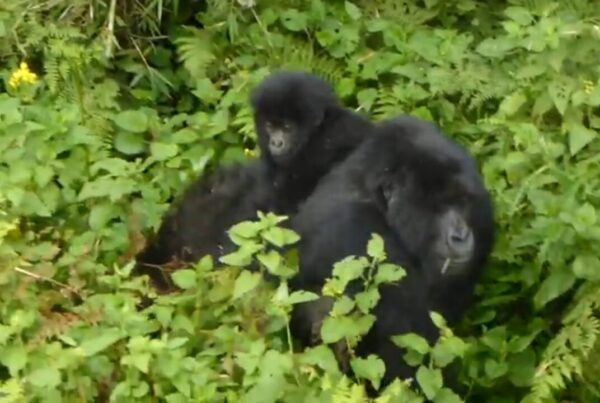
Gorilla mothers form strong attachment bonds with infants that have been extensively documented. The mother-infant bond involves sustained physical contact, including constant carrying for the first year of life, extended nursing, and protective behaviour that clearly involves emotional engagement rather than mere instinct. When infants are separated from mothers — in captive settings or through natural family disruption — both mother and infant display distress behaviour consistent with separation anxiety.
Adult gorillas also show what appears to be friendship: sustained preferences for specific group members that go beyond kinship, manifested in grooming partnerships, proximity maintenance, and social support in conflicts. Field researchers working with habituated families over long periods document these relationships carefully and note their persistence across seasons and years.
What This Means When You Meet Gorillas
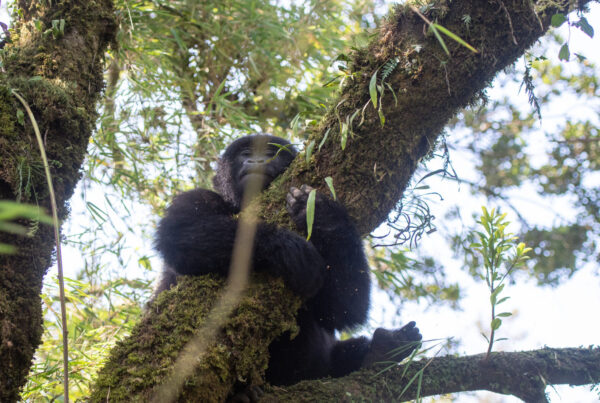
When you spend an hour with a habituated gorilla family in Bwindi, you are in the presence of animals that experience fear, affection, grief, joy, and social attachment. They are not automatons executing hardwired responses. They are emotionally complex individuals whose responses to your group’s presence will reflect a genuine assessment of threat, curiosity, and the comfort of familiar routine.
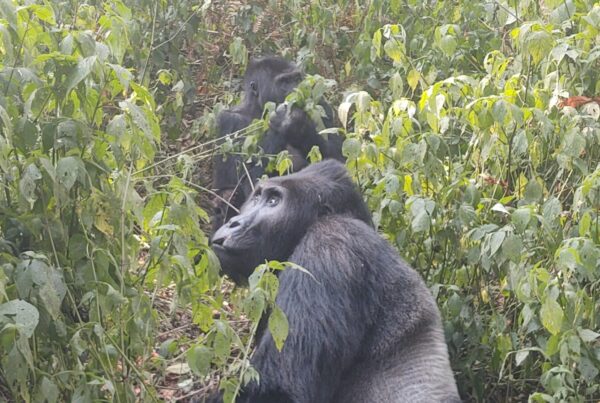
The silverback who glances at your group and returns to feeding is not indifferent. He is confident. The mother who nurses her infant while your group watches from seven metres is not unaware of you. She is comfortable enough to continue something that requires complete emotional safety. These states are real, and recognising them as such transforms the encounter from wildlife spectacle to something far more profound.
Final Thoughts
Science says gorillas have emotions. Not identical to human emotions in every detail, but continuous with them in origin, mechanism, and functional purpose. The research is not complete — it never is in a field this complex — but the direction of the evidence is clear. When you feel moved by your encounter with gorillas, you are responding to animals that may, in their own way, be responding to you. That mutual recognition, however partial, is among the most extraordinary things a person can experience in the natural world.