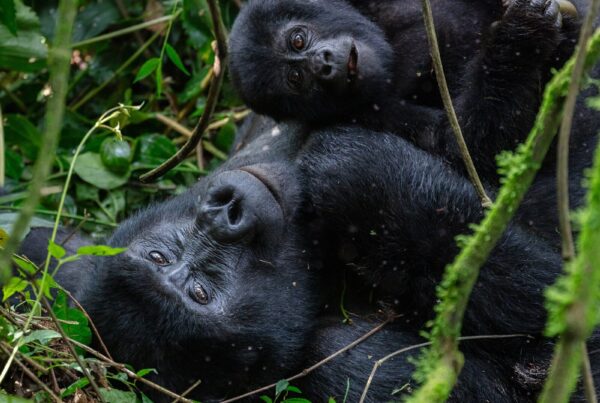
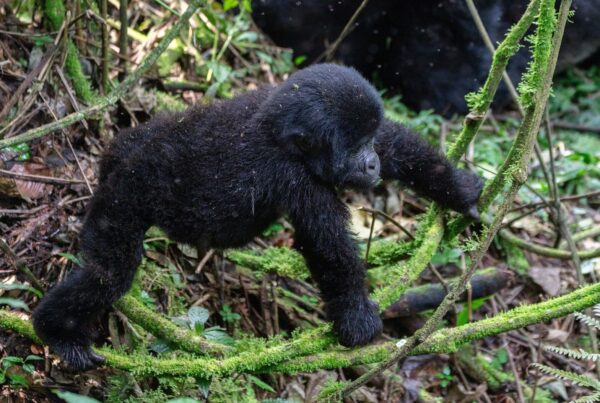
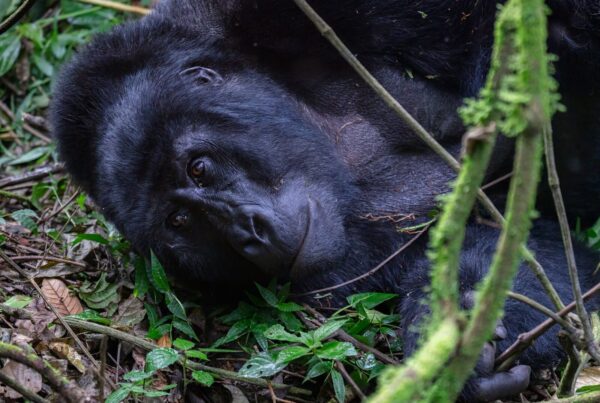
The mountain gorilla is the only great ape whose wild population is currently growing — and gorilla tourism is a direct and measurable part of why. Uganda’s $800 permit fee, collected by Uganda Wildlife Authority for every gorilla trekking visit, funds the rangers, infrastructure, and community programs that make Bwindi Impenetrable National Park viable as a protected area. The 2018 census counted over 1,000 mountain gorillas for the first time in recorded history. Understanding how that number grew is inseparable from understanding how the conservation model built on gorilla tourism works. See the gorilla families protected by this system and the full cost breakdown for what your permit funds.
- Wild population: over 1,000 mountain gorillas — the only great ape population that is growing
- Tourism model: permit fees → Uganda Wildlife Authority → ranger salaries, anti-poaching, park infrastructure
- Community revenue sharing: 20% of park entry fees distributed to surrounding communities by law
- Permit price (Uganda): $800 USD for foreign non-residents
- Why tourism works: it gives surrounding communities a direct economic stake in gorilla survival
The connection between gorilla tourism and mountain gorilla conservation is not incidental or theoretical — it is the direct, structural mechanism through which the most expensive and intensive wildlife protection programme in Africa is funded. Understanding precisely how the $800 gorilla trekking permit fee translates into ranger patrols, veterinary care, community benefit programmes, and habitat protection is essential context for anyone considering a gorilla trekking experience and wondering whether their visit truly makes a difference. The answer is unambiguous: it does, substantially and directly.
The Revenue Flow
When you purchase a gorilla trekking permit in Uganda, the fee of $800 for foreign non-residents (reduced to $700 for East African residents and 300,000 UGX for Ugandan citizens) goes to Uganda Wildlife Authority, the government agency responsible for managing Uganda’s national parks. UWA allocates this revenue across several categories of conservation expenditure.
Ranger operations — the salary, training, equipment, and logistics of the ranger force that protects Bwindi and Mgahinga — represent the largest budget line. Bwindi employs over 200 rangers and supporting staff in a park-wide operation that includes anti-poaching patrols, gorilla monitoring, tourist facilitation, and boundary management. Without the revenue stream from gorilla tourism, funding a ranger force of this size and capability would require either government subsidy (which African national parks have historically been underfunded to provide) or international donor support (which is less reliable and harder to sustain over decades).
Veterinary support — through the gorilla health monitoring programme and the Gorilla Doctors veterinary organisation — is partly funded through UWA revenue and partly through international conservation organisation grants. The gorilla health programme is expensive: the equipment, veterinary expertise, staff time, and logistics of monitoring over 20 habituated gorilla families and responding to medical emergencies require sustained, reliable funding that tourism revenue helps provide.
The Community Revenue Sharing Programme
Uganda’s gorilla conservation model includes a mandatory community revenue sharing component that directs a portion of tourism revenue to communities adjacent to the park. Under the Revenue Sharing Programme, 20% of Bwindi’s entry fees are distributed to local community development projects — schools, health centres, water systems, and livelihood support programmes in the parishes surrounding the park.
This community investment is not charity — it is strategic conservation finance. Communities adjacent to Bwindi’s boundary have historically been excluded from the forest resources the park was established to protect. Without a tangible economic benefit from gorilla conservation, these communities have rational incentives to encroach on park land, poach wildlife, and resist conservation management. The revenue sharing programme aligns community interests with gorilla survival by making each family’s welfare partly dependent on the continued functioning of the gorilla tourism industry.
The Bwindi Mgahinga Conservation Trust (BMCT), funded partly by tourism revenue and partly by international donors, operates additional community development and conservation programmes including community-based conservation education, support for local cultural heritage, and alternative livelihood programmes for former poachers and farmers who have converted to conservation-compatible activities.
Employment and Economic Multiplier Effects
Beyond the direct permit revenue, gorilla tourism creates employment throughout the Bwindi region. Rangers, trackers, guides, porters, lodge staff, restaurant workers, transport operators, and craft sellers all derive income from the tourism economy that gorilla conservation has created. A single gorilla trek generates economic activity well beyond the $800 permit fee: the visitor spending on accommodation, food, transport, and local products multiplies through the local economy, creating income for people with no direct employment in the park but whose livelihoods are nonetheless tied to the gorilla tourism industry.
This economic multiplier effect means that the conservation value of each gorilla trek extends well beyond the direct funding it provides for protection. A regional economy in which significant numbers of households depend on gorilla tourism is an economy in which those households have direct financial interests in gorilla survival — creating a broad-based community constituency for conservation that no amount of enforcement or international pressure can replicate.
The Incentive Structure That Makes Conservation Work
The fundamental innovation of gorilla tourism as a conservation model is the creation of an incentive structure in which living gorillas are more economically valuable than dead ones or than the land they occupy converted to agriculture. This reversal of the normal economics of wildlife in a land-scarce, densely populated landscape is the achievement that has made mountain gorilla recovery possible.
Before gorilla tourism, a dead gorilla could be sold as bushmeat or its infant sold to the wildlife trade. Gorilla habitat could be converted to farmland or charcoal-producing trees. The economic logic pointed toward exploitation. After gorilla tourism, a living gorilla family generates $800 per visit, with multiple visits per week across all habituated families representing millions of dollars in annual revenue. The economic logic now points toward protection.
This is not unique to gorillas — the same logic applies wherever high-value wildlife tourism has been successfully developed around specific species. Mountain gorillas are simply the most successful and best-documented example of the model at scale.
What Happens When Tourism Is Disrupted
The importance of tourism revenue to gorilla conservation becomes acutely visible when tourism is disrupted. During the COVID-19 pandemic, gorilla trekking was suspended in Uganda and Rwanda for extended periods to prevent disease transmission from visitors to gorillas. The financial impact on conservation budgets was immediate and severe: UWA reported significant revenue shortfalls, ranger deployments were reduced, and community benefit payments were delayed or reduced.
International conservation organisations stepped in with emergency funding to bridge the gap, but the episode demonstrated the degree to which gorilla conservation had become dependent on tourism revenue — and the fragility of a conservation model built on a single revenue stream. Post-pandemic recovery planning has included efforts to diversify funding sources while maintaining tourism as the primary revenue pillar.
Your Role as a Visitor
When you book a gorilla trekking permit through Uganda Wildlife Authority, you are not merely purchasing a wildlife experience. You are investing in a conservation system that employs hundreds of people, maintains critical protected habitat, funds veterinary care for endangered animals, and supports community development in one of the world’s most biodiverse regions. The $800 you spend on a permit contributes more directly to species conservation than most other purchases of comparable value available to the conscious traveller.
This does not mean that gorilla tourism is without conservation costs: habituation creates disease transmission risks, tourist disturbance has potential stress impacts on gorilla groups, and the infrastructure development associated with tourism creates some habitat pressure. These costs are real and are managed through the protocols, visit limits, and distance rules that govern trekking. On balance, however, the conservation case for gorilla tourism is overwhelmingly positive — as demonstrated by the fourfold population increase achieved under the tourism-funded conservation system over the past four decades.
Final Thoughts
Gorilla tourism is conservation finance in one of its most direct and effective forms. The money flows from permit fee to ranger salary to anti-poaching patrol to gorilla safety in a chain short enough to trace clearly and real enough to have produced measurable results. When you choose to visit Bwindi’s gorillas, you are choosing to participate in that chain — to be, for one day and $800, a funder of the conservation system that is keeping the mountain gorilla alive. Few tourism choices carry a more direct and verifiable conservation impact.
How does gorilla trekking permit money help conservation?
Uganda Wildlife Authority collects the $800 permit fee and allocates it across ranger operations, park management, anti-poaching units, and infrastructure. UWA is also legally required to distribute 20% of park entry fees to the district local governments and communities surrounding national parks. This revenue-sharing creates a financial incentive for communities to tolerate wildlife rather than convert forest land for agriculture. Without this mechanism, the pressure to farm the fertile land surrounding Bwindi would be difficult to resist.
Have mountain gorilla numbers actually increased because of tourism?
The population trend is clear. In the early 1980s, the mountain gorilla population in the Virungas was estimated at approximately 254 individuals. The 2018 census across both the Virunga Massif and Bwindi counted 1,004 gorillas — the first time the species had exceeded 1,000 individuals in recorded population surveys. Conservation funding, which in Uganda derives substantially from gorilla tourism revenue, underpins the ranger patrols, anti-poaching operations, and veterinary monitoring that drove this recovery.
Is gorilla tourism harmful to the gorillas?
Managed gorilla tourism carries real risks — primarily disease transmission from humans to gorillas, who share approximately 98% of human DNA and are susceptible to human respiratory illnesses. Uganda Wildlife Authority manages these risks through strict protocols: the 7-metre minimum distance, mandatory mask policies when groups approach closer, limits of 8 visitors per family per day, and health screening that bars visitors with active infections from trekking. The weight of conservation science concludes that well-managed tourism benefits gorilla survival by making their protection economically viable.
What organisations does gorilla tourism fund beyond Uganda Wildlife Authority?
Gorilla tourism revenue supports several layers of conservation. Uganda Wildlife Authority manages the parks directly. Community lodges and craft markets in areas like Buhoma are funded indirectly through visitor spending. Conservation NGOs including the Dian Fossey Gorilla Fund International, the International Gorilla Conservation Programme, the Wildlife Conservation Society, and Conservation Through Public Health (CTPH) receive funding partly linked to the economic activity that gorilla tourism generates in the region.
What happens to gorilla conservation funding when tourism stops?
The COVID-19 pandemic, which halted gorilla tourism across Uganda and Rwanda from March 2020 through much of 2021, demonstrated the vulnerability of this model. Uganda Wildlife Authority faced significant funding shortfalls during the closure. Conservation organisations diverted emergency funds to maintain ranger patrols and prevent poaching from spiking during the period when enforcement resources were strained. The crisis accelerated discussion about diversifying gorilla conservation funding beyond tourism dependence, but as of 2026 tourism remains the primary revenue mechanism.
- Gorilla Conservation Success Story: How Tourism Saved Mountain Gorillas
- Gorilla Conservation Success Story: How Tourism Saved the Species
- The Conservation Lover’s Gorilla Trekking Uganda Guide: Impact Tourism
- The 10 Most Endangered Animals in Africa and How Tourism Helps Them
- How gorilla tourism funds conservation in Uganda: the economics of saving a species
- Olympians, explorers, and conservationists: the famous names behind Uganda tourism
- Amy Vedder and Bill Weber: the conservationists who invented gorilla tourism
- Carbon tourism and gorilla conservation: can your trek offset its own footprint?
- Gorilla Conservation Success Stories: How Tourism Saved the Mountain Gorilla
- Meet the conservationist protecting mountain gorillas in the heart of the impenetrable forest.