Three primary schools serving a combined 1,200 children in the villages adjacent to Bwindi Impenetrable National Park were built using money generated by gorilla trekking permits. This is not a metaphor or a marketing claim. There are budget line entries, construction contracts, and ribbon-cutting photographs. The schools exist because gorilla tourism generated the revenue that funded them. This post tells the story of how tourism income becomes school buildings, and what it means for the communities whose children study in them.
The Revenue Mechanism: How Permit Fees Become Infrastructure
Uganda Wildlife Authority collects USD 700 per person for each gorilla trekking permit. Of this amount, 20 percent is allocated to the Community Revenue Sharing fund, which is distributed to communities in the parishes adjacent to each trekking sector. The distribution is managed by elected community development committees working with UWA district liaison officers. Projects are proposed by communities, assessed for feasibility, and funded in priority order: typically water, then health, then education.
As gorilla trekking permit numbers grew from a few hundred per year in the late 1990s to several thousand per year by the 2010s, the annual CRS allocation for Bwindi-adjacent communities grew from a few thousand USD to hundreds of thousands USD. This accumulation over 25 years has funded infrastructure that would otherwise simply not exist in communities whose distance from urban centres and low tax base make government infrastructure investment slow and unpredictable.
Buhoma Primary School: The First CRS Education Project
Buhoma Primary School was built in 2003 with CRS funds accumulated from the first significant years of gorilla trekking revenue. Before the school was built, children in Buhoma village walked more than six kilometres to the nearest government school, a distance that resulted in low attendance, particularly among girls whose families prioritised domestic work over education. The CRS-funded school reduced the walk to under one kilometre. Enrolment in the school’s first year was 380 students. By 2027, it has 580 students and has sent 14 graduates to university — three of whom now work in the tourism and conservation sectors.
The school is not a simple building. It has six classrooms, a library (funded by a supplementary NGO grant that came after the CRS construction), pit latrines, a rainwater collection system, and a school garden that provides nutritional supplementation for the lunch programme. UWA rangers who live in Buhoma serve on the school’s board of governors. Their presence creates a direct link between the conservation sector and the educational future of community children.
Rushaga and Nkuringo: The Next Two Schools
As CRS funds grew with increasing permit sales, the school model was replicated in Rushaga (2007) and Nkuringo (2011). Each school followed the same pattern: community-identified need, CRS funding allocation, community land contribution, and UWA administration of the construction contract to ensure accountability for how funds were spent. Both schools are now among the highest-performing primary schools in their districts by national examination results — a fact that local communities explicitly attribute to the stability and facilities that CRS funding provided.
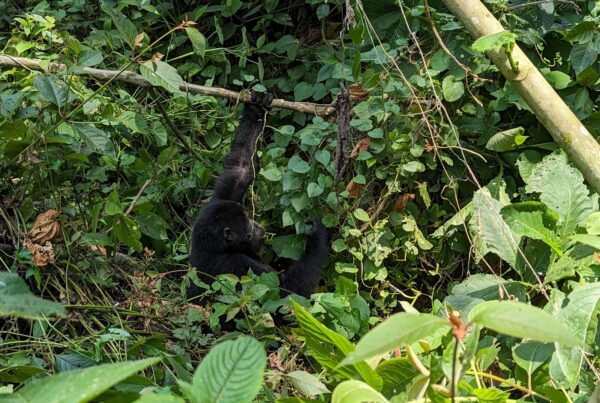
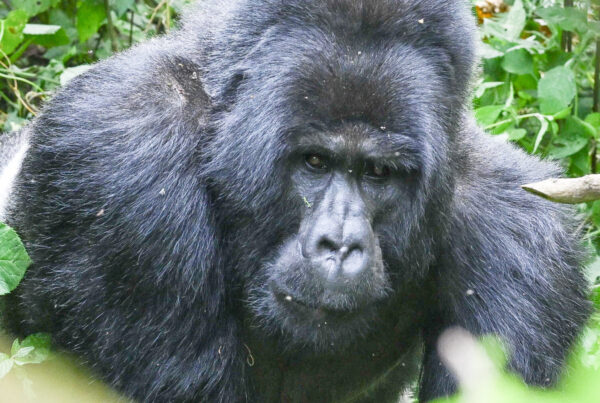
The Nkuringo school is particularly notable. It sits within sight of the forest boundary, and on clear mornings students in the upper classes can sometimes see gorillas moving along the forest edge during break time. The headteacher has integrated gorilla ecology and conservation into the school’s science curriculum — a practical acknowledgment that the animals whose permit fees built the school are part of the children’s educational environment.
The Long-Term Conservation Dividend
Education funded by gorilla tourism creates a long-term conservation dividend that is hard to quantify but deeply real. Children educated in communities that benefit from gorilla conservation grow up understanding the relationship between forest health and community welfare. They are less likely to view the park as an adversary and more likely to enter the workforce with attitudes that support conservation rather than resist it.
Several of the current generation of young UWA rangers in Bwindi attended the three CRS-funded schools. Their understanding of their community’s relationship with the park is formed partly by the education those schools provided. The conservation case for school building is not sentimentality — it is investment in the human infrastructure of long-term wildlife protection.
Your Permit Fee Continues This Work
When you book a gorilla trekking permit for 2027, USD 140 of your permit fee flows into the CRS fund. That fund currently supports the maintenance and staffing of these three schools, construction of a fourth school in the Ruhija sector (planned for 2028), and a bursary programme for secondary school students from CRS-eligible communities. Your trek is not just a wildlife encounter. It is a contribution to the educational infrastructure of one of the world’s most important conservation communities.
Frequently Asked Questions
The standard gorilla trekking permit costs $800 per person for foreign non-residents (FNR). EAC foreign residents pay $700. During low season — April, May, and November — the FNR rate drops to $600. The Gorilla Habituation Experience permit (4 hours, Rushaga sector only) costs $1,800 per person.
Permits are issued by Uganda Wildlife Authority (UWA). Most visitors book through a licensed Uganda tour operator, who handles the UWA reservation, permit transfer, and sector logistics. Direct booking via the UWA eTourism portal is available but operators handle the complexity of sector assignment and date changes.
During peak season (June–September, December–February): book 3–6 months ahead. During low season (April, May, November): 4–8 weeks is usually sufficient. The AFCON 2027 period (June–July 2027) will see unusually high demand — book at least 6 months ahead for any date in that window.
UWA gorilla permits are non-refundable but can be rescheduled to another date subject to availability and sufficient advance notice. Your tour operator handles this process. Travel insurance that covers trip cancellation and curtailment is strongly recommended for all Uganda gorilla bookings.
Yes. The permit price is set by Uganda Wildlife Authority and is fixed regardless of which operator you use. No operator can offer a discount on the $800 permit — only their service fees (accommodation, transport, guiding) vary between companies.