Updated
How Do Gorillas Show Affection? Social Bonding Behaviour
Affection in the Animal Kingdom’s Largest Primate
How Do Gorillas Show Affection?. Mountain gorillas are not the brooding, solitary giants of popular imagination. They are deeply social animals whose lives are structured around bonds of affection, tolerance, and mutual investment. The behaviours through which gorillas express and maintain affectionate relationships — grooming, play, proximity, touch, and vocalisation — are immediately recognisable to human observers because they are, in important ways, analogous to behaviours we use to express and maintain our own social bonds.
Grooming: The Primary Affection Language
As discussed in detail in the gorilla grooming article, social grooming is the primary physical expression of social affection and alliance in mountain gorilla groups. The extended, focused attention that an individual devotes to grooming a social partner — carefully working through their fur, providing physiological relaxation, maintaining sustained physical contact — is the gorilla equivalent of an extended positive social interaction. The recipient’s relaxed response — slow breathing, closed eyes, quiet vocalisations — is a behavioural indicator of experienced pleasure and safety.
The most affectionate grooming relationships in a gorilla group are typically between mothers and their older offspring, between close female allies, and between the silverback and his favoured female partners. These relationships are characterised by high grooming frequency, mutual rather than unidirectional grooming, and the spatial proximity that comes with choosing to be near another individual even when grooming is not active.
Play: Affection Through Shared Joy
Play behaviour is perhaps the most obviously affection-expressing behaviour in gorilla repertoire. When two gorillas play — whether juveniles chasing and wrestling, or a silverback tolerating a young infant’s clumsy attempts to climb on him — both participants are choosing to engage in a positively-experienced, voluntary interaction that has no immediate survival function beyond the shared pleasure of the activity itself.
The play face — the relaxed, open-mouthed expression that great apes produce during play, homologous to the human smile — is the clearest visible signal that an interaction is affiliative rather than threatening. A silverback producing a play face while a juvenile tumbles over him is demonstrating a social tolerance that goes well beyond neutral acceptance: he is actively participating in a positively-valenced interaction with a much smaller and less powerful group member, signalling the safety of that interaction and his own willingness to engage.
Inter-juvenile play is particularly rich and sustained, with play bouts lasting many minutes and involving complex sequences of wrestling, chasing, and social vocalising. These extended play interactions build the peer relationships that will constitute the social network of the adult group, establishing patterns of trust, competitive quality assessment, and social tolerance that persist over years.
Proximity and Contact: Choosing to Be Close
One of the simplest but most meaningful expressions of affection in gorilla social life is the choice to be physically close to another individual during rest periods. Gorillas are not obliged to sit near any particular group member during the midday rest — they can distribute themselves through the rest area as social comfort and personal preference dictate. The consistent co-resting choices that individuals make — settling near the same social partners day after day — are reliable indicators of social preference and affiliation.
Physical contact during rest — leaning against a social partner, resting a hand on another individual’s back, or an infant settling against its mother’s chest for a midday nap — is another form of gentle affectionate contact that requires no active behaviour beyond the choice of proximity. These contact behaviours produce the same neuroendocrine relaxation responses (reduced cortisol, reduced heart rate) that active grooming produces, at lower energy cost.
Maternal Affection
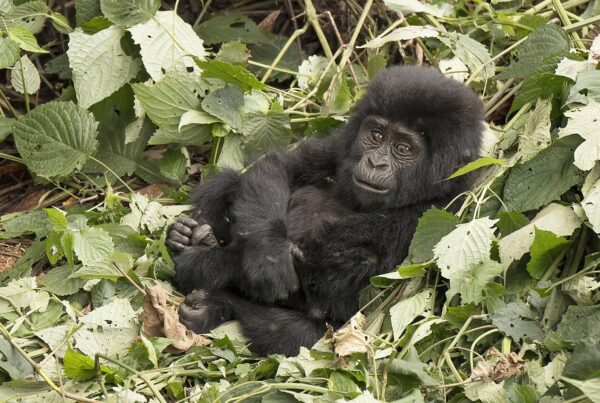
The mother-infant bond in mountain gorillas is among the most intensive and sustained in the animal kingdom. The years of continuous physical contact, nursing, protection, and social guidance that a mother invests in her infant represent an extraordinary commitment of energy and attention. Observed from outside, this bond is expressed through the constant vigilance of the mother over her infant’s position and wellbeing, the immediate response to any infant distress vocalisation, and the gentle management of the infant’s social interactions that protects it while allowing it to develop independence.
Older offspring maintain affectionate bonds with their mothers beyond weaning. Juveniles that have established their own sleeping nests still spend resting periods near the mother, engaging in occasional grooming and receiving ongoing social support. In some long-term monitored families, adult females have been observed near their mothers into adulthood — a bond that persists across the years of development that separate infancy from reproductive maturity.
The Silverback’s Affectionate Side
The silverback’s social role is often characterised in terms of dominance, protection, and leadership — all accurate, but incomplete. Long-term observers of specific silverbacks consistently note the individually variable affectionate dimension of silverback behaviour: some are notably tolerant and gentle with infants and juveniles in ways that go beyond the minimum required by social function. These individuals allow infants to approach and touch them, participate in gentle play with juveniles, and show social interest in group members that appears to reflect genuine affectionate investment rather than purely strategic social management.
The silverback’s relationship with the adult females of his group also has an affectionate dimension. Extended grooming sessions with favoured females, the choice of proximity during rest periods, and the individual attentiveness to specific females in contexts unrelated to reproduction all suggest that silverback social bonds involve something more complex than pure reproductive strategy.
Final Thoughts
Mountain gorillas express affection through the same fundamental behavioural channels that humans and other social mammals use: physical contact, sustained positive interaction, chosen proximity, and attentiveness to others’ wellbeing. Recognising these expressions of affection during the trekking encounter — the grooming pair, the playing juveniles, the mother watching her infant from across the clearing — enriches the experience from wildlife observation to something closer to social recognition. These animals are not performing for visitors. They are simply being with each other in the ways that matter most to them.
Frequently Asked Questions
Uganda is home to the mountain gorilla (Gorilla beringei beringei), one of two subspecies of eastern gorilla. They live exclusively in the Virunga volcanic highlands (Uganda/Rwanda/DRC) and Bwindi Impenetrable Forest (Uganda only). Mountain gorillas are the only gorilla subspecies that cannot survive in captivity — every individual you can trek is a wild animal.
The standard gorilla trekking permit gives you exactly 1 hour with the gorilla family. This time begins when you make first contact with the family — the ranger signals the start. The Gorilla Habituation Experience gives 4 hours with a semi-wild family. The walk to find the gorillas can take 30 minutes to 5 hours depending on where the family has moved.
Stay calm, crouch down slowly, avoid direct eye contact, and remain quiet. Do not run — running triggers a chase response. Rangers accompanying your group manage close approaches. Habituated gorillas are accustomed to humans and almost never make contact, but a charging silverback is managed by staying still and following ranger instructions immediately.
A maximum of 8 visitors per habituated gorilla family per day for standard trekking. The Gorilla Habituation Experience has a maximum of 4 visitors per family per day. These limits are set by UWA to minimise stress on the gorilla families and maintain the quality of the experience.
Uganda is home to the mountain gorilla (Gorilla beringei beringei), one of two subspecies of eastern gorilla. They live exclusively in the Virunga volcanic highlands (Uganda/Rwanda/DRC) and Bwindi Impenetrable Forest (Uganda only). Mountain gorillas are the only gorilla subspecies that cannot survive in captivity — every individual you can trek is a wild animal.