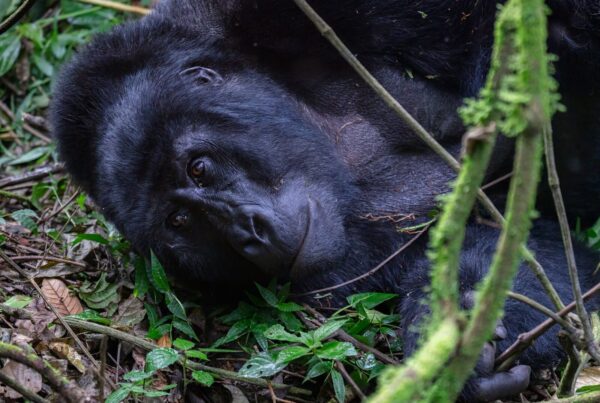
Gorillas grieve, and the evidence for this — documented by field researchers in Bwindi and the Virungas over decades of close observation — is among the most affecting findings in great ape behavioural research. Gorillas have been observed sitting beside dead group members for extended periods, handling the body carefully, and showing behavioural changes consistent with distress that persist for days or weeks after a group member’s death. This capacity for something that looks, from the outside, very much like grief, is not a surprise to anyone who has spent an hour with a gorilla family in Bwindi Forest — the social bonds visible in that hour are clearly deep enough to produce loss when they are severed.
What the Research Shows
The documentation of grief-like behaviour in mountain gorillas comes primarily from long-term field studies conducted at Bwindi and in the Virunga massif, where habituated family groups have been observed continuously for decades. The advantage of long-term habituation is that researchers can observe natural behaviours — including death and its aftermath — without the animals modifying their behaviour for human presence.
Sitting Beside the Dead
The most consistent observation across multiple recorded deaths is that gorillas remain with the body of a deceased group member for extended periods — sometimes hours, sometimes days. They sit beside the body, touch it, groom it, and make no attempt to leave the area. In family groups where the deceased was a high-ranking individual (particularly an infant, whose death typically produces the most prolonged vigil), the entire family group may remain stationary near the body for far longer than would be expected if they were simply confused by the absence of movement.
Mothers and Infant Loss
The most intensely studied cases involve mother gorillas and the deaths of their infants. Research published by the Dian Fossey Gorilla Fund and other organisations has documented mothers carrying dead infants for days after death — behaviour seen in several great ape species, including chimpanzees — and the specific behavioural changes in mothers during this period: reduced feeding, social withdrawal, elevated stress hormones in fecal samples, and the specific quality of carrying the body with the same gentleness used with a living infant.
Interpreting this behaviour as grief is not straightforward — the scientific debate about whether non-human animals experience emotions in a phenomenologically similar way to humans remains active and unresolved. But the behavioural correlates of grief — the prolonged presence near the body, the handling, the reduced social engagement, the elevated stress markers — are real and documented.
The Social Context That Makes Grief Possible
Grief, as a functional emotional category, requires social bonds strong enough that their loss constitutes a significant deprivation. Mountain gorillas have these bonds. Family groups are stable social units that may persist for decades — the same individuals living, feeding, and sleeping together year after year, with relationships that accumulate history and mutual knowledge over time.
Mother-Infant Bonds
The mother-infant bond in mountain gorillas is the most intense social relationship in the species. The extended nursing period of three to four years, during which the infant is in continuous physical contact with the mother, creates a bond with no obvious parallel in human social life except, perhaps, the first weeks of parenthood. The loss of an infant severs a bond that has been the structural centre of the mother’s daily life for years.
Silverback Relationships
The relationship between a silverback and his family group is also long-term and consistent. A silverback who has led a family for fifteen years has known every individual since birth, has protected them, has mediated their conflicts, has made the daily decisions that have kept them safe. The death of the silverback produces documented changes in the group’s social behaviour — increased anxiety, altered movement patterns, disrupted social hierarchies — that are consistent with a significant social loss.
The Debate About Animal Grief
The scientific literature on animal grief is careful about the distinction between behaviours that look like grief and the subjective experience of grief. The behaviours are documented. The experience — whether there is “something it is like” to be a grieving gorilla, in the philosophical sense — cannot be directly accessed by external observation.
The leading positions in the debate range from “animals can experience grief in phenomenologically similar ways to humans” (supported by evolutionary continuity arguments and the functional similarities of the neurological systems involved in primate emotion) to “animals exhibit grief behaviours that serve social functions but do not necessarily involve subjective suffering” (supported by the impossibility of accessing another creature’s subjective experience).
What is not disputed: the behaviours occur, they are meaningful to the animals involved, and they provide evidence of social bond strength that has implications for how we understand gorilla social life and, by extension, how we approach conservation of a species that can lose individuals in ways that produce collective distress.
What This Means for Conservation
The recognition that gorillas grieve has practical conservation implications. When a habituated gorilla dies — from disease, from injury, from occasional poaching — the loss is not simply a reduction in population numbers. It is a disruption to the social fabric of the family group that takes time to resolve and that has measurable effects on the behaviour and potentially the survival of remaining group members.
This understanding informs how conservation teams manage deaths in habituated groups — allowing the family adequate time and space to process the loss before resuming normal tourism activities, monitoring the group for the social disruption that may follow, and supporting families through the period of adjustment that typically follows a significant loss.
Observing Social Bonds on a Trek
The social bonds that make gorilla grief possible are visible during a gorilla trek. The long grooming sessions between adults, the consistent protective proximity of the silverback to nursing females, the way family members look to each other during disturbance — all of it reflects the accumulated history of relationships that run across years and lifetimes.
When you watch a gorilla family for an hour in Bwindi, you are watching the social substrate of grief: the bonds that, when severed, produce the prolonged vigils and the changed behaviour that researchers have documented. The grief potential is present in every interaction you observe. That knowledge makes the hour richer.
Uganda gorilla trekking permits are $800 per person. Contact Uganda Gorilla Trekking to book your permit and plan your visit to Bwindi Impenetrable National Park.