When international travellers research gorilla trekking, they often encounter two types of operators: international travel agencies and booking platforms based in Europe, North America, or Australia that sell Uganda as part of a broader Africa portfolio; and local Ugandan tour operators based in Kampala who specialise in Uganda and East African travel. The choice between them is presented as a trade-off between security (international brand recognition) and value (local knowledge). In reality, the calculation is more nuanced — and often favours the local operator.
The Price Reality
The gorilla permit costs $800 from every legitimate operator. No operator can discount it. The difference in package pricing between international and local operators reflects the different cost structures of their businesses.
International travel agencies typically charge 20-40% above local operator prices for equivalent packages. A mid-range 5-day gorilla trekking package that a licensed Ugandan operator sells for $2,200 per person will often be sold by an international agency for $2,800-$3,100. The $600-$900 difference goes primarily to the international agency’s overhead, profit margin, and the layer of subcontracting between the booking platform and the actual service delivery in Uganda.
Where Local Operators Are Better
Local Ugandan operators have structural advantages that benefit clients directly:
Direct relationships: A Kampala-based operator books your permit directly through the Uganda Wildlife Authority, reserves your lodge directly with the property, and hires a driver-guide from their own team or network. There is no intermediary capturing margin between your payment and the service delivery. This means lower prices for equivalent quality and faster problem resolution when things go wrong.
Knowledge depth: Local operators know Uganda’s national parks, roads, lodges, and logistics from daily operational experience. They know which lodge had a recent plumbing problem, which gorilla family has been trending south toward a particular valley, and which road section to avoid after heavy rain. International operators know what their local subcontractors tell them — which may or may not be current.
Flexibility: Local operators can often accommodate changes, additions, and problem-solving that international booking systems cannot handle without lengthy email chains and revised invoices. A driver-guide from a local company can make a judgment call; a subcontractor for an international agency may not have the authority to deviate from a confirmed itinerary.
Where International Operators Have Advantages
International operators offer a different value proposition that matters to some travellers:
Payment security: Paying a well-known international travel brand provides protection through consumer protection schemes, card chargeback rights, and brand accountability that a small Ugandan operator cannot always match. For travellers who are cautious about paying significant sums to businesses they cannot verify in person, this matters.
Bundled itineraries: International operators can more easily bundle Uganda into a multi-country Africa itinerary that includes Kenya, Tanzania, or Rwanda, managing logistics across borders from a single booking point. Local Ugandan operators typically focus on Uganda and may have less depth in other countries.
How to Assess a Local Operator
The key markers of a legitimate, reputable Ugandan tour operator:
- Uganda Tourism Board (UTB) registration — verifiable on the UTB website
- Uganda Wildlife Authority (UWA) operator licensing
- Physical office address in Uganda (not just a website)
- Verifiable reviews on TripAdvisor, Google, or specialist travel forums
- Clear documentation of UWA permit booking provided before payment
- Transparent, itemised quotes
We are UTB registered, UWA licensed, and based in Kampala with years of gorilla trekking experience. Our packages include legitimate $800 permits, and we can provide booking confirmations before you pay. Contact us for a quote that will typically be 20-30% less than equivalent packages from international agencies.
Frequently Asked Questions
Rough ranges per person (including international flights): Budget: $1,500–$2,500 (economy flight, basic lodge, group tour). Mid-range: $2,800–$4,500 (comfortable lodges, small group or private tour). Luxury: $6,000–$15,000+ (private guide, charter flights, high-end lodges). The $800 permit is a fixed cost for everyone regardless of budget.
The permit covers only the 1-hour gorilla tracking. Budget separately for: Bwindi park entry fee ($40/day), porter hire ($15–$20 per trek — strongly recommended), ranger/tracker tip ($20–$30 per person), accommodation, ground transfers, and international flights. Most tour operators bundle these except the tip.
The only official discount is the low season rate: $600 FNR during April, May, and November (vs. $800 standard). EAC foreign residents pay $700 year-round ($500 low season). There are no group discounts, early-booking discounts, or operator-negotiated rates — the permit price is fixed by Uganda Wildlife Authority.
The permit itself costs the same either way. Booking through a licensed tour operator adds their service fee but simplifies the logistics significantly — permit transfer, sector assignment, accommodation at the right sector, early morning transfers, and post-trek arrangements are all managed for you. Self-arranged gorilla trekking is possible but requires careful coordination.
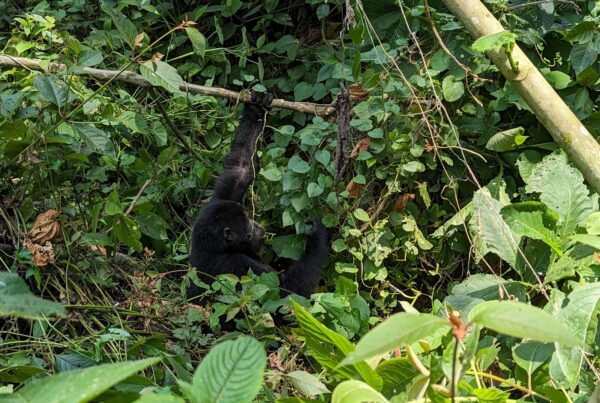
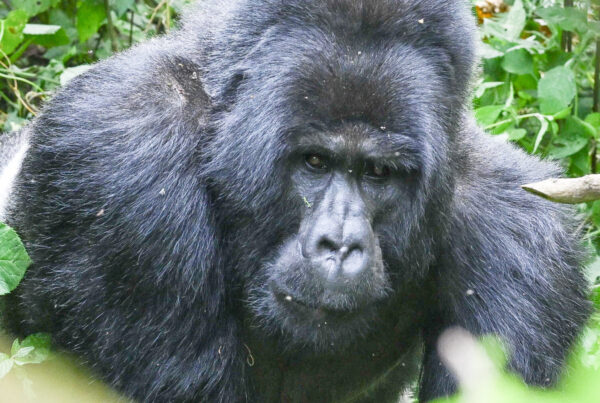
Uganda is home to the mountain gorilla (Gorilla beringei beringei), one of two subspecies of eastern gorilla. They live exclusively in the Virunga volcanic highlands (Uganda/Rwanda/DRC) and Bwindi Impenetrable Forest (Uganda only). Mountain gorillas are the only gorilla subspecies that cannot survive in captivity — every individual you can trek is a wild animal.