Updated
Gorilla Trekking for Photographers: Advanced Camera Tips
Capturing the Soul of the Forest
gorilla trekking photography tips advanced is one of Africa’s most extraordinary wildlife experiences, connecting travellers with mountain gorillas in their natural forest habitat. Gorilla trekking presents one of the most challenging and rewarding photographic opportunities in wildlife photography. The combination of dim forest light, moving subjects, close proximity to large animals, and the absolute prohibition of flash creates technical demands that separate competent photographers from those who return with images that truly convey the encounter’s emotional power. This guide goes beyond basic camera settings to explore the advanced techniques, creative approaches, and ethical considerations that elevate gorilla photography from documentation to art.
Whether you shoot with a professional full-frame system or a high-end smartphone, these principles will help you create images that do justice to the extraordinary privilege of sharing space with wild mountain gorillas.
Mastering Low-Light Photography
Bwindi’s forest canopy reduces ambient light to levels that challenge even modern cameras. Understanding how to work with limited light separates successful gorilla photographers from those who return with blurry, underexposed images.
Shoot at your lens’s widest aperture, typically f/2.8 or wider if available. This maximises light gathering while creating shallow depth of field that isolates subjects from distracting backgrounds. The creamy bokeh of a wide aperture transforms cluttered forest scenes into compositions where the gorilla dominates visually.
Embrace higher ISO settings than you might use in other contexts. Modern cameras produce usable images at ISO 3200, 6400, and even 12800. Noise reduction software in post-processing can clean up grain while preserving detail. A slightly noisy sharp image is always preferable to a clean blurry one.
Image stabilisation, whether in-lens or in-body, allows handheld shooting at slower shutter speeds. With good stabilisation, sharp images are possible at one-fifteenth or even one-eighth of a second when gorillas are relatively still. This capability transforms low-light shooting from frustrating to feasible.
Understanding Gorilla Behaviour for Better Shots
The best gorilla photographs capture behaviour and emotion, not merely appearance. Understanding gorilla social dynamics helps you anticipate moments worth photographing. A mother cradling her infant, juveniles wrestling, a silverback monitoring his family, these interactions reveal the social complexity that makes gorillas so compelling.
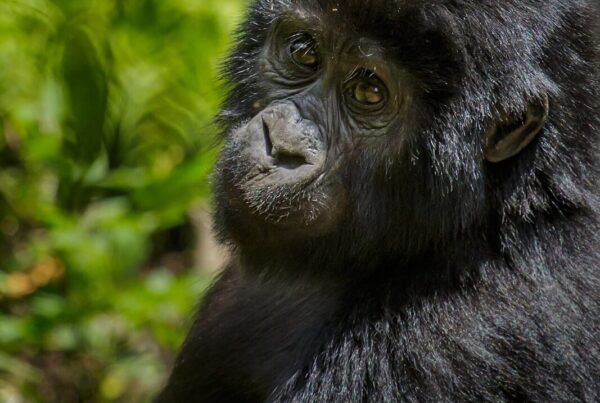
Watch for eye contact. When a gorilla meets your gaze, the resulting image carries extraordinary emotional weight. Maintain your own composure during these moments; the temptation to immediately check your camera can cause you to miss subsequent expressions.
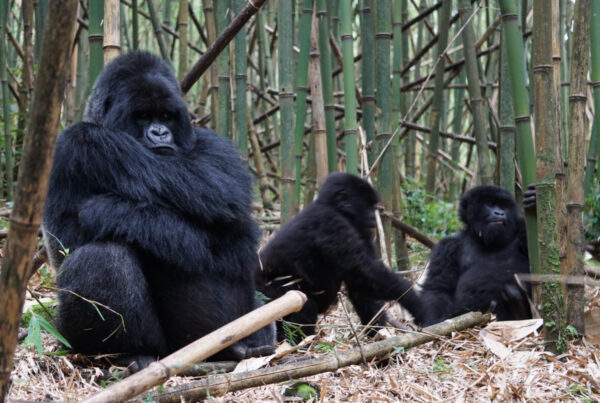
Photograph relationships, not just individuals. The spatial arrangement of family members reveals social structure. A silverback positioned centrally with females and offspring radiating outward tells a story about gorilla society that single portraits cannot convey.
Composition in the Forest
The forest’s visual chaos, vines, leaves, branches, dappled light, creates compositional challenges and opportunities. Rather than fighting the clutter, use it to create depth and context.
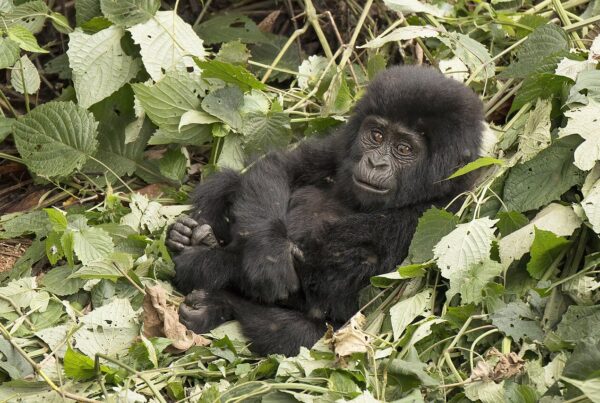
Frame gorillas with natural elements. A silverback glimpsed through hanging vines, an infant partially obscured by ferns, these compositions convey the wildness of the encounter more effectively than clean portraits against dark backgrounds. The forest is not a studio; embrace its complexity.
Use leading lines created by tree trunks, vines, and slopes to draw the viewer’s eye toward your subject. The forest’s vertical elements naturally guide attention upward toward gorillas in trees or on slopes.
Consider negative space. A gorilla positioned in the lower third of the frame, with misty forest filling the upper two-thirds, creates atmospheric images that convey the animal’s place within its environment. This environmental portraiture often resonates more deeply than tight facial shots.
Working Within the Seven-Metre Rule
The minimum distance constraint shapes every compositional decision. At seven metres, a 70-200mm zoom at the long end produces pleasing portraits, while wider focal lengths capture environmental context. The key is choosing focal lengths that suit your distance rather than fighting the constraint.
When gorillas approach closer than seven metres, resist the temptation to zoom in tighter. Continue shooting at your established focal length, allowing the unexpected proximity to create images with dramatic perspective and scale. These unplanned shots often become favourites precisely because they could not be replicated.
Use the seven metres to capture full-body shots that reveal posture and movement. Tight portraits are satisfying, but full-body images show the gorilla’s massive size, the texture of their fur, and their relationship to the forest floor in ways that close-ups cannot.
Ethical Photography Practices
Ethical considerations should guide every photographic decision in the forest. Never use flash, even if you believe your flash is weak or harmless. The prohibition is absolute for excellent reasons: flash startles gorillas, damages infants’ eyes, and can trigger defensive responses.
Shoot deliberately rather than spraying the shutter. The sound of rapid-fire shooting, while quieter than voices, still intrudes on the forest soundscape. Compose carefully, wait for moments, and shoot with intention. This approach produces better images while respecting the gorillas’ environment.
Respect the seven-metre rule even when it means missing a shot. No photograph, however spectacular, justifies endangering the animals or violating the protocols that make tourism possible. If a gorilla approaches you, step back rather than holding your ground for a closer shot.
Post-Processing for Forest Images
Raw files from the forest typically require more processing than images from better-lit environments. Shadow recovery reveals detail in dark fur. White balance correction addresses the green colour cast from canopy-filtered light. Selective noise reduction cleans up high-ISO grain without destroying fine fur texture.
Consider black-and-white conversion for some images. Removing colour eliminates the green cast that often dominates forest photography and emphasises form, texture, and emotional expression. A silverback’s face in monochrome carries a timeless quality that colour sometimes distracts from.
Crop thoughtfully. The forest’s clutter may require cropping to strengthen composition, but avoid over-cropping that leaves images pixelated or artificial. Better to compose well in-camera than to rely on cropping to save poorly framed shots.
Final Thoughts
The best gorilla photographs are not merely technical achievements. They are visual testimonies to an encounter that changed the photographer. Technical excellence serves this testimony; it does not replace it. When you review your images after the trek, the ones that matter will not be the sharpest or best composed. They will be the ones that bring back the feeling of the forest, the weight of the silverback’s gaze, the sound of breathing gorillas.
Your camera is a tool for preserving those feelings, not for creating them. Use it with skill, but use it also with humility, recognising that the true image you seek is the one that remains in your memory long after the files have been archived. That image, which no camera can capture, is the one that will sustain you. The photographs are merely reminders of what you already possess.