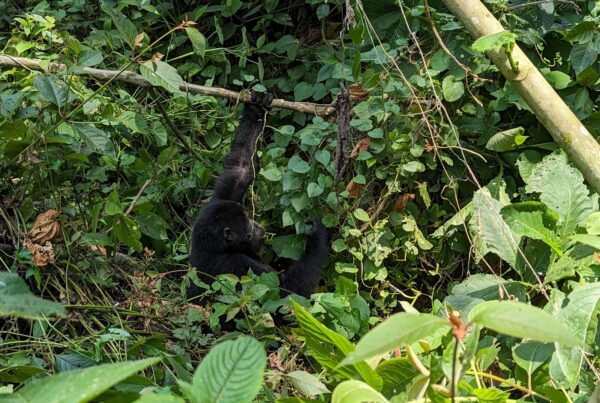
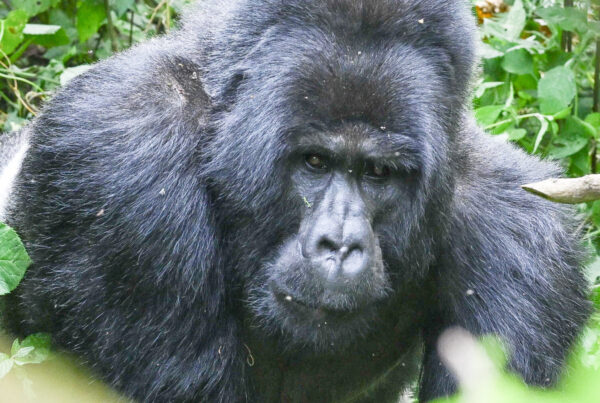
A silverback gorilla is approximately ten times stronger than the strongest human being — and this number, like the 98.3% DNA similarity, becomes something entirely different when you are standing three metres from one. The fact of ten-times-human-strength is not threatening in the context of a habituated gorilla encounter, because these animals have no interest in demonstrating their strength to tourist groups. But knowing it changes how you watch a silverback move, how you interpret the ease of his actions, and how you understand the calm authority that dominates the space around him in a way that photographs and documentaries never fully capture.
What “Ten Times Stronger” Actually Means
The figure of ten times human strength comes from studies measuring grip strength, limb muscle composition, and the structural properties of gorilla skeletal muscle. The science is complex and the exact ratio depends on what you are measuring — pulling strength, pushing strength, lifting capacity — but the order-of-magnitude difference is consistent across measurement methods.
A professional human male weightlifter can, at the peak of human physical achievement, deadlift approximately twice his body weight. A mountain gorilla silverback can bend three-inch steel bars with his bare hands. The comparison is not between a trained athlete and an average gorilla; it is between the maximum achievement of human physical training and the baseline capability of an adult male gorilla going about his ordinary day.
Why Gorillas Are So Strong
The strength comes from several converging biological factors. Gorilla skeletal muscle has a higher proportion of fast-twitch fibres than human muscle — the type that produces explosive force rather than endurance. The muscle attachment points on gorilla bones are positioned to maximise mechanical advantage in ways that human musculature is not. The overall muscle mass of a silverback — which can weigh 200 kilograms — is distributed across a frame designed for climbing, manipulating vegetation, and, when necessary, defending a family group against rival males.
Gorilla arms are also disproportionately long relative to body height — an arm span of over two metres is typical for a large silverback. This gives an enormous mechanical advantage in pulling and lifting movements, adding effective force to the already exceptional muscle capacity.
How the Strength Is Used
The daily life of a mountain gorilla uses this strength constantly, in ways that are invisible as extraordinary because they are simply ordinary for the animal involved.
Vegetation Manipulation
A significant portion of a gorilla’s daily activity involves moving through and feeding on vegetation. Branches that would require a human axe to remove, stems that would need two-handed human effort to bend, roots that would be immovable to most people — gorillas handle these with single-handed casualness. Watching a silverback clear vegetation to access food he wants is one of the quiet demonstrations of the strength differential that trekking visitors observe without always registering explicitly.
Travel
Gorillas travel primarily by knuckle-walking — a gait that uses the knuckles of the hand rather than the palm to bear the upper body’s weight. The forces involved in sustained knuckle-walking over the terrain of Bwindi — the climbing, the slope negotiation, the movement through dense undergrowth — are considerable, and are handled without apparent effort.
Social Displays
The silverback chest beat — the most visually dramatic display in the gorilla social repertoire — involves striking the chest with cupped hands to produce a deep, resonant sound that can be heard from a kilometre away. The physical force required to produce this sound is substantial; attempting to replicate it would bruise human hands immediately. The silverback does it without apparent discomfort, because his physiology is designed for it.
Experiencing the Strength in Person
No gorilla on a standard trekking encounter is likely to demonstrate its strength directly. The habituated gorillas of Bwindi are settled, calm animals that have coexisted with tourist groups for decades and do not, in normal circumstances, need to demonstrate anything to visitors.
What you observe instead are the indirect signs: the ease with which a large male moves through dense vegetation that would require significant human effort to navigate. The specific quality of stillness in a large silverback — a stillness that reads differently from human stillness because you are aware, in the presence of it, that the potential for enormous force is simply not in use at this moment. The way space arranges itself around the silverback as his family moves in response to his position, the way younger animals defer without drama to the physical reality of his authority.
You do not need a demonstration of gorilla strength to understand it. You need proximity to a large silverback to feel it as something that is present and not in use, and that not-in-use quality of contained strength is itself one of the more affecting aspects of the encounter.
The Silverback’s Choice Not to Use It
Perhaps the most remarkable aspect of gorilla strength, in the context of the trekking encounter, is that it is not used. A habituated silverback in the presence of a tourist group is choosing, continuously and without effort, not to exercise the physical capability that would make the encounter very different.
This is not anthropomorphism. It is a factual description of the situation: the animal is capable of enormous force and is not applying it, because the visitor group does not constitute a threat, and because the decades of habituation have taught the family that human visitor groups are harmless and ignorable. The choice is implicit in the behaviour — in the calm feeding, the indifferent glance and return to eating, the passage within two metres of tourist groups without acknowledgment.
Some trekkers describe the awareness of this contained strength as one of the most impressive aspects of the encounter. The silverback is not impressive because he is aggressive. He is impressive because he is the most physically powerful thing in the forest, and the most calm.
Planning Your Visit
Uganda gorilla trekking permits are $800 per person. The experience includes one hour with a habituated family in Bwindi Impenetrable National Park. Contact Uganda Gorilla Trekking to book your permit. You will not be threatened by the strength you observe. But you will understand it differently after meeting it in person than you did from reading about it here.
Frequently Asked Questions
A silverback is a mature male mountain gorilla (12+ years old) whose saddle-area back hair has turned silver-grey — a visible sign of adulthood. The silverback leads and protects his family group, decides when and where the group moves, and mediates conflicts. Each habituated gorilla family in Uganda has at least one silverback.
Adult male mountain gorillas weigh 140–200kg and stand 1.5–1.8m tall. Their arm span can reach 2.3 metres. Females are significantly smaller at 70–113kg. Mountain gorillas are the largest living primates. Despite their size, mountain gorillas are generally peaceful and only become aggressive if threatened.
Habituated silverbacks are accustomed to small groups of human visitors and generally ignore the trekking group. You may see the silverback feeding, resting, grooming family members, or moving the group through the forest. Direct eye contact should be avoided. If a silverback charges or bluff-charges, rangers instruct visitors to crouch down, avoid eye contact, and stay still.
A blackback is a sub-adult male gorilla (8–12 years old) whose hair has not yet turned silver. Blackbacks have not reached full maturity and typically live in the family group until they leave to establish their own. A silverback is a fully mature male, larger, dominant, and recognisable by the silver saddle. Both may be present in a single habituated family.
Uganda is home to the mountain gorilla (Gorilla beringei beringei), one of two subspecies of eastern gorilla. They live exclusively in the Virunga volcanic highlands (Uganda/Rwanda/DRC) and Bwindi Impenetrable Forest (Uganda only). Mountain gorillas are the only gorilla subspecies that cannot survive in captivity — every individual you can trek is a wild animal.