Updated
Baby Gorilla Development: From Birth to Independence
Baby gorilla development: from birth to independence
Baby gorilla development is one of the slowest and most carefully observed processes in the primate world. From birth at about 2 kg to full independence at age 8, infant mountain gorillas spend longer in the close care of their mothers than almost any non-human primate. This guide walks through the milestones — physical, social, and behavioural — and what they mean for the family group.
Birth and the first weeks
Mountain gorilla pregnancy lasts about 8.5 months. Births most often happen at night, in the sleeping nest, with no obvious labour observed by researchers. The newborn weighs about 2 kg (4.4 lb) — small for the mother’s size — and is helpless: pink-skinned, eyes barely open, unable to support its own weight.
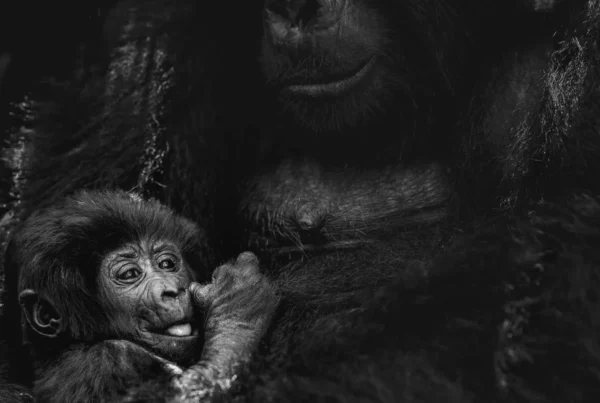
For the first 4 months, the infant is in constant physical contact with the mother. She holds it, cradles it while feeding, and uses one arm to support it through movement. The mother’s nest is built more carefully and softer than usual during these months.
Months 1–4: the “passenger” phase
- Eyes fully open within the first week.
- Begins to grasp the mother’s fur reflexively.
- Carried ventrally (chest-to-chest) by the mother throughout.
- Suckles every few hours.
- Almost no separation from the mother — even centimetres of distance is unusual.
- Other group members are interested but tolerated only at a distance; the mother is highly protective.
Mortality in this phase is the highest of any life stage. Infants who survive the first 4 months have a much better chance of reaching adulthood.
Months 4–12: starting to explore
From around 4 months, the infant transitions from ventral carrying (on the chest) to dorsal carrying (on the mother’s back) — riding piggyback as she knuckle-walks through the forest. This frees the mother’s arms for feeding and gives the infant a better view of the world.
By 6 months, the infant is supplementing milk with small amounts of plant matter, mimicking the mother’s selections. By 9 months, the first attempts to move independently happen — short, wobbly excursions of a few metres before returning to her.
Other family members can now interact more freely. Older siblings (juveniles 3–8 years old) often serve as informal babysitters, leading to one of the comedic features of any trek with infants: a 5-year-old “auntie” trying very seriously to keep up with a 7-month-old who has just figured out it can move on its own.
Year 1–2: rapid social learning
By 12 months, the infant walks independently, plays with siblings, and tries adult foods. Weaning begins around 18 months but does not finish for another 2–3 years.
This is the phase of fastest social learning. The infant watches the silverback and adult females closely, learning vocalisations, gestures, food selection, and group rules. Discipline starts: a misbehaving 18-month-old will get a single pig grunt from the silverback, and rapidly learns what is and is not acceptable.
Year 2–4: weaning and the move toward independence
Weaning is a gradual process spread over months. By age 3 the infant is mostly eating solid food but may still suckle for comfort. By age 4, weaning is complete in most individuals.
The mother, by this point, is often pregnant again or has another infant. The older juvenile separates a bit more — sleeping closer to other juveniles than to the mother, foraging at a distance, joining play groups.
This is also the phase of most active play — wrestling, chase games, mock chest beating, climbing. Play in young gorillas is genuinely educational: it builds physical coordination, teaches conflict resolution, and establishes social hierarchy that will matter for life.
Year 4–8: juvenile life
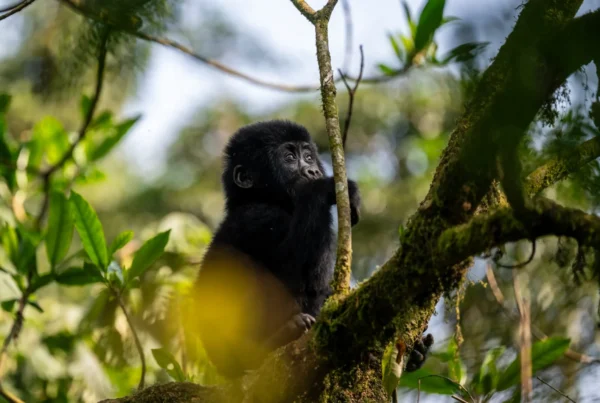
From 4 to 8 years, gorilla juveniles look like miniature adults but behave like teenagers. They feed independently, sleep in their own nests, and forage with the family but maintain looser ties.
By 6, they have developed strong food preferences and can identify dozens of plant species accurately. By 7, they know the family’s territory well enough to range independently within it.
Sex differences appear:
- Young females become attractive to other groups’ silverbacks; some will transfer to a new group around age 7–8.
- Young males begin the long process toward “blackback” status, eventually leaving the natal group around age 13–15.
Year 8 onwards: sub-adult and beyond
By age 8 a young gorilla is functionally independent, though typically still part of the natal group. Females may begin reproducing at 8–10. Males have several more years to develop into blackbacks and then silverbacks; full adult body size is reached around 12–13.
What you might see on a trek with an infant
If your assigned family has a young infant (under 1 year), several things change:
- The mother stays closer to the silverback’s centre of the group.
- The silverback is more vigilant — expect more glances toward your group, more posture changes.
- The infant is the focus of family attention; older juveniles are unusually present near the mother.
- The hour goes faster than usual — there is constant activity to watch.
Rangers will brief you specifically on infant protocol: keep extra distance, no flash, no sudden movement, low voice.
Mother-infant bonds in mountain gorillas
Mountain gorilla mothers are exceptional caregivers by any standard. They carry, groom, comfort, and protect with intensity for 4 years and continue caring for several more. Mortality of mothers is occasionally followed by adoption — adult females (sisters, aunts, the silverback in some cases) take over care of an orphaned infant. This is more common than in some primates and reflects the cohesive structure of mountain gorilla family groups.
The first year is the most dangerous
About one in four mountain gorilla infants does not reach age 5. Causes include:
- Disease (especially respiratory infections, sometimes traceable to humans).
- Falls and accidents in steep terrain.
- Infanticide during silverback transitions.
- Predation (rare; primarily leopards on isolated infants).
- Maternal death before weaning.
Conservation programmes — particularly the Mountain Gorilla Veterinary Project — have reduced infant mortality significantly since the 1990s. Health monitoring of habituated families means sick infants are sometimes treated in the field with antibiotics or supportive care delivered by darted injection.
Frequently asked questions
How big is a newborn mountain gorilla?
About 2 kg (4.4 lb), roughly the same as a human infant despite the adult species reaching 200 kg.
How often do mountain gorilla females give birth?
Roughly every 4 years on average, conditional on the previous infant surviving to weaning.
Do silverbacks help raise infants?
Yes, more than most large mammals. Silverbacks tolerate infants climbing on them, defend them against threats, and sometimes share food. They do not feed infants directly but their presence is core to infant safety.
Can I see baby gorillas on a trek?
Often, depending on the family. Some habituated families have one or two infants under age 4 at any given time. Rangers can often tell you in advance which families have infants if it matters to you.
What is the role of older siblings?
Significant. Older siblings are a major source of socialisation, play, and informal childcare. Their presence likely improves infant survival.
See the cycle in person
A trek with a family that includes a 6-month-old, a 4-year-old, and an old silverback gives you a snapshot of the whole development cycle in one hour. See our bucket list overview for trip shapes, or get in touch with your dates and we will recommend a sector and family with the right family composition.
- Gorilla Baby Development: From Birth to Independence
- 2020 Gorilla Baby‑Boom in the Impenetrable Forest
- Gorilla Pregnancy and Birth: What Happens in the Wild
- The Gorilla Baby That Made Our Entire Group Fall Silent
- Our Daughter Was Born the Same Week This Gorilla Baby Was: A Story
- Baby Gorillas Are Born at Only 2kg: Smaller Than a Human Newborn
- Gorillas Play and Wrestle: Juvenile Social Development Explained
- New Gorilla Baby Born in Bwindi March 2026: First Details
- How Rangers Rescued a Baby Gorilla Separated From Its Family
- The Day Tourists Witnessed a Gorilla Birth in the Wild: A First