Updated
Mountain Gorilla Diet: What Do Gorillas Eat in the Wild
Mountain gorilla diet: what wild gorillas actually eat
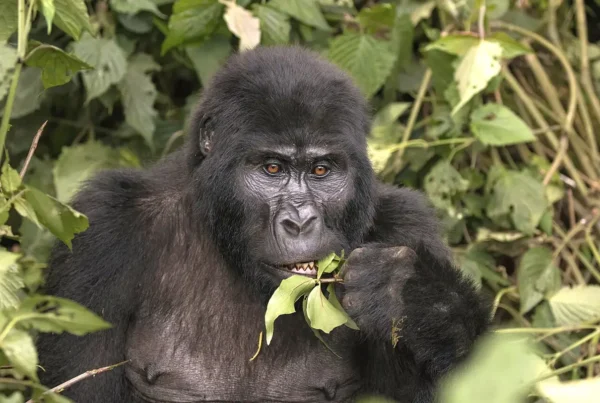
The mountain gorilla diet is one of the surprises of a Bwindi or Mgahinga trek. The first time you see a 200-kg silverback meticulously stripping bamboo shoots or chewing celery-like stems for an hour, the answer to “what do gorillas eat” stops being abstract.
The short version: mountain gorillas are almost entirely vegetarian, eat about 30 kg of plants per day, and depend on a surprisingly small list of preferred plant species in the Bwindi and Virunga forests. This guide walks through what they eat, how they eat it, when they drink water, and why their diet shapes the trekking experience.
The core diet: leaves, stems, fruit, and bamboo
Mountain gorillas eat more than 140 plant species across their range, but roughly 80% of their daily intake comes from a much smaller list:
- Wild celery (Peucedanum linderi) — high water content, year-round, eaten stem and pith.
- Bamboo shoots (Sinarundinaria alpina) — seasonal, soft new growth in the wet season, a delicacy.
- Bedstraw (Galium spp.) — a tangled vine; often the bulk daily filler.
- Thistles (Carduus, Cirsium) — surprisingly important, eaten despite the spines.
- Wild fruits — figs, pseudoarthria, and other forest fruits when seasonal.
- Roots and tubers — dug occasionally, particularly during dry spells.
- Bark from a few preferred trees, especially in periods of leaf scarcity.
An adult silverback eats roughly 25–30 kg (55–66 lb) of vegetation per day. An adult female eats around 18–22 kg. Juveniles eat proportionally less but spend almost all daylight hours feeding or moving between feeding sites.
How they eat: a slow, deliberate process
Watching gorillas feed up close is what changes most trekkers’ mental image of them. They are not voracious. They are slow, methodical, and selective. A silverback will pick up a bamboo shoot, peel the outer layer with his teeth, inspect the inner pith, take a few bites, drop it, and reach for another.
This precision matters because their food is mostly low-calorie, fibrous, and has to be processed in volume. Mountain gorillas spend roughly 30–40% of daylight hours feeding, 25–30% resting (often after feeding bouts, while their digestion catches up), and the rest moving between feeding sites or socialising.
Do mountain gorillas drink water?
Almost never directly. Mountain gorillas extract roughly 95% of their water from their food — wild celery, bamboo shoots, and most leafy plants in their diet are 80–90% water by weight. Rangers and primatologists working in Bwindi report seeing direct water consumption only a handful of times across full careers.
This water-from-food strategy explains why gorillas can live in steep, broken terrain without permanent water sources, and why they tolerate dry-season conditions well as long as the forest understory stays green.
Do mountain gorillas eat meat or insects?
Very rarely. Their diet is more than 99% plant-based. The exceptions:
- Insects — ants, termites, and some grubs are eaten incidentally, perhaps deliberately on occasion. Ants in particular are sometimes consumed when feeding on the bark of trees that house them.
- Small invertebrates attached to leaves are eaten by accident with the leaves.
- Soil and clay — geophagy is documented, particularly in Bwindi; thought to be for mineral supplementation.
Mountain gorillas do not hunt vertebrates. Reports of “gorilla predation” are either misidentified chimpanzees (chimps do hunt) or fiction.
Seasonal variation
The composition of the diet shifts through the year. In the wet seasons (March–May, September–November), bamboo shoots come in and become a preferred food — gorilla family ranges sometimes shift toward bamboo zones. Fruits peak at different times depending on the species; figs in particular are a windfall when in season. In the dry seasons, leafy plants and wild celery dominate.
The total volume eaten varies less than the composition. A silverback eats 25–30 kg whether it is January or July; what changes is what is available to choose from.
Why this affects your trek
Two practical consequences for trekkers:
- Trekking distance follows feeding patterns. Trackers locate the family from the previous day’s nest, but where they have moved overnight depends on where the next preferred food patch is. A bamboo-rich morning means short tracking; a sparser zone means a longer trek to find them.
- Encounters are calm. Gorillas you visit are almost always feeding when you arrive. They tend to ignore observers because eating is more interesting than you are. This is the reason a habituated trek feels so peaceful — the family is doing exactly what they would be doing if you were not there.
What gorillas do NOT eat in the forest
For all the variety in the diet, gorillas are surprisingly choosy:
- Many tree leaves are ignored — bitter, toxic, or too tough.
- Most fungi are not eaten, despite being abundant.
- Birds, eggs, and reptiles are not part of the diet.
- Crops adjacent to the forest are sometimes raided — banana, maize, sugarcane — which is the main source of human-gorilla conflict around park boundaries.
Crop raiding is one of the active conservation issues around Bwindi: Mubare and Habinyanja groups have entered farmland in the past, which is why community-buffer programmes (planting unpalatable crops at the boundary, beehive fences) matter so much for long-term coexistence.
How diet drives gorilla group size and movement
Because their food is energy-poor and they need volume, gorilla groups cannot stay in one place for long. A typical family of 10–15 individuals moves 0.5–1.5 km per day depending on food density, building new sleeping nests every evening from leafy material on hand. Groups of 20+ (uncommon but documented) need correspondingly larger ranges.
This is also why the Bwindi forest, despite being only 321 km², supports about half the world’s mountain gorillas — the diversity of plant species and altitudinal zones gives families enough variety to coexist without overlapping ranges too much.
FAQ
Is mountain gorilla diet the same as lowland gorilla diet?
No. Lowland gorillas (in the Congo Basin) eat more fruit — up to 70% in some seasons. Mountain gorillas live above the fruit-rich altitudinal zone and eat mostly leaves, stems, and bamboo.
Can I feed gorillas?
Absolutely not. Feeding wild gorillas is illegal, dangerous, and disrupts their behaviour. Even bringing food into the forest is regulated.
Why do silverbacks have such large bellies?
A long fermentation gut — needed to extract calories from fibrous plants. The “barrel chest” of a silverback is mostly digestive system.
Do gorillas eat all day?
They feed in bouts, typically 30–60 minutes at a time, separated by rest periods. Total feeding time is 4–5 hours per day, spread across morning and afternoon.
Are there foods unique to Bwindi gorillas?
A few — Bwindi’s lower altitude and richer forest mean its gorillas have access to more fruit species than the Virunga gorillas in Rwanda or Uganda’s Mgahinga. The diets overlap heavily but Bwindi gorillas are slightly more frugivorous.
See it in person
The diet is one of those things you read about and then watch happen in front of you. If you are planning a Bwindi or Mgahinga trek, see the 2026 permit guide for booking, or the bucket list overview for typical trip shapes. Get in touch with your dates and we will plan a trek that puts you in front of a feeding family.
- How Long Do Mountain Gorillas Live? Lifespan in the Wild
- Mountain Gorilla Diet: What Do Gorillas Eat in Bwindi?
- Mountain Gorilla Diet and Feeding Habits: What Gorillas Eat
- What do gorillas eat? The complete diet of Bwindi’s mountain gorillas
- Bamboo forests and mountain gorilla diet: the seasonal importance of Arundinaria alpine
- Why Gorilla Trekking in Uganda Is Africa’s Most Unforgettable Wildlife Adventure
- Meet the conservationist protecting mountain gorillas in the heart of the impenetrable forest.
- Gorilla Behaviour in the Wild: Understanding the Gentle Giants of Africa
- What a 3-Day Uganda Wildlife and Cycling Safari Did to My Family Was Beyond Anything We Expected
- Wildlife in Uganda – Where Nature Still Roars, Hums, and Soars Free