How gorillas communicate: vocalisations, gestures, and chest beating
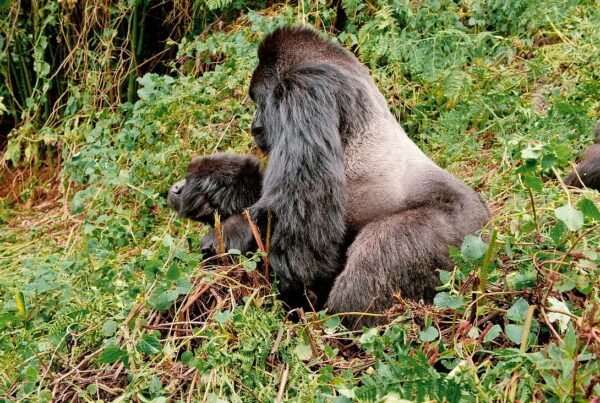
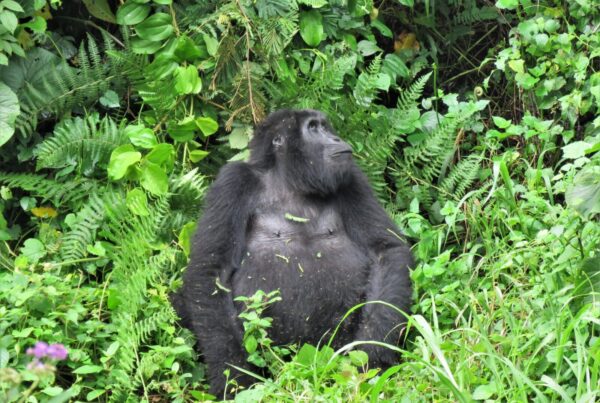
Gorilla communication is one of the most surprising parts of a habituated trek. Within ten minutes of arriving at a feeding family, you start to hear it — soft grunts, clicks, hums, and the occasional bark. Within twenty minutes you start to see it: glances, postures, gentle hand movements, the small choreography of group life. By the time the silverback gives a single deep belch and the whole family resettles, you understand that gorillas are talking to each other constantly.
This guide walks through how mountain gorillas communicate — the vocalisations, the body language, the famous chest beating — and what each signal actually means in the family group.
The vocal repertoire
Researchers have catalogued more than 22 distinct vocalisations across mountain gorilla populations. The ones you are most likely to hear on a habituated trek:
- Belch vocalisations (“naoom” hums) — the most common contented sound. A long, low rumble made while feeding or resting. It tells the rest of the family “all is well, I am here.”
- Pig grunts — short, sharp grunts used during disagreements, especially over food or proximity. The silverback often uses them as mild reprimands.
- Whimpers and screams — juveniles in distress, mostly. Adults respond rapidly.
- Barks — alarm or aggression. A short, sharp bark tells the family to be alert; a louder bark can announce the silverback’s annoyance with another silverback or a perceived threat.
- Roars and screams — full-volume territorial display. Rare in habituated families because they have no reason to use them.
- Cough grunts — a soft “huh huh huh” — often associated with the silverback signalling moves.
- Wraagh (alarm bark) — sharp, sudden, usually paired with a brief stare in the direction of the perceived threat.
The belch hum is the soundtrack of a habituated visit. If you hear it from multiple individuals at once, the family is calm and feeding. If it stops, something has changed.
Body language
Gorillas read each other (and you) primarily through body language — direction of gaze, posture, distance, and small gestures.
- Direct stare — a challenge. Trekkers are explicitly briefed not to stare at silverbacks for this reason.
- Averted gaze — submission or peaceful intent. The silverback uses it to defuse mild conflicts within the family.
- Fully turned back — strong dismissal or trust. A silverback turning his back on you means he has accepted you are no threat.
- Bipedal posture — usually preceded by chest beating; signals strength.
- Hand on the ground, knuckle-walking toward another — neutral or low-level approach.
- Tense shoulders, raised hair — a real threat signal. Rangers will move you back if they see it directed at the group.
Chest beating: not what you think
Chest beating is the most famous gorilla behaviour, and it is genuinely impressive — a silverback rises onto two feet, claps cupped hands against his chest at high speed, and produces a sound audible across kilometres of forest.
What it actually signals depends on context:
- Display to other silverbacks — the most common context. A way to broadcast size, status, and territory without an actual fight. Most chest beats are received as information, not provocation.
- Female-attraction display — younger silverbacks chest beat to advertise their fitness, especially around females coming into oestrus.
- Excitement or play — juveniles chest beat as part of play behaviour, often unsuccessfully (their chests are small and the sound is comical).
- Mild irritation — sometimes a silverback chest beats at humans or other animals not as a precursor to charge but as a “back off a step” message.
Recent research at Karisoke (the long-term Rwanda research site) suggests that the frequency of chest beats correlates with body size — bigger silverbacks beat at lower frequency. So nearby silverbacks can assess each other’s size acoustically, without needing to meet face to face.
Mock charges and real charges
A silverback who feels his family is threatened may mock-charge — running forward bipedally, screaming, breaking branches. The rule, drilled into every trekker at the briefing, is: do not run. A mock charge stops short. The silverback is testing you. If you stand your ground (or, better, kneel and look at the ground), he resettles.
Real charges (resulting in contact) are extraordinarily rare in habituated families. They happen sometimes when a silverback is unhabituated, when an unfamiliar male enters the family’s range, or when humans break the rules. Tourist injuries during habituated treks are a tiny fraction of one percent across both Uganda and Rwanda over the past 30 years.
How juveniles communicate
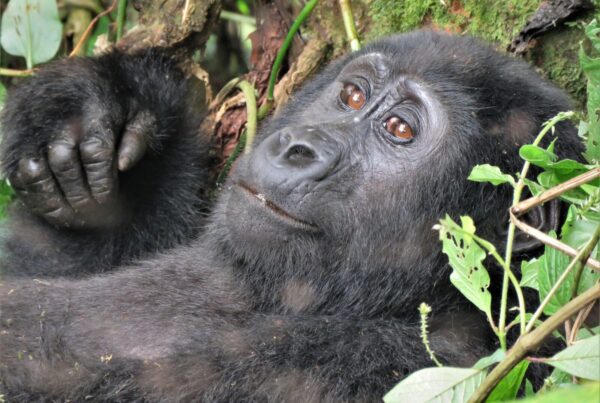
Juvenile gorillas are noisier and more visually expressive than adults. Play involves chuckling sounds (a kind of gorilla laughter), wrestling, chase games, and constant testing of social rules. They learn vocalisations and gestures by watching the silverback and adult females, and by getting reprimanded — usually a single pig grunt is enough to stop a misbehaving juvenile.
Watching a 4-year-old learn to chest beat is one of the comedic highlights of any trek. They get the choreography right, but the chest is too small to make the proper sound, and the silverback usually pretends not to notice.
Communication with humans
Habituated families have learned a specific human-gorilla protocol. Rangers communicate consistently: low voice, calm posture, no sudden movements, no direct eye contact with silverbacks beyond a few seconds. The gorillas in turn read humans as a known quantity — neither food nor threat. Some individuals are visibly curious (juveniles especially) and may approach to within a few metres; rangers will gently move you back to maintain the seven-metre distance.
One of the things long-term trackers say about habituation: the family learns to recognise individual rangers. A new ranger gets more cautious looks for the first few visits, even if his behaviour is identical to the team he replaces. Gorilla communication is, in part, recognition.
Frequently asked questions
Can gorillas understand human speech?
Wild gorillas do not understand the words. They read tone, volume, and posture. Whispering, smiling (without showing teeth), and calm body language all read as friendly to a habituated gorilla.
Why are we told not to show teeth?
A bared-teeth display is a threat or fear signal in gorilla communication. A friendly human smile (with teeth) can be misread.
Do gorillas use sign language in the wild?
No. Sign language gorillas (Koko, Michael) were captive individuals taught a modified American Sign Language. Wild gorillas have a rich communication system but it is not human sign language.
Can I record sound during the trek?
Yes — many trekkers use phones to record vocalisations. Keep volume off (no playback to the family) and stay seven metres back.
What is the loudest sound a silverback makes?
A full chest-beat-and-roar combined display can reach 115 dB at the source — louder than a chainsaw. You hear them from a kilometre away.
Plan a trek and listen for it
Reading about gorilla communication is one thing; sitting four metres from a feeding family and hearing the belch hums move through them like a wave is the actual experience. See our bucket list overview for trip shapes, or get in touch to plan a trek with your dates.
- How gorillas communicate: vocalisations, gestures, and the language researchers have decoded
- How Gorillas Communicate: Sounds, Gestures and Body Language
- Why Gorillas Beat Their Chests: The Real Science Explained
- Why Do Gorillas Beat Their Chests? The Full Display Explained
- A Silverback Chest Beat Can Be Heard 1km Away: The Science Behind It
- Gorillas Use Over 25 Different Sounds to Communicate With Each Other
- Mountain gorilla vocalisations: what the sounds in the forest mean