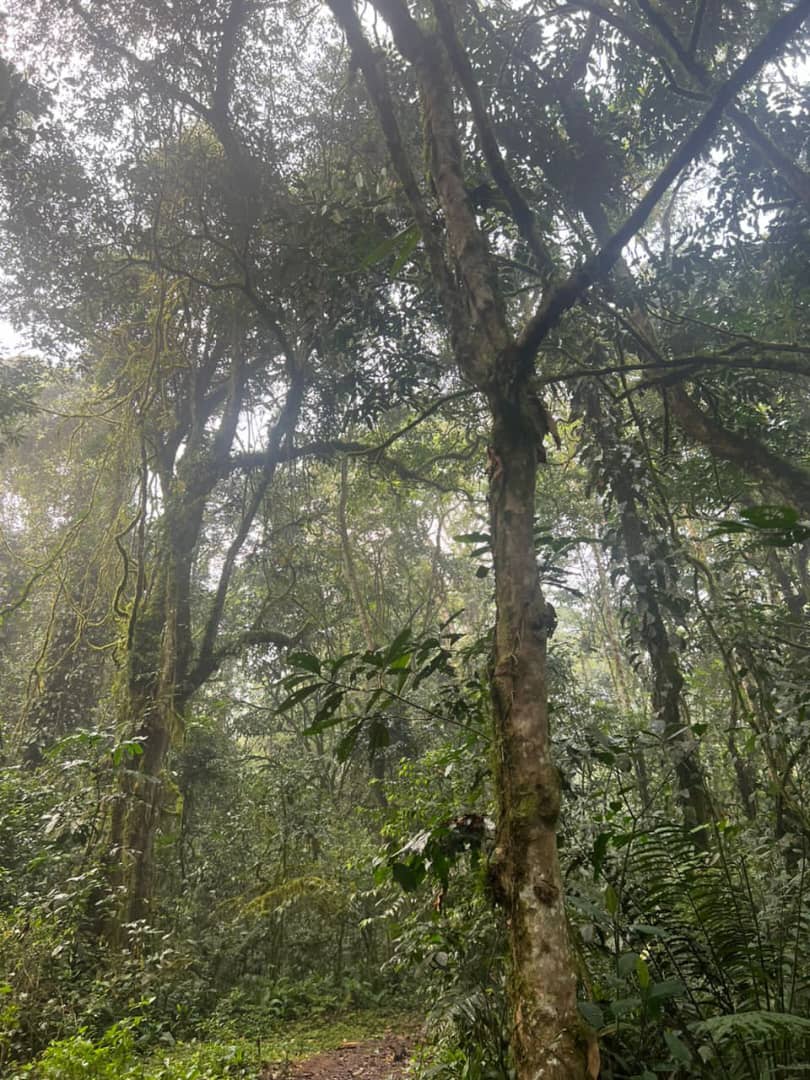
Bwindi Impenetrable National Park’s forest is not simply a collection of trees—it is a three-dimensional ecosystem in which every vertical zone, from the forest floor to the emergent canopy layer forty metres above, supports distinct communities of plants and animals. Among the most ecologically important and visually striking elements of this vertical world are the strangler figs and the diverse assemblage of epiphytic plants: ferns, orchids, mosses, bromeliads, and lichens that live their entire lives attached to the trunks and branches of other trees, never touching the ground.
What an epiphyte is and why Bwindi has so many
An epiphyte is any plant that grows on another plant for physical support while deriving its nutrients from the air, rainwater, and decomposing organic matter that accumulates around it—not from its host. Unlike parasites, epiphytes do not extract nutrients from the trees they inhabit. They are opportunists exploiting elevated real estate: by growing on tree trunks and branches, they access light that would be unavailable on the heavily shaded forest floor.
Bwindi’s high rainfall—averaging between 1,130 and 2,390mm annually—and persistent cloud cover create an atmosphere of near-constant humidity that epiphytes require to absorb moisture from the air between rain events. The forest’s diversity of tree species and its complex structural profile, with multiple distinct canopy layers, provide an enormous surface area and range of microclimates. The result is an epiphytic community of exceptional richness: over 100 species of orchids, 200 species of ferns, and countless mosses and lichens have been recorded within Bwindi’s boundaries.
Strangler figs: from seed to giant
Strangler figs belong primarily to the genus Ficus and begin life as seeds deposited by fruit-eating birds or bats in the canopy of a host tree. The seed germinates high above the ground and sends roots downward along the trunk of the host, while simultaneously extending branches upward to reach light. Over decades, the fig’s roots multiply and fuse around the host trunk, forming a latticed wooden cage. As the roots thicken, they compress the host tree’s vascular tissue, eventually killing it—hence the name.
The death of the host leaves a hollow column inside a self-supporting strangler fig tree. These hollow centres become refuge for bats, insects, reptiles, and small mammals. The fig tree that remains is often among the largest and most architecturally complex in the forest, with buttressed roots spreading across metres of ground and a canopy that supports hundreds of fruiting events throughout the year.
Why fig trees are keystone species
Ficus species in Bwindi are keystone species: they have a disproportionate effect on the ecosystem relative to their biomass because they fruit continuously and asynchronously, providing food during periods when other fruit sources have failed. Mountain gorillas consume fig fruits extensively, as do chimpanzees, hornbills, grey-cheeked mangabeys, colobus monkeys, and many other species. The fig-fig wasp mutualism—every Ficus species is pollinated by a specific wasp species that breeds inside the fig’s enclosed flower structure—makes the system even more remarkable. Remove the fig trees and the consequences cascade through dozens of dependent species.
Orchids: the jewels of Bwindi’s epiphytic community
Bwindi’s orchid diversity is extraordinary. Most are small and inconspicuous, growing as clusters of pseudobulbs and slender leaves attached to mossy bark, blooming in tiny flowers that require magnification to appreciate fully. But some are spectacular: large-flowered Eulophia species emerge from the forest floor in grassland clearings, while delicate Angraecum species with white star-shaped flowers and long nectar spurs occupy mid-canopy positions. Bulbophyllum species, with their intricate, often bizarre flower structures, are particularly numerous in Bwindi, and specialist botanists continue to document new species during survey expeditions.
Orchid collection from the wild is illegal and has historically been one of the pressures on Uganda’s orchid populations. Conservation management in Bwindi now includes monitoring of rare orchid populations, and community education programmes explain the ecological and aesthetic value of leaving these plants in place.
Mosses and the water cycle
Mosses cover virtually every available surface in Bwindi’s wetter zones: tree bark, fallen logs, rocks, and soil. Their ecological role extends far beyond decoration. Moss mats absorb rainfall at rates that can exceed their own dry weight by ten times, releasing water slowly into the soil and streams rather than allowing it to run off the surface immediately. This sponge function moderates stream flow, reduces soil erosion, and maintains the groundwater levels that sustain the park’s rivers year-round.
For gorillas and other forest mammals, moss-covered bark provides drinking water during dry periods—animals will press their faces against mossy surfaces to extract moisture. Forest elephants and buffalo also use moss-rich seeps and springs, and rangers tracking gorillas learn to read the distribution of mossy areas as indicators of where groundwater is accessible.
Observing the vertical forest on your trek
Most gorilla trekkers focus naturally on the gorillas themselves and may overlook the extraordinary plant life surrounding each encounter. Before the gorilla family is reached and during rest stops on the trail, look upward: identify the trunk lattices of strangler figs, the cascading fern fronds hanging from mid-canopy branches, the tiny orchids in flower on mossy bark. A brief conversation with your guide about what you are seeing enriches the experience significantly and deepens the context in which the gorillas live. These plants are not background scenery—they are the functional infrastructure of an ecosystem that has supported mountain gorilla life for millions of years.
- Strangler figs of Bwindi: the remarkable trees that build and destroy a forest
- Strangler figs in Bwindi: the trees that reshape the forest
- Tree ferns and prehistoric plants: Bwindi’s connection to ancient forest ecosystems
- Medicinal plants of Bwindi: what the forest provides for local communities
- Medicinal plants of Bwindi Impenetrable Forest: a guide to the forest pharmacy
- Forest elephants in Uganda: the giants that share Bwindi’s ecosystem
- African wild ginger and other medicinal plants of Bwindi’s forest floor
- Traditional medicinal plants of the Bwindi region: the forest pharmacy
- African wild ginger and forest floor herbs: the medicinal plants of Bwindi’s understorey
- Bwindi Impenetrable Forest – Gorilla Trekking in Uganda’s UNESCO Jungle
Frequently Asked Questions
Minimum: 3 days (arrive, travel to Bwindi, trek, return — very rushed). Recommended: 5–7 days to include proper travel time and a buffer day. If combining with Kibale chimps or a game park, allow 8–12 days. The 8-hour road journey from Kampala to Bwindi means a 3-day trip involves almost no rest.
A popular 7-day itinerary: Day 1 — Arrive Entebbe, transfer to Kampala or Entebbe hotel. Day 2 — Fly or drive to Bwindi. Days 3–4 — Gorilla trekking (one or two treks), forest walks. Day 5 — Return to Entebbe via Kampala or direct charter. Days 6–7 — Optional Entebbe or Kampala city time before departure.
Yes, but they are in different countries. A combined itinerary typically routes Entebbe (Uganda gorillas) → Nairobi or Kilimanjaro (Tanzania/Kenya safari) with a connecting flight between legs. Allow 10–14 days total. Alternatively, Uganda’s own Queen Elizabeth National Park offers excellent big game alongside the gorilla experience without the international connection.
Near Bwindi: Batwa Cultural Experience (indigenous forest walk with the Batwa community), guided birding walks (350+ species), forest nature walks, waterfall hikes, community village visits. Within 2–3 hours of Bwindi: Lake Bunyonyi (canoeing, island walks), Mgahinga (golden monkey trekking, Virunga volcano hiking).
Uganda is home to the mountain gorilla (Gorilla beringei beringei), one of two subspecies of eastern gorilla. They live exclusively in the Virunga volcanic highlands (Uganda/Rwanda/DRC) and Bwindi Impenetrable Forest (Uganda only). Mountain gorillas are the only gorilla subspecies that cannot survive in captivity — every individual you can trek is a wild animal.