Updated
spiritual gorilla encounter Bwindi is a subject central to Uganda’s wildlife tourism, where mountain gorilla conservation and responsible visitor experiences go hand in hand. There is a category of experience that resists the practical language of wildlife tourism and ecological education — an encounter so outside the normal texture of daily life that it requires a different kind of vocabulary. Many gorilla trekkers reach for spiritual language to describe what happens when a mountain gorilla meets their eyes for the first time. Not because they are religious in a conventional sense, and not because they are prone to mysticism, but because the encounter genuinely disturbs the ordinary categories through which experience is processed and asks something of the person who undergoes it.
The spiritual dimension of gorilla encounters: what the forest asks of you
The phenomenology of the encounter
Phenomenology is the philosophical study of conscious experience — what it is like to undergo something from the inside. The phenomenology of the gorilla encounter has several specific characteristics that distinguish it from other wildlife experiences and from most encounters with large animals.
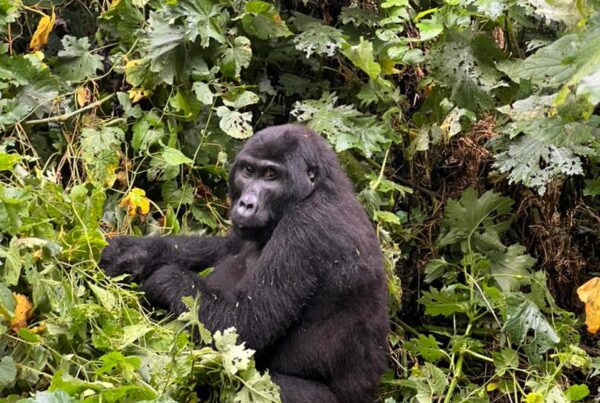
The first is the mutual recognition. When a gorilla looks at you directly — not the alarmed assessment of a threatened animal, but the calm, curious, evaluative gaze of a habituated animal that has seen humans many times and has simply decided to look at you for a moment — the recognition is felt as precisely that: mutual. The ordinary relation of observer and observed collapses. You are not watching an animal; the animal is watching you watching it. This symmetry of attention, across a distance of evolutionary time and ecological difference that makes the meeting almost improbable, can produce a quality of presence that is difficult to account for in ordinary descriptive terms.
The second characteristic is the scale disruption. Gorillas are larger than most people’s mental image of them, and proximity to that size — particularly to a silverback whose bulk and power are apparent even in a relaxed resting posture — overrides the intellectual knowledge that the animal is not threatening. The body responds before the mind can interpret. Heart rate increases. Breathing becomes deliberate. Time slows. This physiological response to proximity with something much more powerful than yourself is ancient and universal, and it creates an unusual quality of concentrated presence — what athletes call “being in the zone” — that ordinary life rarely generates.
What contemplative traditions have to say
Several contemplative traditions have developed conceptual frameworks that fit the gorilla encounter better than ordinary tourist language does. Buddhist thought on interconnection — the idea that all sentient beings participate in a shared field of consciousness that precedes individual identity — is frequently cited by meditators who have also encountered gorillas as a practice that prepared them to receive the experience with more openness. The concept of interbeing developed by Thich Nhat Hanh — the understanding that nothing exists independently but only in relation to everything else — has an almost literal truth in a forest ecosystem where the gorillas, the plants, the soil organisms, the atmospheric moisture, and the visiting human are each constituted by and constitutive of the others.
Indigenous African spiritual traditions around the Bwindi area also have frameworks for understanding the forest and its inhabitants that are different from either Western scientific ecology or conventional wildlife tourism. The Bakiga communities who have lived adjacent to this forest for centuries do not relate to it as a resource to be managed or a spectacle to be visited. It is a presence — something that is there in a way that shapes the landscape of experience regardless of whether it is being engaged with directly. The forest sounds at night, the mist on the hills at dawn, the knowledge of what lives in the interior — these constitute a background awareness that structures daily life in ways that visitors from environments thoroughly separated from wild nature can barely imagine.
The ethics of the encounter
The spiritual language that gorilla encounters generate is not merely personal and descriptive — it has ethical implications. If the gorilla that looked at you is, in any meaningful sense, a subject of experience rather than merely an object of scientific study and conservation management, then the obligations that follow from that recognition are significant. Many trekkers leave Bwindi with a deepened sense of what it means to live in a world shared with beings whose inner lives may be richer and more varied than most people assumed before the encounter.
Peter Singer’s animal ethics framework — which grounds moral consideration in the capacity for suffering rather than in species membership — is relevant here, as are the legal arguments for great ape personhood that have been advanced in various jurisdictions. Mountain gorillas are not persons in the legal sense, but they have social bonds, emotional responses, play behaviour, grief responses to loss, and problem-solving intelligence that make their existence morally significant in ways that exceed what purely instrumental conservation arguments capture.
The one-hour time limit, the seven-metre distance rule, the prohibition on visits by people with symptoms of illness, the requirement for cough masks — these are not arbitrary bureaucratic constraints but expressions of a genuine ethical commitment to minimising the cost that human visits impose on the animals being visited. The rules exist because the people who made them took seriously the idea that gorilla welfare matters in itself, not just as an economic asset or a conservation symbol. Observing them is a form of ethical practice as well as a regulatory compliance.
Sitting with the experience
There is an old tradition in some forms of contemplative practice of sitting with an experience rather than immediately processing and categorising it. The gorilla encounter — which tends to arrive with considerable emotional charge and a sense of having been touched by something that cannot be immediately explained — rewards this kind of patient attention. Not rushing to post the photographs, not immediately framing the experience in narrative for social media, not reaching for the ready-made language of travel writing or conservation advocacy: just allowing what happened to have the full texture of its significance without prematurely closing it down into an anecdote.
The afternoon after a gorilla trek is one of the quieter, more reflective experiences that travel offers if you allow it to be. The lodge veranda, the light changing over the canopy, the sounds of the forest below — these provide a context in which the morning’s encounter can settle and deepen rather than dissipate. Many trekkers describe this afternoon as part of the experience rather than a recovery from it: a space in which something that happened in the forest continues to happen, below the surface of ordinary thought, throughout the day.
- Gratitude and awe in the forest: the psychology of transformative wildlife encounters
- Bwindi Impenetrable Forest – Gorilla Trekking in Uganda’s UNESCO Jungle
- Meet the conservationist protecting mountain gorillas in the heart of the impenetrable forest.
- 2020 Gorilla Baby‑Boom in the Impenetrable Forest
- Gorillas and Their Fascinating Social Structures: The Heartbeat of the Forest
- 3 Days Congo Gorilla Trekking Safari: Raw Encounters in Africa’s Wildest Jungle
- Uganda Primate Safaris: Journey Into the Forests Where We First Belonged
- Silverback Gorilla Size: The Full Measure of a Forest Titan
- Silverback Gorilla Habitat: Where the Kings of the Forest Truly Belong
- Gorilla Group Formation and Dynamics: The Deep Bonds That Shape Life in the Forest