Updated
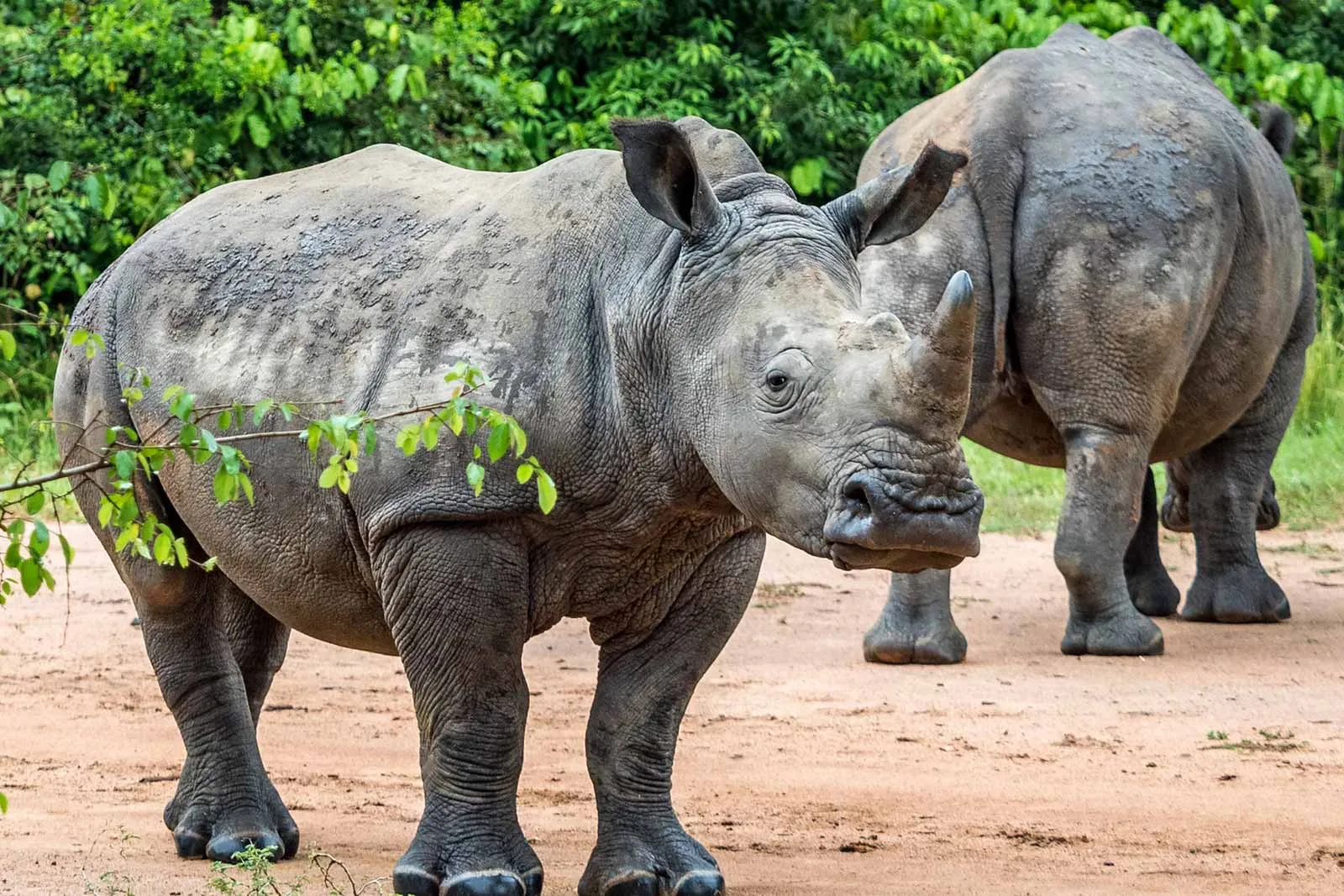
Remarkable Return of Rhinos in Uganda How Uganda lost its rhinos Uganda once had two kinds of rhino. Uganda lost its last wild rhino in 1983. Today about 50 southern white rhinos live in the country again, almost all of them bred at Ziwa Rhino Sanctuary, a fenced private ranch about 176 km north of Kampala. In January 2026 the first of them were moved back into a protected area in the north. This is how the comeback happened, where it stands now, and how you can track rhinos on foot at Ziwa on the way to Murchison Falls.
Remarkable Return of Rhinos in Uganda
How Uganda lost its rhinos
Uganda once had two kinds of rhino. Northern white rhinos grazed the grasslands of the West Nile region, including the area that is now Ajai Wildlife Reserve. Eastern black rhinos lived in Murchison Falls and the Karamoja plains around Kidepo. Both were wiped out during the insecurity of the 1970s and early 1980s, when army deserters and organised gangs shot wildlife for horn and ivory and park protection collapsed.
The last native rhino was killed in Murchison Falls in 1982, and rhinos were declared extinct in Uganda in 1983. The northern white rhino has since all but vanished everywhere. Only two females survive, in Kenya, so Uganda’s original white rhinos can never return. Any comeback had to use the closely related southern white rhino.
Ziwa Rhino Sanctuary: six founders and a fence
Planning for a return began in the late 1990s under Rhino Fund Uganda, a non-profit working with the Uganda Wildlife Authority. What was missing was a safe place to breed. Parks were still recovering from the poaching years and could not yet guarantee a rhino’s safety. The answer came from a private landowner. Ziwa Ranchers set aside about 70 square kilometres of bush and swamp in Nakasongola District, and the sanctuary was enclosed with an electric fence and patrolled by armed rangers.
Six founder rhinos arrived in 2005 and 2006: four from Kenya and two from Disney’s Animal Kingdom in Florida. Fittingly, the Disney animals descended from rhinos that had left Uganda decades earlier. The first calf born on Ugandan soil in more than 20 years arrived in 2009. His father was Kenyan and his mother American, and he was named Obama.
Since then the herd has grown steadily through natural breeding. That is slower than it sounds: a female carries a calf for about 16 months and usually breeds again only two to three years later. By late 2025 Ziwa held around 49 rhinos, which made it one of the few places in Africa where white rhino numbers were rising while the species declined elsewhere.
From one sanctuary back to the wild: 2025–2026
Keeping a whole national population inside one fence is risky. A disease, a fire or a single well-organised poaching gang could undo twenty years of work, and in a closed herd related animals end up breeding with each other. Uganda’s National Rhino Conservation Strategy therefore aims to spread rhinos across several protected areas and to add new bloodlines from outside the country.
Both have now begun. In December 2025 Uganda received eight southern white rhinos from South Africa to widen the gene pool. In January 2026 the Uganda Wildlife Authority moved four rhinos from Ziwa about 220 km north to Ajai Wildlife Reserve in West Nile. It was the first time rhinos had been moved from one Ugandan protected area to another, and the first rhinos at Ajai since the northern whites disappeared. Sixteen more are due to follow once the first group has settled. Kidepo Valley National Park is next in line as a future rhino home.
For now, Ziwa remains the only place in Uganda where visitors can reliably see rhinos. It is still the source herd for every future release, so a tracking fee paid there goes straight into the programme.
Tracking rhinos on foot at Ziwa
Ziwa offers something that is rare in Africa: walking up to white rhinos with a ranger. The rangers know where each rhino group spent the night and keep in radio contact with the teams that watch them around the clock. After a short briefing you drive to the area and then walk the last stretch through grass and acacia scrub. The walk is usually 1–3 hours in total and the terrain is flat, so most people can do it without special fitness.
Once you reach the rhinos, the ranger positions the group downwind, often 15 to 30 metres away. White rhinos are grazers with poor eyesight and are calm when undisturbed, so you can watch them feed, wallow and nurse calves while the ranger explains each animal’s name and history. Rules are simple: stay together, speak quietly, keep behind the ranger and move to a tree if told to. Charges are rare but possible, particularly from a mother with a young calf.
Rhino tracking for foreign non-residents has been around US$50 per person, with lower rates for residents and East African citizens. Park entry and guiding are bundled in, but check the current rate when you book because sanctuary fees change. Other activities include a guided nature walk, birding and night walks. Early morning shoebill canoe trips run in the Lugogo swamp, which is one of the better chances of seeing a shoebill in central Uganda.
Fitting Ziwa into a Uganda safari
Ziwa sits on the Kampala–Gulu highway, three to four hours from Kampala and roughly halfway to Murchison Falls National Park. Most travellers stop there on the way north: leave Kampala early, track rhinos late morning, have lunch at the sanctuary, and reach Murchison by late afternoon. If you want the shoebill canoe trip or a less rushed visit, stay overnight at the sanctuary’s lodge or guesthouse.
Adding Ziwa gives a Uganda trip all of the Big Five, though for now the rhinos are in a sanctuary rather than a wild park. A typical route pairs rhinos at Ziwa with elephants, lions, buffalo and leopards in Murchison Falls National Park or Queen Elizabeth National Park, then chimpanzees in Kibale and gorillas in Bwindi. A northern loop of Ziwa, Murchison and Kibale before the gorillas fits well into 10–12 days.
What the rhino story says about Uganda’s conservation
The rhino comeback follows the same pattern as the mountain gorilla recovery. Strict protection, rangers on the ground and visitor fees that pay for both allowed a population that had almost disappeared to grow again. Mountain gorillas were moved from critically endangered to endangered in 2018, and gorilla permit income is still the backbone of protection in Bwindi. Read more in our pieces on how tourism saved mountain gorillas and the economics of the US$800 gorilla permit.
Frequently asked questions
Not yet in visitable numbers. Almost all of Uganda’s rhinos live at Ziwa Rhino Sanctuary. The first four were moved to Ajai Wildlife Reserve in January 2026, and Kidepo Valley is planned as a future home.
Roughly 50 to 60 southern white rhinos, counting the herd bred at Ziwa and the eight imported from South Africa in December 2025.
Yes, when you follow the ranger. White rhinos are generally calm, and rangers keep groups at a safe distance and downwind of the animals.
Yes. Ziwa is on the Kampala–Gulu road, about halfway to Murchison, and most visitors track rhinos there on the drive north.
No. Uganda’s eastern black rhinos were lost by the early 1980s, and all rhinos in the country today are southern white rhinos.