TALK TO AN EXPERT +256 716 068 279 WHATSAPP OPEN NOW.
Climate, Weather & Seasons

Reading Uganda’s weather: how to check forecasts and plan your trek day

Home / Travel News, Stories & Tips / Tales from the Mist / Reading Uganda’s weather: how to check forecasts and plan your trek day

Gorilla trekking proceeds in all but genuinely dangerous weather—there is no standard policy for cancellation due to rain, and the gorillas certainly do not take wet days off. But understanding Uganda’s weather patterns and knowing how to read and interpret forecasts for the Bwindi area allows you to set the right expectations, pack the right gear, and make the most of the atmospheric conditions—whatever they turn out to be—on your trek day.

Why Bwindi’s weather is hard to forecast precisely

Bwindi Impenetrable National Park sits in a complex topographic setting—a highland ridge system at 1,160 to 2,607 metres, positioned at the boundary between the Congo Basin climate system (which drives moisture-laden weather from the west) and the East African highlands climate system (which has its own precipitation dynamics driven by the Great Rift Valley and the Great Lakes). This complexity means that standard weather forecast models—which operate at scales of tens to hundreds of kilometres—cannot reliably resolve the hyperlocal precipitation patterns at Bwindi. A forecast showing “partly cloudy with afternoon showers” for the Kabale region may describe conditions at Bwindi Buhoma sector accurately or may describe conditions at a weather station 30 kilometres away while Bwindi itself is either clear or heavily rained upon. Treat any specific forecast for Bwindi as indicative rather than definitive.

Useful forecast sources for Bwindi

Several weather forecast services provide reasonably useful data for the Bwindi area. Weather.com and AccuWeather both provide hourly forecasts for Kabale district—the nearest urban centre with its own weather station—which give a reasonable proxy for broad conditions (rainy vs. dry, temperature range) if not precise local conditions. Dark Sky (now integrated into the Apple Weather app) and Meteoblue provide higher-resolution forecast data that accounts for terrain elevation more precisely than standard forecasts; Meteoblue’s specific mountain weather product is worth checking for any trek day that could be affected by elevation-related weather. For Uganda-wide weather context, the Uganda National Meteorological Authority (UNMA) publishes seasonal outlooks and medium-range forecasts on its website, which are particularly useful for understanding whether a specific week falls within a dry or wet period for the season. Your lodge staff and park rangers have the most current local knowledge—ask them the morning of the trek what conditions they expect based on the overnight and morning weather pattern.

Reading the morning sky

Experienced Bwindi rangers and guides read the morning sky to assess likely conditions for the day with a local knowledge that no forecast model can replicate. Several patterns are useful for travellers to know. Clear skies at 6 a.m. with light mist in the valley bottoms typically indicate a fine morning that may cloud over by early afternoon—classic dry season pattern. Low cloud sitting on the ridges at dawn often burns off by 9 to 10 a.m. during dry season. Persistent heavy cloud with no break by 7 a.m. during wet season typically indicates a rain-likely day—rain may come in the morning or the afternoon but is probable. A “red sky in morning” at Bwindi (unusual—requires specific cloud and dust conditions) is taken by local weather observers as a reliable rain predictor for the same day. Your ranger guide will have made this assessment before you even ask; the briefing they give at the park gate will already account for expected conditions.

Temperature forecasts and what to wear

Temperature forecasts for Bwindi’s elevation should be adjusted downward by approximately 6°C from Kabale town forecasts—the lapse rate (temperature decrease with altitude) means that the lodge at 1,800 metres is meaningfully cooler than the Kabale valley floor at 1,850 metres only if you account for the terrain and wind exposure. A forecast for 22°C in Kabale might translate to 18°C at the Bwindi trailhead and 14°C on an exposed ridge section at 2,200 metres—a range requiring layering rather than a single clothing choice. The layering principle: a moisture-wicking base layer, a mid-weight fleece or softshell, and a waterproof outer layer that stays in the daypack until needed. This system handles the full temperature range of a Bwindi trek day regardless of whether the forecast proves accurate or not.

Wind and its effects on the forest

Wind is the most underforecast weather element for Bwindi trekkers. The highland ridge setting means that when air masses move from the Congo Basin into the Rift Valley highlands, the topography channels and accelerates wind in ways that make specific exposed ridges and open forest sections feel significantly windier than valley-bottom trails. Wind increases evaporative cooling—a lightweight fleece that feels warm in still air in the forest may feel inadequate on a windy ridge. It also affects wildlife behaviour: gorilla families tend to move to more sheltered lower-elevation positions during high wind, and the approach through the forest can be noisier (wind in the canopy) and more disorienting in terms of sound. Rangers navigate by sight and track rather than sound in high-wind conditions; the trek proceeds normally, but the arrival at the gorilla family may require a different approach than on still days.

What weather does not affect: the gorilla encounter itself

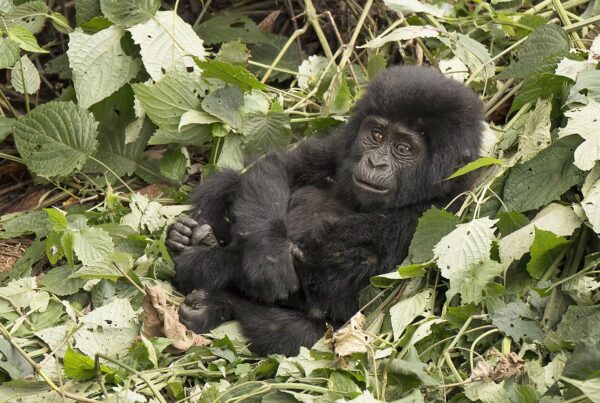
It is worth stating clearly: the weather does not determine whether you see gorillas. The habituated gorilla families are located by rangers using both radio tracking (some families wear radio collars) and the knowledge built up over years of daily monitoring. Rangers locate the family’s sleeping trees from the previous night before dawn and are in position to guide trekking groups to the family’s morning location. Even in heavy rain, the gorillas are found—they are in the forest, not conditional on sunshine. The weather affects your comfort during the walk, the photography conditions during the encounter, and the aesthetic character of the experience. It does not affect the fundamental fact of the encounter itself, which will happen regardless of whether the morning is clear or overcast, still or windy, dry or wet. Pack for the weather. Don’t worry about whether it will happen.

The unexpected gift of bad weather days

Many experienced Bwindi trekkers report that their most memorable encounters happened in rain—the forest intimate and misted, the gorillas closer to the ground and less likely to move away, the one-hour window extended in quality by the atmospheric conditions even if the photographic light is challenging. Rain in the forest at Bwindi is not unpleasant in the way that rain in a city or on a beach is unpleasant. It is part of the forest’s sound, its smell, its texture. The patter of rain on broad leaves, the mist rising from valley streams, the silverback sitting like a boulder while rain runs off his massive back: these are images that do not require good weather. They require only the willingness to be there, wet and present, in the forest that the rain is making more itself.

Ready to experience Uganda’s mountain gorillas in 2026? Secure your gorilla permits early and let us craft a seamless safari tailored to your travel style, preferred trekking sector, and accommodation level. From luxury lodges to well-designed midrange journeys, every detail is handled for you. Every itinerary is carefully planned to maximize your time in the forest while ensuring comfort, safety, and unforgettable encounters.

Have questions about gorilla permits, travel dates, or the best itinerary for you? Speak with a safari expert and get clear, honest guidance to plan your trip with confidence.

When is the last time you had an adventure? African Gorillas!!! Up Close With Uganda’s Wild Gorillas Touched by a Wild Gorilla: An Unforgettable Encounter Inside Gorilla Families: Bonds, Hierarchies & Jungle Life Face to Face With a Silverback: The Wild Encounter You’ll Never Forget