Updated
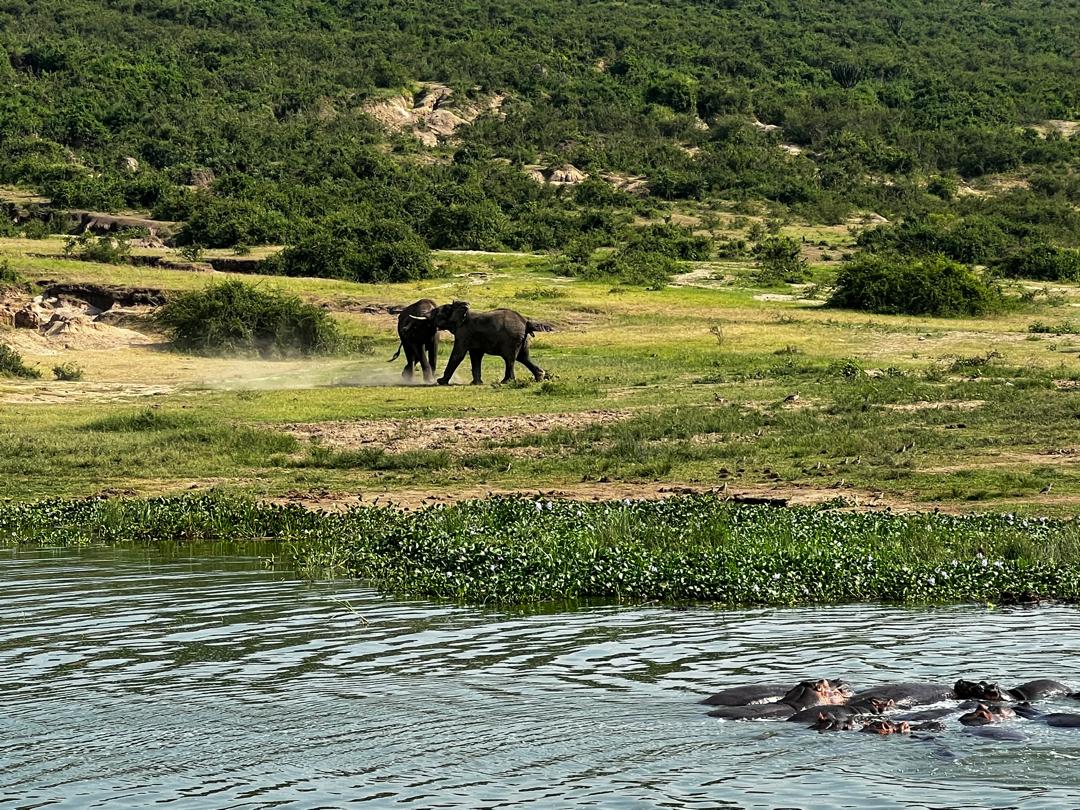
hippos Uganda Queen Elizabeth National Park is one of Uganda’s most impressive wildlife species, encountered in national parks on game drives and guided safari experiences. No Uganda wildlife itinerary is complete without a hippo encounter, and no park in Uganda delivers hippos more reliably and dramatically than Queen Elizabeth National Park. The Kazinga Channel—a 40-kilometre natural channel connecting Lake George to Lake Edward, running through the heart of the park—holds one of Africa’s highest concentrations of hippopotamus, with an estimated 2,500 to 3,000 individuals lining its banks and wallowing in its shallows. A boat safari on the Kazinga Channel is one of the most reliable close-range hippo experiences available anywhere in Africa.
Hippos of Uganda: the river horse in Queen Elizabeth National Park
The hippo: basic biology and behaviour
The common hippopotamus (Hippopotamus amphibius) is the world’s third-largest land animal after the elephant and the white rhinoceros—adult males can weigh 1,500 to 3,000 kilograms and measure over five metres in length. Despite their bulk, hippos can run at speeds up to 30 kilometres per hour over short distances and are among the most dangerous animals in Africa, responsible for more human deaths annually than lions or leopards combined. Their danger comes not from aggression in the conventional sense but from the intensity of their territorial defence—males defending water territory will attack boats, vehicles, and people who come between them and the water. On a Kazinga Channel boat safari, where hippos are encountered at five to ten metres from a flat-bottomed launch, the guides and park rangers who run the boats know these individuals by their scarring and territorial positions and navigate accordingly.
The Kazinga Channel boat safari
The two-hour afternoon launch trip on the Kazinga Channel, departing from the Mweya Peninsula jetty, is consistently rated among the top five wildlife experiences in East Africa. The flatwater setting allows close approach to animals that would maintain greater distances from land-based vehicles: hippos open their mouths in territorial yawning displays metres from the boat, crocodiles bask on sandy banks at eye level, and the incredible bird diversity of the channel margins—Goliath heron, yellow-billed stork, African spoonbill, malachite kingfisher, pied kingfisher, and the astonishing variety of waders and wildfowl—provides a bird list that approaches 100 species on a productive two-hour run. The afternoon departure timing (typically 3 to 5 p.m.) coincides with the peak activity period for both hippos and birds as the day cools and wildlife becomes more active after midday torpor.
Hippo behaviour: what you will see
In the water during daylight hours, hippos exhibit a characteristic repertoire of behaviours that the boat position allows you to observe closely. Territorial yawning—the wide-open mouth display revealing tusks that can reach 50 centimetres in adult males—is a threat display rather than tiredness, used against rival males and anything perceived as a territorial intrusion. Snorting and sinking—the hippo inhales at the surface, then sinks backward below the surface for two to five minutes before rising again to breathe—is the basic respiratory cycle of a semi-aquatic animal that sleeps in the water during the day and grazes on land at night. Social contact between females and young—touching, resting against each other, allowing calves to climb on adults’ backs—is one of the more visually appealing behaviours visible from the boat. The sounds the hippos produce—the deep, resonant honk-grunt that carries across the channel and communicates territorial information between groups—are among the most distinctive sounds of the African wetland.
Queen Elizabeth’s elephant and buffalo
Queen Elizabeth National Park holds considerably more wildlife than its hippos and waterbirds suggest. The park’s savannah zones—particularly the Kasenyi Plains in the north and the Ishasha Plains in the south—support elephant, buffalo, Uganda kob, waterbuck, warthog, topi, and spotted hyena. The Ishasha sector is famous for a tree-climbing lion population—a small group of lions with the unusual habit of resting in fig and acacia trees during the heat of the day, behaviour documented only at Ishasha and at a few locations in Tanzania’s Lake Manyara. Arranging a game drive through the Ishasha sector as part of a combined Queen Elizabeth–Bwindi itinerary adds both the tree lions and a drive through some of the most beautiful savannah in Uganda to the wildlife experience.
Queen Elizabeth as part of the Uganda circuit
The standard positioning of Queen Elizabeth National Park in a Uganda gorilla trekking itinerary is as a one or two night stop on the journey between Kampala and Bwindi—breaking the overland route into manageable sections while adding significant wildlife value. From Kampala, the drive to Queen Elizabeth’s Mweya Peninsula takes approximately five to six hours; from Mweya, the drive to Bwindi’s Buhoma sector takes approximately two to three hours. The timing works naturally: arrive Queen Elizabeth on day two, Kazinga Channel boat safari on the afternoon of day two, morning game drive on day three, then drive to Bwindi for the evening before the trek on day four. The contrast between the open savannah of Queen Elizabeth—hippos, elephants, kob, the famous tree lions—and the dense enclosed world of Bwindi makes each destination more vivid in retrospect. Uganda rewards this kind of contrast itinerary.
Hippo conservation and human-wildlife conflict
Hippopotamus populations across sub-Saharan Africa have declined significantly over the last three decades, with the IUCN classifying the species as Vulnerable. The primary threats are habitat loss (wetland drainage and shoreline agriculture reducing hippo grazing habitat) and human-wildlife conflict—hippos that leave the water at night to graze in agricultural fields cause crop damage that generates intense hostility from farming communities. In Uganda, hippo-crop conflict is most severe along the shores of Lake Victoria and around the smaller lakes and rivers that border agricultural land. In Queen Elizabeth National Park, the Kazinga Channel’s protected status has maintained the hippo population at high density—making it a conservation success story within a continent-wide decline. The boat safari revenue that funds park management is a direct contributing factor to the hippos’ continued presence in those numbers.
Photography tips for hippo encounters
The Kazinga Channel’s flat-water setting means the photographic challenge is less about reaching the animals and more about managing the strong equatorial light (harsh midday sun versus better afternoon quality), the boat’s gentle movement, and the variable distance between the boat and subjects. A 100–400mm or 150–600mm zoom is ideal for the range of subjects encountered—close hippos at 5 to 10 metres may require a moderately wide setting, while distant bird subjects on the far bank need full extension. The boat rocks gently but consistently; use the fastest shutter speed the light allows to minimise motion blur. The most dramatic hippo photographs are the yawning territorial displays—these last only two to five seconds. Anticipate them by watching for the initial head lift and neck extension that precede the full yawn, and have the camera ready before the peak display rather than scrambling after it has already peaked.
- Queen Elizabeth National Park Uganda: Wildlife Safari and Chimps
- Queen Elizabeth National Park Animals: Complete Species Checklist
- Queen Elizabeth National Park: tree-climbing lions and the Kazinga Channel explained
- Queen Elizabeth National Park: complete visitor guide
- Top 10 Photography Spots in Queen Elizabeth National Park
- Mgahinga Gorilla National Park – Uganda’s Hidden Gem for Gorilla Trekking 2025
- Game Drives in Kidepo Valley National Park: Into Uganda’s Wildest Frontier
- 3 Days in Queen Elizabeth Uganda Safari: A Hidden Gem Compared to Serengeti & Masai Mara
- Combining Gorilla Trekking With Safari: Queen Elizabeth, Chimps and More
- The History of Bwindi Impenetrable National Park: From Forest to World Heritage Site