Updated
preparing children for Uganda safari is a subject we explore in depth in this guide, drawing on direct experience and expertise from Uganda’s wildlife and safari industry. A safari to Uganda—particularly one that includes gorilla trekking—is among the most powerful educational experiences a child can have. It is also, if handled poorly, a source of anxiety, boredom, or disappointment. The difference between a child who returns from Bwindi transformed by what they witnessed and one who spent the trip complaining about mosquitoes usually comes down to preparation. What a child understands before they arrive shapes everything they perceive when they get there. This guide is for parents who want to do that preparation thoughtfully.
Preparing children for their first safari: age-appropriate lessons before Uganda
Start with the basics: where is Uganda?
Children who have a geographic anchor for a journey pay more attention to everything that follows. Before the trip, spend ten minutes with a globe or an atlas. Find Uganda—equatorial East Africa, west of Kenya, east of the DRC, north of Rwanda. Find Bwindi Impenetrable National Park in the southwestern corner. Trace the route from home. Show them Lake Victoria—the second-largest freshwater lake on Earth—and the Nile flowing north from it. Show them the chain of volcanoes that forms the Albertine Rift, and explain that gorillas live in the forests on those volcanic slopes. Geography stops being abstract when it has a destination attached to it. Children who know where they are going look out of plane windows with curiosity rather than restlessness.
Mountain gorillas: building genuine knowledge
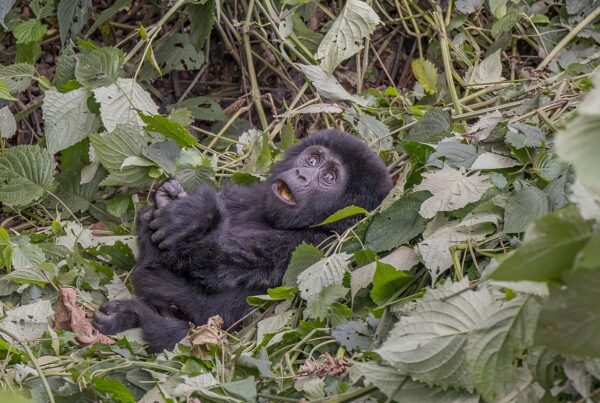
Many children have seen gorillas on television or in zoos, but their concept of what a mountain gorilla actually is—its size, its social life, its intelligence, its vulnerability—may be vague or distorted by cartoons and Hollywood. Before the trip, watch the BBC and Netflix documentary footage of mountain gorillas: David Attenborough’s work in particular treats gorillas with reverence and accuracy. Read together from age-appropriate natural history books. Explain that mountain gorillas are one of the world’s most endangered species, that fewer than 1,100 exist on Earth, and that your permit fee directly funds their protection. When children understand they are visiting a genuinely rare and protected animal—not a theme park exhibit—their behaviour during the actual encounter changes markedly. They become quieter, more attentive, more emotionally engaged.
The trekking reality: what to expect physically
Gorilla trekking is not a zoo visit. Children need to know—honestly and without sugarcoating—that the trek involves steep slopes, thick vegetation, mud, insects, and uncertain duration. You could hike for two hours or six hours before locating the gorillas, depending on where the group has moved. Once found, you have exactly one hour with them. Framing this honestly prevents the most common source of child discomfort on trek: the realisation that things are harder or longer than expected. But the honest framing also builds anticipation: the gorillas are wild, free, living on their own terms, and you are going into their world to find them. That framing—adventure rather than inconvenience—transforms a child’s experience of the same physical reality.
Age minimums and what they mean
Uganda Wildlife Authority requires all gorilla trekking participants to be at least 15 years old. This minimum exists for welfare reasons on both sides: younger children are more likely to make sudden movements, speak loudly, or become distressed during the encounter, which can disturb the gorilla family and create safety risks. Older teenagers, properly prepared, are typically excellent trekkers—curious, focused, and deeply moved by the experience. For families with children under 15, alternatives exist: chimpanzee trekking in Kibale (minimum age 12), golden monkey trekking in Mgahinga (minimum age 12), and the Batwa cultural trail (no minimum) all offer extraordinary wildlife and cultural encounters that younger children can participate in fully.
Teaching conservation before you arrive
One of the most valuable conversations you can have with a child before a Uganda safari is about why wildlife conservation matters and what threatens it. Mountain gorillas were pushed toward extinction by habitat loss, poaching, and disease. Their population collapsed to around 620 individuals in the late 1980s before conservation efforts—funded in large part by tourism—began to reverse the trend. Today there are over 1,100, and the population is still growing. This is a conservation success story, but it is fragile. Explaining this gives children a framework for understanding what they will see: the rangers, the permits, the strict rules about distance and time, the community programmes. None of it is bureaucracy—it is the machinery of survival for an animal their generation might actually save.
Wildlife identification: a pre-trip game
Uganda has over 1,000 bird species, more mammal species than any other country in Africa, and extraordinary insect diversity. Giving children a field guide before the trip and encouraging them to learn 10 to 20 species—birds are easiest—transforms them from passive observers into active participants. The African fish eagle, the grey crowned crane (Uganda’s national bird), the hornbill, the sunbird, the marabou stork: each is visually distinctive and memorable. When a child spots a crowned crane at Lake Bunyonyi and recognises it, the moment becomes theirs—a personal achievement rather than something an adult pointed out. This same principle applies to mammals: the Ankole longhorn cattle, the hippo, the vervet monkey, the red-tailed monkey. Knowledge creates connection.
Cultural preparation: the people of Uganda
Uganda is not just wildlife—it is people. The Baganda, Bakiga, Batwa, Banyankole: each group has distinct traditions, languages, foods, and crafts. Before the trip, explore Uganda’s cultural geography with children at an appropriate level. Explain that the Batwa were the original forest-dwellers of Bwindi and that visiting the Batwa Trail is an opportunity to hear their story directly. Teach a few words of Rukiga or Luganda—agandi (hello), webale (thank you)—and encourage children to use them. Local people are consistently delighted when foreign visitors make even a small effort with local language, and the response children receive when they try reinforces the value of cultural respect in a way no lecture can match.
Managing expectations around technology
Mobile connectivity in the forest is limited—lodges may have WiFi in common areas but gorilla trekking happens in zones where phones are offline. For many children (and honestly many adults) this is a bigger adjustment than the physical demands of the trek. Framing the disconnect positively—as part of what makes the experience real—helps. Some families make an explicit agreement before the trip: phones are for photography only during the trek, not for social media or gaming. This is worth discussing openly. A child who has mentally agreed to the digital rules before arriving adjusts far more gracefully than one for whom the restriction comes as a surprise at the park gate.
After the trip: sustaining the lesson
The preparation does not end when the plane lands home. What children do with their Uganda experience in the weeks and months afterward shapes whether it becomes a lasting part of their worldview or fades into holiday memory. Encourage them to write about what they saw, draw the gorillas, present to their class, donate a portion of their pocket money to a gorilla conservation organisation. The Gorilla Doctors, the International Gorilla Conservation Programme, and the Bwindi Community Hospital all accept small donations and can send the child updates about the animals they visited. Connection sustained is education deepened.
- Uganda Primate Safaris: Journey Into the Forests Where We First Belonged
- Travelling to Uganda With Children: Family Gorilla Safari Tips
- Bwindi Gorilla Trekking with Children: Family Safari Guide
- First Safari? Why Uganda in 2026 Is the Best Decision You’ll Ever Make
- How to explain endangered species to children: lessons from the mountain gorilla
- Wildlife journals for children: how to keep field notes on a Uganda safari
- Planning a multi-generational Uganda safari: what works for grandparents and grandchildren
- Gorilla conservation games and activities for children on a Uganda safari
- What children learn from seeing a mother gorilla with her infant: lessons in nurture and care
- Gorilla Trekking Cost in Uganda – 2025 Permit, Safari & Budget Breakdown