Updated
junior ranger programmes Uganda children lies at the heart of Uganda’s commitment to protecting its extraordinary wildlife heritage for generations to come. Conservation begins with children who grow up believing that wild animals matter and that their own choices have consequences for the natural world. Uganda—with one of the most significant concentrations of large mammal and bird diversity on Earth—is an extraordinary classroom for this kind of learning. Beyond the passive experience of watching gorillas or elephants, several programmes in Uganda actively involve children in the ranger and conservation activities that protect these animals. These junior ranger and youth conservation programmes are among the most powerful educational tools available to families visiting Uganda, and they are worth seeking out deliberately rather than discovering by accident.
Junior ranger programmes in Uganda: getting children involved in conservation
What junior ranger programmes offer
Junior ranger programmes in Uganda’s national parks typically involve a structured curriculum of activities led by Uganda Wildlife Authority rangers and community conservation staff. Activities vary by park and programme but commonly include: guided nature walks focused on species identification (plants, birds, insects) rather than large mammal viewing; ranger demonstrations of tracking skills, snare detection, and wildlife monitoring techniques; tree planting and forest restoration activities; conservation talks from park rangers covering the threats facing specific species and what is being done to protect them; and crafts or science activities (dissecting an owl pellet, examining insect specimens, drawing wildlife from life) that develop observational skills. Some programmes conclude with a junior ranger certificate and a badge—tangible markers of participation that children wear with genuine pride.
Uganda Wildlife Authority youth programmes
Uganda Wildlife Authority runs junior ranger programmes at several of its national parks, with the most established operations at Bwindi Impenetrable (Buhoma sector), Queen Elizabeth, Murchison Falls, and Kibale. The programmes are not always prominently advertised to international visitors—they are primarily designed for Ugandan school groups visiting national parks as part of environmental education programmes—but international families who request participation in advance are usually accommodated. The cost is modest; contact UWA’s tourism department through your safari operator well before the trip to confirm availability and to book. If a structured programme is not available on your dates, requesting a ranger-guided nature walk with an educational focus (rather than purely wildlife viewing) achieves similar outcomes in a less formalised format.
Gorilla Doctors’ educational engagement
The Gorilla Doctors—the international veterinary organisation that provides medical care to habituated mountain gorilla groups in Uganda, Rwanda, and DRC—runs educational programmes that extend to schools and community groups in the areas surrounding the parks they work in. While they do not typically run formal programme for international tourist children, their educational materials are available online and their work provides an excellent framework for pre-trip learning: the science of gorilla health monitoring, the veterinary interventions that have saved specific named individuals, and the One Health framework (connecting the health of humans, animals, and ecosystems) that underpins their approach. Children who are familiar with the Gorilla Doctors’ work and who encounter rangers on trek or in the field can ask informed questions about veterinary monitoring—a level of engagement that rangers find genuinely rewarding to respond to.
Community-based youth conservation in Bwindi buffer zone
Around the Bwindi park boundary, several community organisations run youth environmental education programmes as part of their community conservation mandates. The Bwindi Community Hospital’s environmental health programme includes school outreach activities in the parishes surrounding the park. Nature Uganda—a conservation organisation with strong roots in the Albertine Rift region—runs school birding clubs and youth nature groups in communities near several national parks. These programmes are primarily for local children, but visiting families who connect with community organisations through lodge introductions or operator recommendations sometimes find opportunities to participate in tree planting days, school conservation presentations, or joint walks with local youth groups. These encounters—international children and Ugandan children around the same trees, planting the same seedlings, taught by the same ranger—are among the most quietly transformative experiences that Uganda travel can produce.
Roots and Shoots school groups near Bwindi
Jane Goodall’s Roots and Shoots programme has active groups in Uganda, including schools in communities near national parks in the southwest. Roots and Shoots Uganda coordinates youth environmental and humanitarian projects—tree planting, waste management, wildlife education—and some groups are located in the parishes immediately surrounding Bwindi. A few lodges and community organisations near Buhoma and Rushaga have informal connections with local Roots and Shoots groups that can sometimes be facilitated for visiting families. The encounter—an international child meeting a Ugandan child who is already engaged in conservation activity—transcends the tourist-community relationship in ways that standard village visits do not. These connections must be initiated through lodge staff or your operator; cold approaches to schools are not appropriate or effective.
Making the most of the safari as education
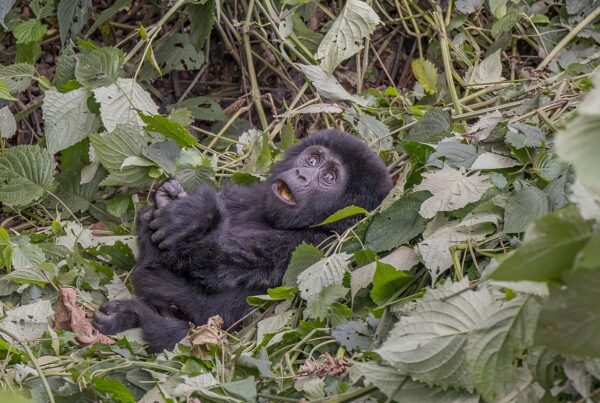
Even without a formal junior ranger programme, the entire Uganda safari can be structured as educational engagement for children. Give each child a field guide and a species list to work through. Ask rangers and guides to explain what they do and why—most are delighted to share their expertise with genuinely curious children. Visit the Batwa Trail and encourage children to ask the guide questions about the forest and the Batwa relationship with it. Let children lead a section of the community walk, identifying plants or birds they have prepared for. When the gorilla hour is over, ask children to describe one specific thing they noticed that surprised them—not “the gorillas were amazing” but “I noticed the juvenile was eating a specific kind of leaf and the adult was watching him.” Observational specificity is the beginning of scientific thinking, and the gorilla encounter provides material for it that no textbook can match.
After the trip: sustaining junior ranger identity
The junior ranger certificate, the field notes, the photographs, the species list: these are the tangible outputs of a child’s engagement with Uganda’s wildlife. Sustaining that engagement after the trip requires connection to an ongoing community of practice—a school wildlife club, a Roots and Shoots group, a correspondence with a Gorilla Doctors programme, or simply a regular habit of wildlife watching that keeps the observational skills sharp. Many lodges provide information about conservation organisations that accept child sponsorships or correspond with young donors—the Gorilla Doctors’ “adopt a ranger” or the Dian Fossey Fund’s youth education arm are good options. A child who returns from Uganda and becomes the wildlife advocate in their school class—explaining the conservation status of mountain gorillas, describing how permit fees work, sharing their field guide with friends—is a conservation multiplier whose impact cannot be quantified but is entirely real.
- Gorilla adoption programmes for children: how symbolic adoption supports real conservation
- What a Gorilla Ranger Earns Per Month and Why It Matters for Conservation
- From Farmer to Ranger: How Conservation Changed a Community
- How children learn conservation values through wildlife encounters in Uganda
- The role of the Uganda Wildlife Authority: rangers, management, and the people behind conservation
- Teaching children about conservation through gorilla trekking stories
- Teaching children about conservation through gorilla trekking stories
- The role of women in Ugandan conservation: rangers, researchers, and community leaders
- Teaching children about gorilla conservation: how young visitors understand the forest
- School conservation programmes near Bwindi: education as a long-term strategy