Updated
gorilla trekking family experience conservation perspective is one of Africa’s most extraordinary wildlife experiences, connecting travellers with mountain gorillas in their natural forest habitat. Across thousands of accounts from families who have done gorilla trekking in Uganda — in post-visit surveys conducted by lodges, in published travel writing, and in the informal record of what visitors say to rangers and guides in the week after their trek — a consistent pattern emerges: the encounter with a habituated gorilla family changes how visitors understand conservation from an abstract cause supported at a distance to a specific and personal responsibility connected to specific animals they have met in a specific forest that would not exist without ongoing, deliberate human decisions to protect it. The mechanism is not sentiment alone. See Bwindi gorilla trekking and Uganda safari packages.
- Permit revenue flow: USD 800 gorilla permit; 20% (USD 160) goes directly to adjacent communities via UWA’s community revenue sharing programme
- UWA revenue use: anti-poaching rangers, habitat monitoring, veterinary care, community development projects
- Population change: mountain gorillas are the only great ape species whose population is growing; from ~300 in 1990s to over 1,000 today
- The conservation logic: habituated gorilla families that generate tourism revenue are protected assets; the economics make their protection in local interest
The following account is a composite drawn from the kinds of stories shared by families who have done gorilla trekking in Uganda — the practical challenges, the emotional moments, and the lasting impact that the experience tends to produce. Names and specific details are illustrative rather than drawn from any single family’s account.
How gorilla trekking changed one family’s perspective on conservation: a composite story
Before the trip
When the Hargreave family — two parents in their late forties, a seventeen-year-old daughter, and a fifteen-year-old son — started planning a significant family trip, the initial suggestions were predictable: beach holiday, city tour, something European and manageable. It was the son who pushed for Uganda. He had watched a BBC documentary about gorilla conservation and had started reading about Dian Fossey and the Karisoke research station. He wanted to see what he had watched. He made his case carefully, showing his family the costs, the logistics, and the conservation significance of the trip.
The planning took six months. The permits were booked nine months in advance for a June departure, taking the advice of every guide who warned about peak season availability. The family researched lodges, read trip reports, ordered appropriate footwear, and in the months before departure, worked through preparation together: documentaries, books (both adults read “Gorillas in the Mist,” the daughter read it twice), online resources about the specific gorilla families they might encounter. By the time they boarded the flight to Entebbe, all four knew more about mountain gorilla conservation than most adults who have spent careers working in Africa.
The morning of the trek
The briefing at Bwindi’s Buhoma sector started at 8 am. The ranger delivered the standard briefing — the distance rule, the coughing protocol, the instruction to remain calm if gorillas approached, the one-hour limit — and the family listened with the particular attention of people who had been anticipating this moment for months. The father, who had done significant hiking in his life, felt some anxiety about the terrain; the mother, who had not, felt considerably more.
Each family member hired a porter. The ranger had assessed their fitness levels quietly during the briefing and the morning’s initial walk out of the briefing area, and the group was assigned to the Mubare family — one of Bwindi’s longest-habituated groups, with a home range that on this particular June morning was relatively accessible from the sector headquarters. The walk took ninety minutes. The forest closed around them within five minutes of leaving the road. The mother, who had worried about the terrain, found that the worry dissolved in the reality of the forest itself: she was too busy looking, listening, and managing her footing to sustain anxiety about what was ahead.
The encounter
They heard the gorillas before they saw them — the distinctive belch vocalisations that the ranger had described in the briefing, a deep rumbling that seemed to come from the vegetation ten metres ahead. The ranger held up his hand and the group stopped. He spoke quietly in Rukiga to the other rangers ahead, listened, and then turned and said simply: “They are here.”
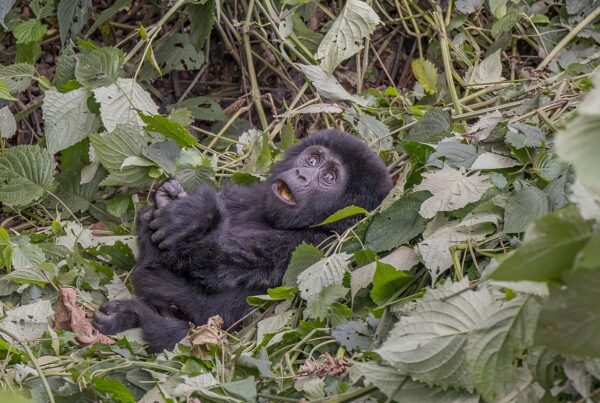
The first gorilla they saw was a juvenile — perhaps three years old — sitting in a small opening in the vegetation eating a stem. The family arranged itself as the ranger directed, finding positions with sight lines through the vegetation. Within two minutes, more gorillas were visible: a mother with an infant on her back moving through the understorey to the left; another juvenile climbing a vine perhaps five metres above the ground; and then, twenty metres beyond, the silverback, sitting with his back to the group and eating slowly.
The son later described the next forty minutes as the most fully present he had ever been. He was not thinking about school, about his phone, about anything beyond the specific animals in front of him. He watched the mother set her infant down and begin grooming it with the focused attention of someone inspecting a fine piece of work. He watched the juvenile descend from the vine, approach the group to within four metres, make direct eye contact with the daughter for several seconds that felt much longer, and then scramble back into the vegetation. He watched the silverback turn and look at the group once — a long, evaluating gaze — and then return to eating.
When the hour ended and the ranger said it was time to leave, the mother was the one who cried first. She had not expected to. She had expected to find it moving and interesting and significant — she had not expected to find it overwhelming. She did not quite know what to do with the intensity of what she had felt watching the infant’s face, or the silverback’s look. Walking out of the forest, she did not speak for almost an hour.
After the trip
The family returned to the United Kingdom changed in ways that are hard to articulate precisely and easy to list concretely. The father, who had never previously donated to conservation organisations, set up a monthly standing order to the Dian Fossey Gorilla Fund. The daughter changed her school project from a topic she had been planning for two years to a presentation on gorilla conservation and the economics of wildlife tourism. The son started a school club for wildlife conservation awareness. The mother began following several conservation scientists on social media, reading their updates about mountain gorilla population numbers, health events, and political challenges in the DRC and Uganda with the specific attention of someone who had seen the animals she was reading about.
None of these were dramatic transformations. They were small, consistent changes in the direction of greater engagement with the natural world and its protection. They accumulated, as small consistent changes do, into something substantial. Two years after the trip, the family returned to Uganda for a second gorilla trek, this time adding Kibale chimpanzees and a Murchison Falls boat trip. The son is now applying to university to study conservation biology.
What the gorillas gave them
What the Hargreave family received from an hour with mountain gorillas in Bwindi was not a transaction — not a service rendered for a fee. It was an encounter with something real in a world increasingly mediated by screens, designed environments, and curated experiences. The gorillas were not performing. The forest was not arranged for their comfort. The encounter could not be replicated, downloaded, or shortened to a highlight reel without losing what made it significant.
That reality — the specific, irreplaceable, uncontrolled reality of wild animals in a wild place — is what gorilla trekking offers and what no other experience adequately substitutes for. The Hargreaves knew this intellectually before they went. They understood it, in a completely different register, when they came back.
Why does meeting gorillas in person affect conservation attitudes more than reading about them?
The psychological mechanism behind the attitude change is well-studied in environmental psychology: direct encounter with a charismatic animal in its habitat activates emotional and identity-based conservation motivation in ways that information transfer alone does not. Reading that gorilla populations are threatened is information; watching a specific silverback make eye contact with you across 8 metres of Bwindi forest creates a memory with specific emotional valence that is processed differently from abstract information. The specificity matters: a conservation cause with a face and a place is more motivationally powerful than a conservation cause without one. This is not a weakness in human cognition but a feature: our species’ strongest motivational systems evolved to respond to specific, concrete, immediate situations rather than abstract statistical populations. The gorilla encounter delivers conservation motivation through exactly the channels that produce durable attitudinal change — direct experience, emotional memory, personal relationship (however brief) with a specific animal, and a concrete understanding of what is at stake if protection fails.
How does spending money on gorilla trekking directly help gorilla conservation?
The tourism revenue mechanism for gorilla conservation is more direct than most visitors realise. The USD 800 permit fee flows to Uganda Wildlife Authority, which uses it to fund: the ranger-guides who lead every trek (approximately 100-200 trained UWA rangers at Bwindi); the anti-poaching patrols that operate continuously in and around the park boundary; the Mountain Gorilla Veterinary Project veterinary team that provides medical intervention when gorillas are injured by snares, acquire respiratory illness, or require veterinary care; and the park infrastructure (roads, ranger posts, visitor facilities) that makes tourism viable. The 20% community revenue share (USD 160 per permit) funds projects selected by the communities adjacent to the park — schools, medical facilities, water infrastructure, agricultural support — that directly address the economic conditions that drive poaching and forest encroachment. The logic is explicit: communities that benefit economically from the gorillas’ presence have a financial stake in their survival that communities with no such benefit do not. The tourism permits are literally paying for the conditions that make gorilla survival possible.
What do visitors say is the most surprising thing about seeing gorillas?
Post-visit accounts from gorilla trekking visitors consistently identify similar surprises regardless of nationality, age, or prior wildlife experience. The most common: the gorillas’ indifference to human presence. Visitors arrive expecting the encounter to feel tense — a large wild animal being watched — and find instead that the habituated family treats the human group as a minor environmental feature, less interesting than what is available to eat on the next plant. This indifference is simultaneously reassuring and disconcerting: it means the habituation has worked, and it means the visitor must adjust their expectation of being the center of the encounter. The second most common surprise: the smell. Mountain gorillas have a distinctive musty, fermented vegetation odour at close range that is impossible to convey in advance and instantly memorable once experienced. The third: the sound. The deep, resonant belch-vocalisation (“belch vocalisations” are contentment sounds) made by a settled gorilla family is completely unlike anything most visitors have heard before and registers as much in the chest as in the ear. The combination of these three sensory specifics — the indifference, the smell, the sound — produces a multi-sensory memory that differs from the visual memory that photographs capture.
How do family members who don’t trek typically feel compared to those who do?
The asymmetry of experience within a family group — where some members trek and others wait at the lodge — is worth planning around rather than accepting passively. Family members who cannot trek (children under 15, adults with physical limitations, or family members who chose not to) typically describe feeling genuinely left out of the experience that defines the trip, particularly when they hear the returning trekkers’ accounts. The planning mitigation: ensure that non-trekking family members have a substantive alternative activity on trek day rather than waiting at the lodge. The Batwa Cultural Trail at Buhoma is available to all ages and produces its own significant experience. Bird walks with a specialist guide at a lodge like Bwindi Lodge or Mahogany Springs produce a forest experience that is genuinely different from but as memorable as the gorilla trek for birding-interested participants. Community visits to the Bwindi community centre, craft workshops, and community-guided village walks are available at most Bwindi lodge areas. For families with children below the trekking age, incorporating Kibale chimpanzee trekking (age 12+) earlier in the itinerary gives younger children their own great ape encounter before the Bwindi portion of the trip.
What should families do differently after the trek to sustain the conservation connection?
The conservation motivation produced by a gorilla encounter is strong in the days and weeks following the trip and fades without reinforcement — which is a normal cognitive pattern, not a failure of the visitor’s values. Specific actions that sustain the connection: support an organisation that does ongoing gorilla conservation work with a regular contribution — the Dian Fossey Gorilla Fund, the Mountain Gorilla Veterinary Project, or the Bwindi Impenetrable Conservation Trust are all funded by individual supporters and do verifiable work. Use the trip photographs as a teaching tool: schools, community groups, and family circles respond to a personal account with photographs of a specific gorilla family in ways that abstract conservation appeals do not produce. Connect children’s interest to curriculum topics: the gorilla encounter provides personal experience for science topics (primate evolution, animal behaviour, genetics), geography (East Africa, the rift valley system), and social studies (community conservation, economic development and wildlife protection). Plan a return visit: repeat visits to Bwindi produce deeper conservation engagement because the visitor begins to know specific family members across visits — the silverback that was dominant on the first visit may have been replaced by a different male on the second, and the story of that change is a conservation narrative with specific individuals as its characters.
- Gorilla Conservation Success Story: How Tourism Saved Mountain Gorillas
- Gorilla Conservation Success Story: How Tourism Saved the Species
- Gorilla Conservation History: 60 Years of Protecting Mountain Gorillas
- Bwindi Impenetrable Forest: Ecology, History, and Conservation
- From Farmer to Ranger: How Conservation Changed a Community
- The Silverback Who Lost His Family and Started Again: A True Story
- How the Kyaguliro Family Split Into Two Groups: The Full Story
- The Mountain Gorilla Comeback: Africa’s Greatest Conservation Story
- Why the Mountain Gorilla’s Story Is the Most Hopeful in Conservation
- The Ugandan Women Who Changed Gorilla Conservation With Bare Hands