TALK TO AN EXPERT +256 716 068 279 WHATSAPP OPEN NOW.
Uganda Food & Culture

Gomesi Uganda: the traditional women’s dress complete guide

Home / Travel News, Stories & Tips / Tales from the Mist / Gomesi Uganda: the traditional women’s dress complete guide

The gomesi is Uganda’s most distinctive women’s garment — a floor-length, square-cut dress with large butterfly-shaped sleeves, worn with a wide cloth sash (obutiti) tied around the waist. It is the formal dress of Buganda women and has become a nationally recognized symbol of Ugandan elegance worn by women of all ethnic groups on formal occasions. In 2027, the gomesi remains actively worn and deeply valued, not as a museum piece but as a living garment that Ugandan women wear proudly to signal dignity, cultural identity, and occasion.

Origins of the gomesi

Like the kanzu, the gomesi’s origins are intertwined with Uganda’s encounter with outside cultural influences in the late 19th century. The standard account traces the garment to the Indian community and possibly to missionary influence in the early colonial period — the square-cut, modest silhouette was considered appropriately modest for Christian Buganda women by the missionary standards of the time. The name itself may derive from the Gomes family, Indian traders in early colonial Uganda, though the etymology is debated.

What is certain is that by the early 20th century, the gomesi had been fully adopted as a Buganda women’s garment and was associated with the respectability and elegance that Buganda court culture valued. It was worn by women at the Buganda royal court, by educated women in the growing colonial town of Kampala, and by Christian women at church. From Buganda, it spread more broadly across Uganda as the dominant culture’s formal dress became associated with sophistication and modernity in a colonial context.

What a gomesi looks like

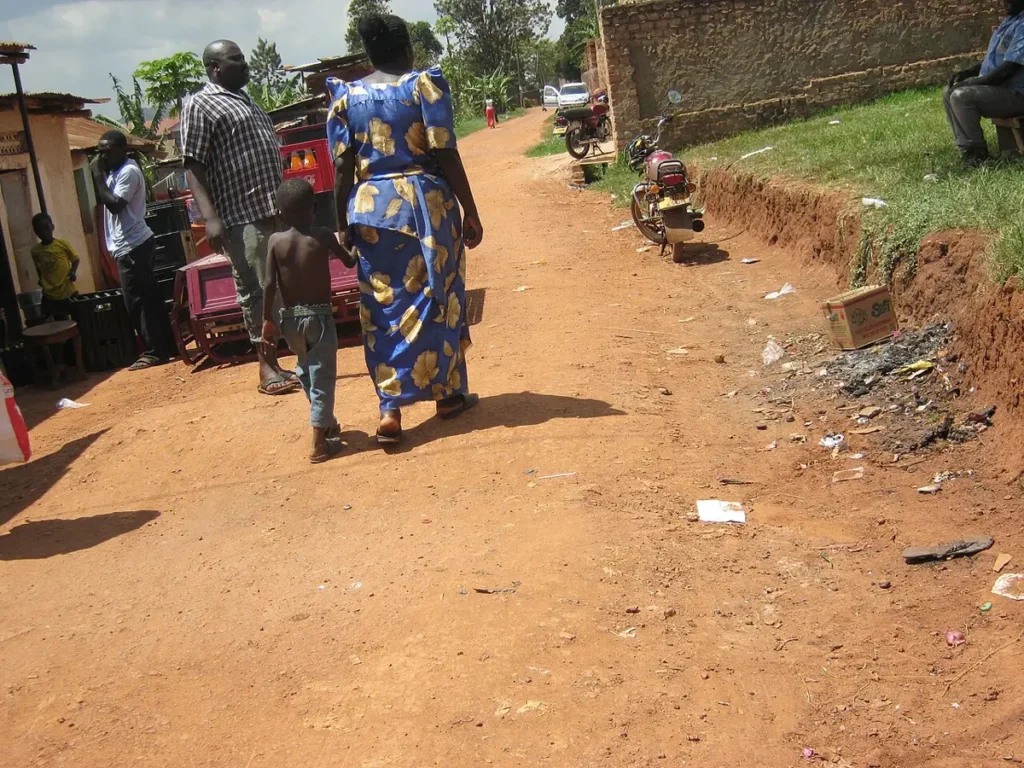
The gomesi is cut from two to three meters of fabric in a distinctive square or rectangular pattern. The characteristic feature is the large sleeves — cut at right angles to the body rather than set in, creating the butterfly wing effect when the arms are slightly raised. The neckline is square or V-shaped and modest. The dress falls to the floor, typically with a small train at the back. The waist is defined by the obutiti, a wide cloth sash that is wrapped around the waist and tied in a specific way that itself communicates social information — different tying styles indicate different roles and occasions.

Gomesis are made in an enormous range of fabrics: plain cotton in primary colors, elaborate African wax prints, silk and satin for formal occasions, sheer fabrics over lining for evening events. The color choices communicate occasion and status — white or cream for funerals and mourning, bright colors and prints for celebrations, deep purples and golds for royal occasions. A woman who can read the color and fabric of another woman’s gomesi knows immediately something about the occasion she is attending and the statement she is making.

When Ugandan women wear the gomesi

The gomesi is formal wear. Ugandan women wear it at:

  • Introduction ceremonies (kwanjula) — the groom’s female family members arrive as a delegation dressed in matching or coordinated gomesis
  • Church weddings — female guests and family members typically wear gomesis
  • Funerals — white or muted-color gomesis for mourning
  • Buganda Kingdom official events
  • Important church services
  • Government and official functions
  • Formal visits to elders or community leaders

Outside formal occasions, Ugandan women typically wear modern casual and professional clothing. The gomesi is not everyday wear — it is the garment brought out to signal that an occasion matters, that respect is being shown, that cultural identity is being affirmed.

How to buy and wear a gomesi as a visitor

Female visitors to Uganda in 2027 can have a gomesi made to measure by Kampala tailors at very reasonable prices. The process involves choosing fabric from a market stall (the Owino market and the Kikuubo trading area have extensive fabric selections), taking the fabric to a tailor who specializes in gomesis, and returning for a fitting. A custom-made gomesi from a competent tailor costs perhaps $20-50 including fabric, depending on the material chosen.

A foreign woman wearing a gomesi at a cultural event, a church visit, or even just during a market visit creates genuine delight among Ugandan observers. It signals respect, cultural curiosity, and willingness to engage with Ugandan life on its own terms rather than as an outside observer. The obutiti tying technique is something any female visitor can learn from a Ugandan friend, guide, or tailor — and having someone teach you how to tie it properly is itself a warm cultural exchange.

The gomesi is the kind of Uganda souvenir that gets worn again: distinctive, beautiful, and loaded with a story that makes it genuinely interesting at home. It is also entirely practical — comfortable in the warm Ugandan climate, modest enough for all occasions, and eye-catching enough to draw compliments wherever it is worn.

Ready to experience Uganda’s mountain gorillas in 2026? Secure your gorilla permits early and let us craft a seamless safari tailored to your travel style, preferred trekking sector, and accommodation level. From luxury lodges to well-designed midrange journeys, every detail is handled for you. Every itinerary is carefully planned to maximize your time in the forest while ensuring comfort, safety, and unforgettable encounters.

Have questions about gorilla permits, travel dates, or the best itinerary for you? Speak with a safari expert and get clear, honest guidance to plan your trip with confidence.

When is the last time you had an adventure? African Gorillas!!! Up Close With Uganda’s Wild Gorillas Touched by a Wild Gorilla: An Unforgettable Encounter Inside Gorilla Families: Bonds, Hierarchies & Jungle Life Face to Face With a Silverback: The Wild Encounter You’ll Never Forget