Uganda covers approximately 241,000 square kilometres, making it smaller than the United Kingdom and roughly the size of the American state of Oregon. For a country of this size, what it contains in terms of biodiversity is extraordinary by any measure. Over 1,000 bird species. More than 350 mammal species. 13 species of primates. 4,900 plant species. All four of Africa’s great ape species within or immediately adjacent to its borders. The concentration of life in Uganda per unit area is, by most calculations, unmatched anywhere on the African continent.
The Geographic Explanation
Uganda’s extraordinary biodiversity is not an accident. It is the product of the country’s geographic position at the convergence of several of Africa’s great ecological zones. Uganda sits at the junction of the East African savannah, the Congo Basin rainforest, the Albertine Rift highlands, and the Nile watershed. Each of these ecosystems has its own characteristic fauna and flora, and where they meet — in Uganda’s western highlands and the rift valley that defines its western border — the overlap creates an environment of exceptional richness.
The Albertine Rift runs along Uganda’s western border with the DRC, and the escarpments, forests, and montane zones it creates are among the most species-rich environments anywhere on earth. The Albertine Rift has a higher concentration of endemic vertebrate species — species found nowhere else on earth — than any other region in continental Africa. Bwindi Impenetrable Forest, which sits on the Albertine Rift escarpment, holds more tree species per hectare than any other forest in East or Central Africa.
The Bird Numbers
Uganda’s 1,000-plus bird species is a figure that requires context to appreciate. The entire continent of North America holds approximately 914 regularly occurring bird species. The whole of Europe records around 800. Uganda, in a land area smaller than either, exceeds both. The country’s avian richness reflects the intersection of multiple biomes: savannah birds in the north, forest specialists in Bwindi and Kibale, waterbirds on the Nile and the lakes, and highland specialists in the Rwenzoris. The shoebill stork — found in Uganda’s swamps and wetlands — is a species that birdwatchers from across the world travel specifically to see.
The Primate Record
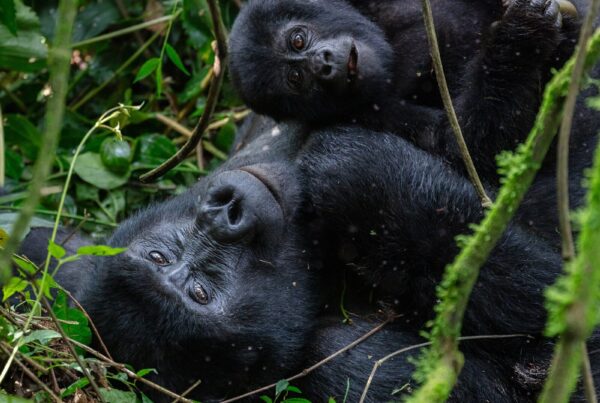
Uganda holds thirteen species of primates. This includes both chimpanzees and mountain gorillas — a combination found in no other country on earth in accessible, touristically feasible conditions. Kibale National Park holds the highest density of primates anywhere on the planet. A morning walk in Kibale forest might yield chimpanzees, red colobus, black-and-white colobus, red-tailed monkeys, grey-cheeked mangabeys, and olive baboons — a primate diversity that is simply unmatched at any other single site.
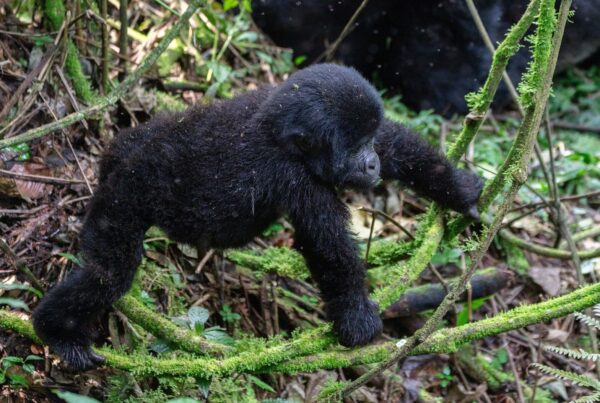
The mountain gorilla population in Uganda — approximately 500 individuals in Bwindi and Mgahinga, out of a global total of around 1,100 — represents one of the most significant concentrations of a single critically endangered species anywhere on earth. Trekking to visit them costs $800 USD per person in 2027 and provides direct funding for the conservation infrastructure that has enabled the gorilla population to grow from its nadir of around 620 in 1989 to its current level.
The Forest Ecosystems
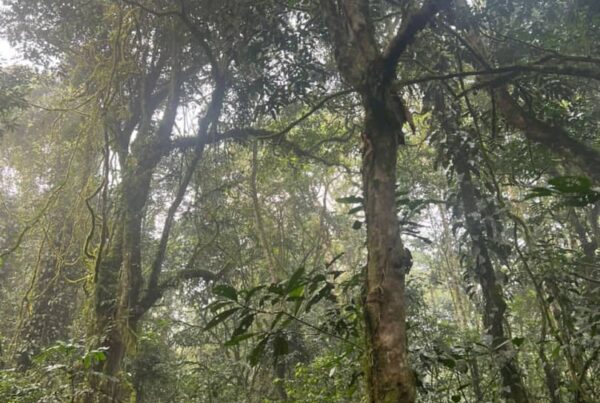
Uganda contains several distinct forest types, each with its own character and fauna. Bwindi is ancient montane rainforest, over 25,000 years old, that survived the ice ages as a forest refugium while surrounding vegetation changed. It is dense, dark, and biologically extraordinary. Kibale is mid-altitude moist forest, warmer and more open than Bwindi, with a different primate community and a birdlife of its own. The Budongo Forest in the north is one of the largest mahogany forests in East Africa. Mabira Forest near Kampala is a surviving patch of central Ugandan lowland forest with its own endemic subspecies.
The Savannah Component
Uganda’s biodiversity is not confined to its forests. Queen Elizabeth National Park in the south-west holds the famous tree-climbing lions of the Ishasha sector, large elephant herds, hippos in the Kazinga Channel, and one of the best concentrations of water birds in East Africa. Murchison Falls in the north has healthy populations of Rothschild’s giraffe, buffalo, elephant, and lion, alongside the Nile’s extraordinary aquatic fauna. Kidepo Valley National Park in the far north-east offers a wilderness experience comparable to the most remote parts of the Serengeti, with predator-to-prey ratios that support one of Uganda’s most impressive lion populations.
Why It Matters for Travellers
Uganda’s biodiversity density has a practical implication for travellers: you can pack more genuine wildlife experiences into a shorter time and smaller geographic radius than almost anywhere else in Africa. A two-week Uganda itinerary can realistically include gorilla trekking, chimpanzee tracking, big game safari, bird watching, and Nile boat trips — a range of experiences that would require travel across multiple countries in much of the rest of Africa. For travellers optimising for variety, depth, and the concentration of rare species per day of travel, Uganda offers a value proposition that its more famous neighbours cannot match.
Frequently Asked Questions
Uganda is home to the mountain gorilla (Gorilla beringei beringei), one of two subspecies of eastern gorilla. They live exclusively in the Virunga volcanic highlands (Uganda/Rwanda/DRC) and Bwindi Impenetrable Forest (Uganda only). Mountain gorillas are the only gorilla subspecies that cannot survive in captivity — every individual you can trek is a wild animal.
The standard gorilla trekking permit gives you exactly 1 hour with the gorilla family. This time begins when you make first contact with the family — the ranger signals the start. The Gorilla Habituation Experience gives 4 hours with a semi-wild family. The walk to find the gorillas can take 30 minutes to 5 hours depending on where the family has moved.
Stay calm, crouch down slowly, avoid direct eye contact, and remain quiet. Do not run — running triggers a chase response. Rangers accompanying your group manage close approaches. Habituated gorillas are accustomed to humans and almost never make contact, but a charging silverback is managed by staying still and following ranger instructions immediately.
A maximum of 8 visitors per habituated gorilla family per day for standard trekking. The Gorilla Habituation Experience has a maximum of 4 visitors per family per day. These limits are set by UWA to minimise stress on the gorilla families and maintain the quality of the experience.
Uganda is home to the mountain gorilla (Gorilla beringei beringei), one of two subspecies of eastern gorilla. They live exclusively in the Virunga volcanic highlands (Uganda/Rwanda/DRC) and Bwindi Impenetrable Forest (Uganda only). Mountain gorillas are the only gorilla subspecies that cannot survive in captivity — every individual you can trek is a wild animal.