If you draw a line from northern Uganda through western Uganda, Rwanda, Burundi, and into eastern DRC, you are tracing the Albertine Rift — a geological and ecological zone of extraordinary richness that most Africa travellers have never heard of by name but which contains some of the continent’s most significant biodiversity. Understanding the Albertine Rift is essential context for understanding why Uganda, Rwanda, and the DRC hold species and habitats that exist nowhere else on earth, and why the western Uganda corridor is the most biologically important landscape on the African continent.
What the Rift Is
The Albertine Rift is the western arm of the East African Rift System — the massive geological fracture that has been splitting the African continent apart for tens of millions of years. The eastern arm of the Rift contains the lakes and valleys of Kenya and Tanzania. The western arm — the Albertine Rift — contains a chain of deep lakes including Lake Albert, Lake Edward, Lake Kivu, Lake Tanganyika, and Lake Malawi, separated by mountain ranges and rift escarpments that create a dramatic landscape of peaks, valleys, forests, and wetlands.
The Albertine Rift is named after Lake Albert, the northernmost of its great lakes, which sits on the border between Uganda and the DRC. The geological activity that created the rift also created the mountains that define its edges — the Rwenzori Mountains on the Uganda-DRC border, the Virunga volcanoes straddling Uganda, Rwanda, and DRC, and the escarpment forests of Bwindi and Echuya in south-western Uganda.
Why It Is So Biodiverse
The Albertine Rift contains more endemic vertebrate species — species found nowhere else on earth — than any other region in continental Africa. The biodiversity concentration reflects several factors working together over geological time. During the ice ages, when much of Africa’s vegetation shifted and dried, the Albertine Rift escarpment forests remained as forest refugia — isolated pockets of stable, moist forest where species survived while surrounding vegetation changed. When conditions stabilised, these species radiated outward but retained distinctive characteristics that set them apart from relatives elsewhere in Africa.
The altitudinal gradient of the rift also contributes to species richness. From the lowland forests at the base of the escarpment to the Afroalpine zone at the summit of the Rwenzori mountains (which reach over 5,000 metres), the Albertine Rift compresses multiple climatic and ecological zones into a small geographic area. Species adapted to each zone have evolved in relative isolation, creating the high endemism that characterises the region.
The Mountain Gorilla in Context
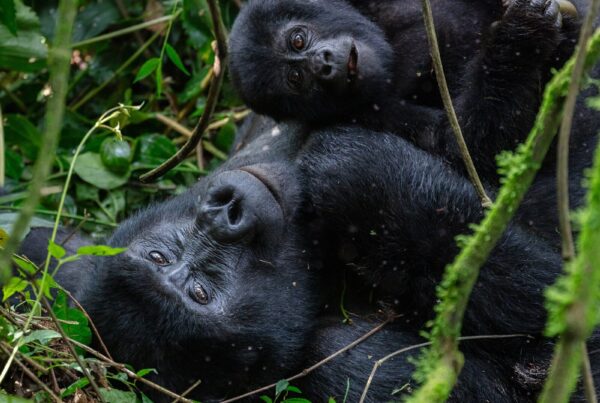
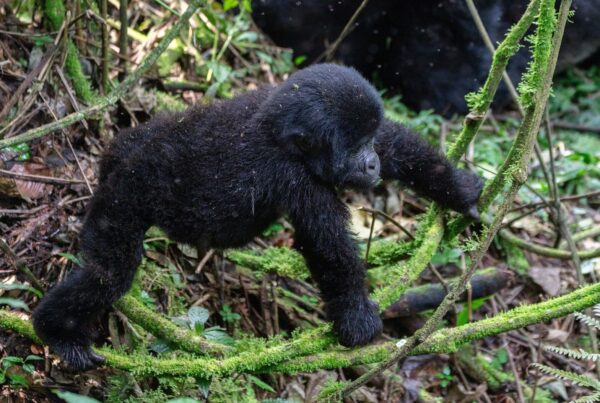
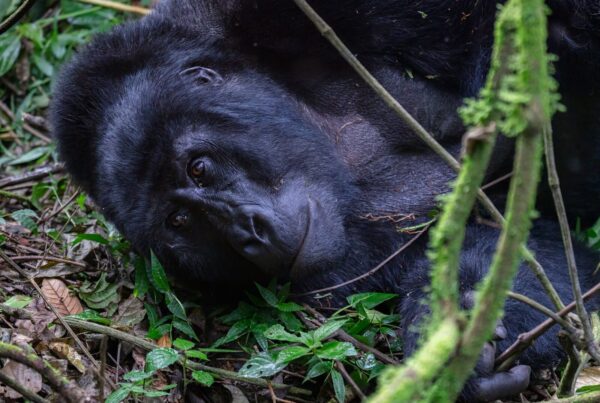
The mountain gorilla (Gorilla beringei beringei) is the Albertine Rift’s most famous resident and arguably its most important conservation symbol. All approximately 1,100 mountain gorillas alive on earth live within the Albertine Rift — in the Bwindi forest on the Uganda-DRC-Rwanda border zone, and in the Virunga Massif that straddles the same three-country intersection. They exist nowhere else. Their entire world is a narrow strip of Albertine Rift forest.
Gorilla trekking in Uganda — conducted at $800 USD per person per trek in 2027 — is, from a conservation economics perspective, one of the most efficient mechanisms for generating protection for a critically important piece of Albertine Rift habitat. The permit revenue funds ranger salaries, patrol logistics, and community support programmes for the villages surrounding Bwindi. Without this income stream, the economic case for maintaining Bwindi as a national park rather than converting it to agriculture would be significantly weaker.
Other Albertine Rift Species
The mountain gorilla is the most visible Albertine Rift endemic, but far from the only one. The Albertine Rift has over 500 endemic plant species. More than 40 endemic fish species live in its lakes. Birds endemic to the Albertine Rift include the African green broadbill, the Grauer’s broadbill, the Rwenzori turaco, and the Shelley’s crimsonwing — species that dedicated birdwatchers travel specifically to the region to see. Mammals including the golden monkey, the aquatic genet, and the Rwenzori duiker are found primarily within the Albertine Rift zone.
Threats to the Rift
The Albertine Rift faces significant pressures. Population growth in the surrounding countries creates demand for agricultural land, firewood, and building materials from the rift’s forests. Climate change is altering the rainfall patterns and temperature regimes that the rift’s species depend on. Political instability in eastern DRC has hampered conservation efforts in large parts of Virunga National Park, reducing the protection available to the DRC gorilla population.
In Uganda and Rwanda, where governance and conservation infrastructure are more stable, the Albertine Rift forests are better protected — and the gorilla population’s recovery is the evidence. The mechanisms that have made Bwindi a conservation success — permit revenue, ranger capacity, community buy-in — are a template that other Albertine Rift countries are working to replicate.
Visiting the Albertine Rift
For travellers with an interest in the natural world, the Albertine Rift offers experiences found nowhere else on earth. Gorilla trekking in Bwindi. Chimpanzee tracking in Kibale. Bird watching in the Rwenzori foothills. Trekking on the glaciers of the Rwenzori peaks, the “Mountains of the Moon.” Lake cruises on the great rift lakes. All of these experiences take place in a landscape shaped by tens of millions of years of geological and evolutionary history — and all of them are only possible because the forests and ecosystems of the Albertine Rift have been protected. The decision to visit is also a decision to fund that protection.
Frequently Asked Questions
Uganda is home to the mountain gorilla (Gorilla beringei beringei), one of two subspecies of eastern gorilla. They live exclusively in the Virunga volcanic highlands (Uganda/Rwanda/DRC) and Bwindi Impenetrable Forest (Uganda only). Mountain gorillas are the only gorilla subspecies that cannot survive in captivity — every individual you can trek is a wild animal.
The standard gorilla trekking permit gives you exactly 1 hour with the gorilla family. This time begins when you make first contact with the family — the ranger signals the start. The Gorilla Habituation Experience gives 4 hours with a semi-wild family. The walk to find the gorillas can take 30 minutes to 5 hours depending on where the family has moved.
Stay calm, crouch down slowly, avoid direct eye contact, and remain quiet. Do not run — running triggers a chase response. Rangers accompanying your group manage close approaches. Habituated gorillas are accustomed to humans and almost never make contact, but a charging silverback is managed by staying still and following ranger instructions immediately.
A maximum of 8 visitors per habituated gorilla family per day for standard trekking. The Gorilla Habituation Experience has a maximum of 4 visitors per family per day. These limits are set by UWA to minimise stress on the gorilla families and maintain the quality of the experience.
Uganda is home to the mountain gorilla (Gorilla beringei beringei), one of two subspecies of eastern gorilla. They live exclusively in the Virunga volcanic highlands (Uganda/Rwanda/DRC) and Bwindi Impenetrable Forest (Uganda only). Mountain gorillas are the only gorilla subspecies that cannot survive in captivity — every individual you can trek is a wild animal.